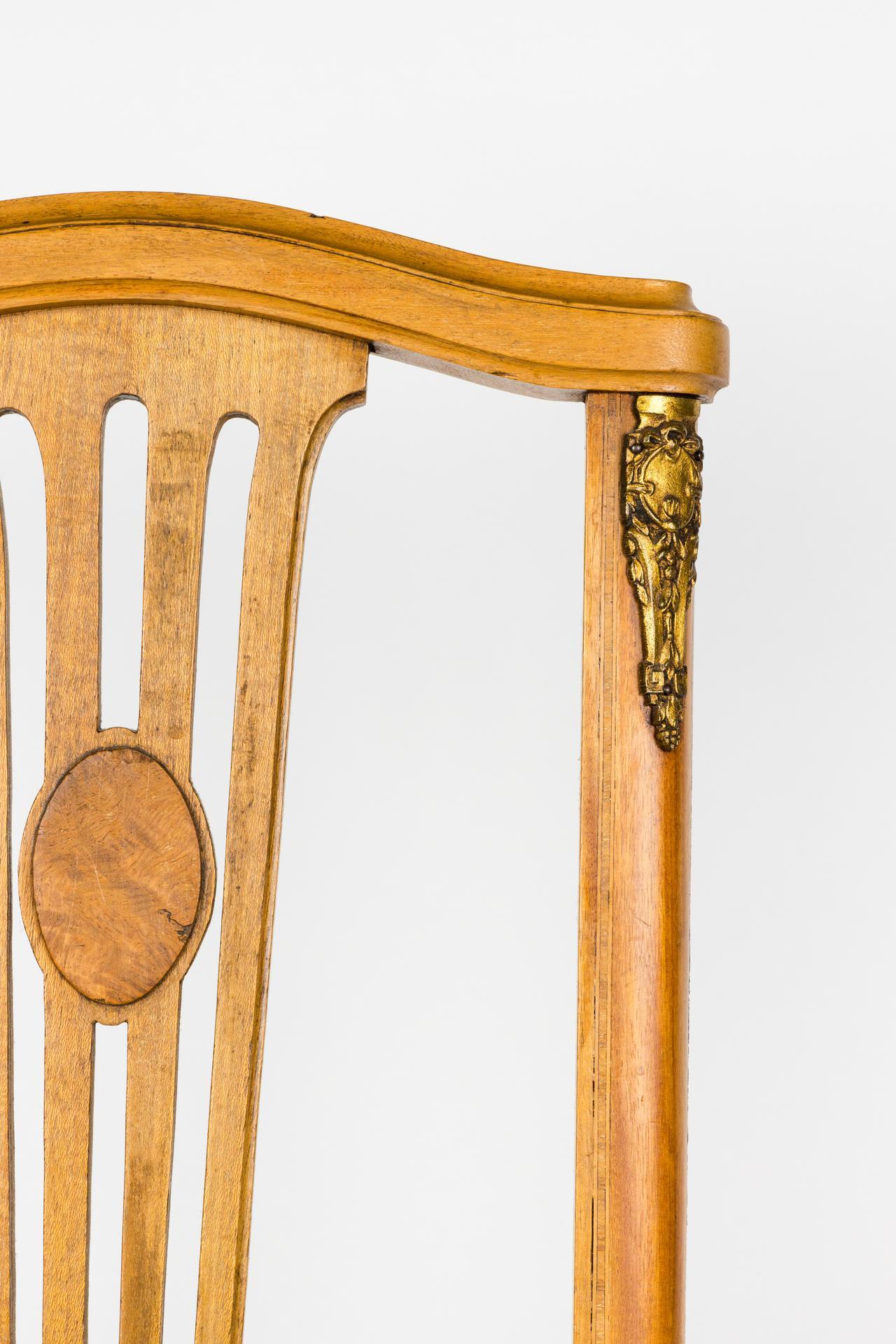
Fauteuil - Wood, Leather


05
days
23
hours
21
minutes
09
seconds

No bids placed
Catawiki Buyer Protection
Your payment’s safe with us until you receive your object.View details
Trustpilot 4.4 | 140738 reviews
Rated Excellent on Trustpilot.
A late 19th/early 20th century antique set consisting of an armchair and two high‑back chairs, crafted in pau-santo and mahogany with carved and framed detailing, leather upholstery, and metal tack trim in a Baroque revival style.
AI-assisted summary
Description from the seller
Portugal, late 19th century / early 20th century, circa 1880–1910. A set consisting of a high-back armchair and two high-back chairs, made of santo wood and mahogany, with turned, carved and moulded decoration, leather covering and metal brading.
The armchair features a tall, architectural backrest, flanked laterally by two columns with pronounced helical twists, interrupted by turned baluster-like elements. The horizontal, stepped top rail is capped by successive molded friezes, including tremble (shudder) decoration, small carved geometric reserves, and sixteenth/seventeenth-century-inspired moldings.
At the center of the backrest is a large rectangular panel of dark leather, fixed by hemispherical-headed nails, richly decorated in relief with a large stylized central flower, vegetal scrolls, palmettes and symmetrical floral motifs. The leather treatment approaches the Iberian tradition of tooled or stamped leather used in Portuguese furniture of the 17th and 18th centuries, a tradition largely revived by late 19th-century historicist furniture. Historic and revival Portuguese pieces with this combination of high back, embossed leather and nails are documented in collections and auctions.
The arms are straight, slightly molded, ending in rectangular supports and resting on turned supports. The seat is also upholstered in tooled leather, with floral and vegetal decorative motifs in a symmetrical composition, highlighted by a large central flower surrounded by volutes. The front edge of the arm is adorned with a sequence of large decorative metallic tacks.
The front legs present long twisted sections, alternating with turned elements and square blocks. The ensemble is further stabilized by an outer peripheral brace, equally turned, with spiral elements and balusters. The rear legs, simpler and straighter, extend the uprights of the backrest.
The two chairs follow the same decorative language as the armchair, but on a smaller scale, preserving the tall backs, twisted columns, architectural caps with trembles, seats and backs covered in tooled leather and metal nails.
The joint use of spiral columns, trembles, tooled leather and nails is precisely one of the most characteristic elements of the revival interpretation of Portuguese furniture from the 17th and early 18th centuries. A late 19th-century Portuguese example sold by Strauss presents an extremely close configuration: santo wood, backs and seat in leather, twisted columns, stepped upper crest, nails and turned legs.
Condition: The set shows a fairly expressive ancient patina. Wear and abrasions on the leather, especially along the front edges of the seats, scratches and minor surface losses in the wood finish, signs of use and aging, as well as a crack. There are also traces of wood-boring activity, particularly visible on some lower surfaces. A conservative cleaning and stabilization is preferable to repainting or replacement, because the patina significantly contributes to the character and commercial value of the set.
Dimensions: armchair 122 × 57 × 47 cm; each chair 103 × 45 × 38 cm.
Portugal, late 19th century / early 20th century, circa 1880–1910. A set consisting of a high-back armchair and two high-back chairs, made of santo wood and mahogany, with turned, carved and moulded decoration, leather covering and metal brading.
The armchair features a tall, architectural backrest, flanked laterally by two columns with pronounced helical twists, interrupted by turned baluster-like elements. The horizontal, stepped top rail is capped by successive molded friezes, including tremble (shudder) decoration, small carved geometric reserves, and sixteenth/seventeenth-century-inspired moldings.
At the center of the backrest is a large rectangular panel of dark leather, fixed by hemispherical-headed nails, richly decorated in relief with a large stylized central flower, vegetal scrolls, palmettes and symmetrical floral motifs. The leather treatment approaches the Iberian tradition of tooled or stamped leather used in Portuguese furniture of the 17th and 18th centuries, a tradition largely revived by late 19th-century historicist furniture. Historic and revival Portuguese pieces with this combination of high back, embossed leather and nails are documented in collections and auctions.
The arms are straight, slightly molded, ending in rectangular supports and resting on turned supports. The seat is also upholstered in tooled leather, with floral and vegetal decorative motifs in a symmetrical composition, highlighted by a large central flower surrounded by volutes. The front edge of the arm is adorned with a sequence of large decorative metallic tacks.
The front legs present long twisted sections, alternating with turned elements and square blocks. The ensemble is further stabilized by an outer peripheral brace, equally turned, with spiral elements and balusters. The rear legs, simpler and straighter, extend the uprights of the backrest.
The two chairs follow the same decorative language as the armchair, but on a smaller scale, preserving the tall backs, twisted columns, architectural caps with trembles, seats and backs covered in tooled leather and metal nails.
The joint use of spiral columns, trembles, tooled leather and nails is precisely one of the most characteristic elements of the revival interpretation of Portuguese furniture from the 17th and early 18th centuries. A late 19th-century Portuguese example sold by Strauss presents an extremely close configuration: santo wood, backs and seat in leather, twisted columns, stepped upper crest, nails and turned legs.
Condition: The set shows a fairly expressive ancient patina. Wear and abrasions on the leather, especially along the front edges of the seats, scratches and minor surface losses in the wood finish, signs of use and aging, as well as a crack. There are also traces of wood-boring activity, particularly visible on some lower surfaces. A conservative cleaning and stabilization is preferable to repainting or replacement, because the patina significantly contributes to the character and commercial value of the set.
Dimensions: armchair 122 × 57 × 47 cm; each chair 103 × 45 × 38 cm.
Details
Era
1400-1900
Style subtype
Baroque style
Country of origin
Portugal
Material
Leather, Wood
Style
Antique
Condition
Good condition - used with small signs of aging & blemishes
Height
122 cm
Width
57 cm
Depth
47 cm
Estimated period
1850-1900
Sold by