Chair - Wood


05
days
15
hours
55
minutes
11
seconds

No bids placed
Catawiki Buyer Protection
Your payment’s safe with us until you receive your object.View details
Trustpilot 4.4 | 140462 reviews
Rated Excellent on Trustpilot.
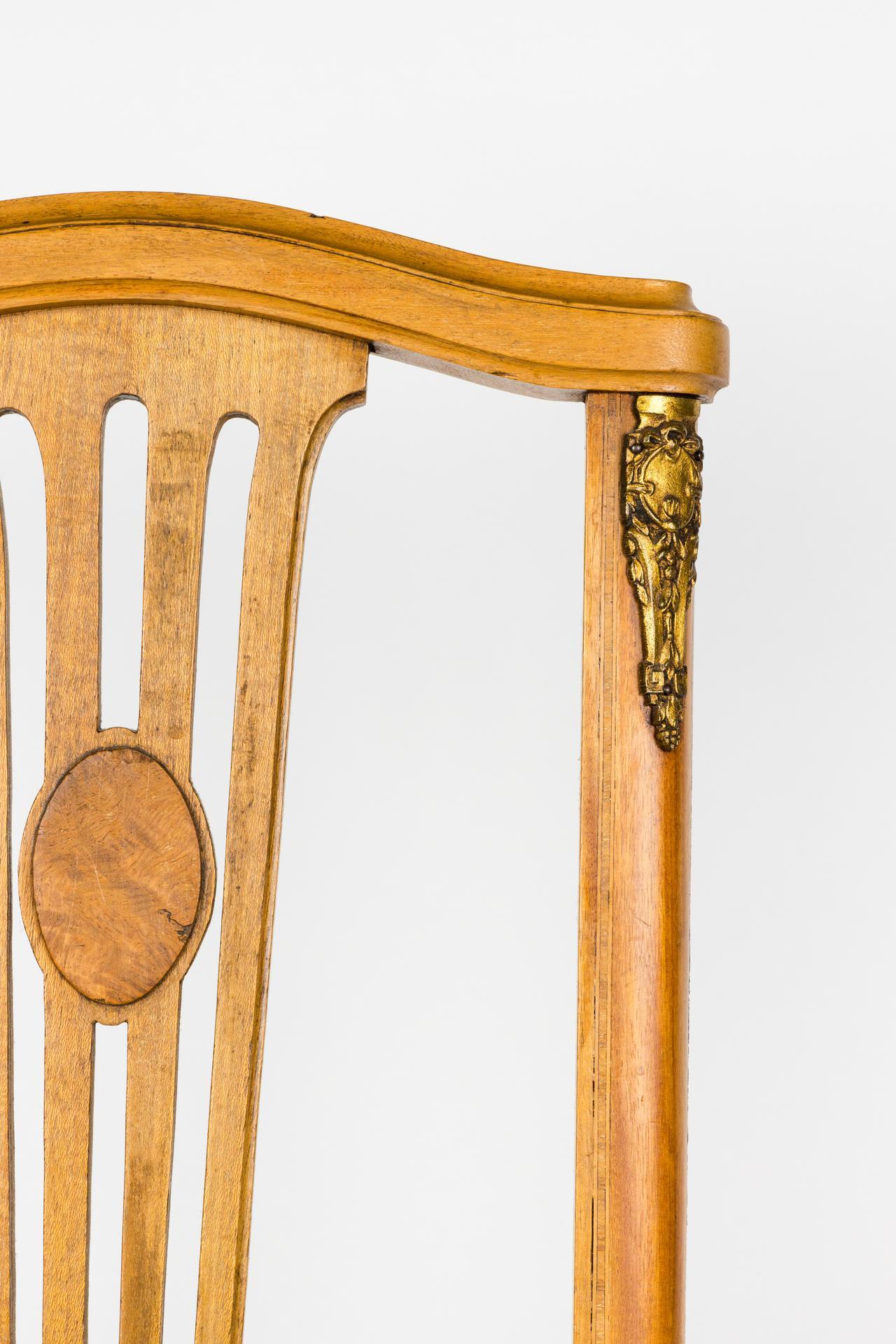
High-back chair in walnut wood, carved and partially gilded, dating to the late 19th century (c. 1880–1900) in Historicist/Neo‑Renaissance style, with beige upholstered seat and back, and dimensions 105 × 45 × 41 cm, origin Portugal.
AI-assisted summary
Description from the seller
High-back chair in carved walnut, partially gilded - Portugal, late 19th century.
Object: high-back chair
Country of origin: Portugal, probable
Period: late 19th century
Dating: c. 1880–1900
Style: Historicism / Neo-Renaissance, with Neo-Baroque influences
Main material: walnut
Decoration: turned and carved wood, with gilded accents
Upholstery: seat and backrest upholstered and covered in beige fabric
Dimensions: 105 × 45 × 41 cm
Portuguese high-back chair in walnut wood, with architectural and vertical composition, featuring turned, carved and partially gilded elements.
The backrest is structured by two tall turned uprights with successive baluster forms, alternating cylindrical bodies, rings and bulbous elements. The uprights terminate at the top in squared blocks decorated with geometric incisions highlighted in gold and are capped by turned pinnacles.
The central area of the backrest presents a predominantly rectangular upholstered panel, finished at the top with a cut-out arch. The upholstery is covered in beige fabric with a small pattern and edged by decorative gimp.
The most notable element is the carved headboard crest, of symmetrical design, consisting of an exuberant composition of volutes, scrolls, leaves and a central vegetal or palmette motif. Some of the grooves and reliefs in the carving retain gilding, providing contrast with the warm tone of the walnut.
The gilded ornamentation extends discretely along the frame of the backrest and along the upper blocks of the uprights.
The seat, approximately trapezoidal in shape and slightly bowed at the front, features generous upholstery and is covered in the same beige fabric.
The front legs are also turned, with large cylindrical and bulbous elements separated by rings, ending in small turned feet. The rear legs constitute the continuation of the backrest uprights.
The lower structure is reinforced by an H-brace, the front crosspiece more elaborately turned, with a small central balustraded element.
Style and dating: Although it recovers elements of old Portuguese furniture — high-back, pinnacles, turnings and gilding — the formal combination is typical of Historicist production in the second half/late 19th century. The straight uprights, baluster legs, pinacles and the symmetrical composition of the crest bring it much closer to Neo-Renaissance / Renaissance Revival of the late 19th century.
Gilding: The gilded details were used mainly as decorative accents, applied to the carving grooves, the geometric shapes of the blocks and some elements of the pinnacles.
Upholstery: The beige fabric is later than the chair, probably the result of a modern reupholstery. This is not strictly a problem for a piece of furniture of this kind. Stains and dirt are visible, particularly on the seat and, to a lesser extent, on the backrest panel.
Condition: Generally reasonable for its age, with normal signs of use and aging. Small marks, scratches and wear are visible on the wood and gilded areas. One of the pinnacles is damaged. The upholstery is stained and requires cleaning.
High-back chair in carved walnut, partially gilded - Portugal, late 19th century.
Object: high-back chair
Country of origin: Portugal, probable
Period: late 19th century
Dating: c. 1880–1900
Style: Historicism / Neo-Renaissance, with Neo-Baroque influences
Main material: walnut
Decoration: turned and carved wood, with gilded accents
Upholstery: seat and backrest upholstered and covered in beige fabric
Dimensions: 105 × 45 × 41 cm
Portuguese high-back chair in walnut wood, with architectural and vertical composition, featuring turned, carved and partially gilded elements.
The backrest is structured by two tall turned uprights with successive baluster forms, alternating cylindrical bodies, rings and bulbous elements. The uprights terminate at the top in squared blocks decorated with geometric incisions highlighted in gold and are capped by turned pinnacles.
The central area of the backrest presents a predominantly rectangular upholstered panel, finished at the top with a cut-out arch. The upholstery is covered in beige fabric with a small pattern and edged by decorative gimp.
The most notable element is the carved headboard crest, of symmetrical design, consisting of an exuberant composition of volutes, scrolls, leaves and a central vegetal or palmette motif. Some of the grooves and reliefs in the carving retain gilding, providing contrast with the warm tone of the walnut.
The gilded ornamentation extends discretely along the frame of the backrest and along the upper blocks of the uprights.
The seat, approximately trapezoidal in shape and slightly bowed at the front, features generous upholstery and is covered in the same beige fabric.
The front legs are also turned, with large cylindrical and bulbous elements separated by rings, ending in small turned feet. The rear legs constitute the continuation of the backrest uprights.
The lower structure is reinforced by an H-brace, the front crosspiece more elaborately turned, with a small central balustraded element.
Style and dating: Although it recovers elements of old Portuguese furniture — high-back, pinnacles, turnings and gilding — the formal combination is typical of Historicist production in the second half/late 19th century. The straight uprights, baluster legs, pinacles and the symmetrical composition of the crest bring it much closer to Neo-Renaissance / Renaissance Revival of the late 19th century.
Gilding: The gilded details were used mainly as decorative accents, applied to the carving grooves, the geometric shapes of the blocks and some elements of the pinnacles.
Upholstery: The beige fabric is later than the chair, probably the result of a modern reupholstery. This is not strictly a problem for a piece of furniture of this kind. Stains and dirt are visible, particularly on the seat and, to a lesser extent, on the backrest panel.
Condition: Generally reasonable for its age, with normal signs of use and aging. Small marks, scratches and wear are visible on the wood and gilded areas. One of the pinnacles is damaged. The upholstery is stained and requires cleaning.
Details
Era
1400-1900
Style subtype
Renaissance Style
Country of origin
Portugal
Material
Wood
Style
Antique
Condition
Good condition - used with small signs of aging & blemishes
Height
105 cm
Width
45 cm
Depth
41 cm
Estimated period
1850-1900
Sold by