Barrel-back chairs - Fauteuil - Wood, Textile - Captain's chairs


05
days
21
hours
04
minutes
43
seconds
Starting bid
€ 1
Reserve price not met

Expert
Selected by Michel Karis
Art historian with extensive experience working at various auction houses in antiques.
Estimate € 550 - € 650
No bids placed
Catawiki Buyer Protection
Your payment’s safe with us until you receive your object.View details
Trustpilot 4.4 | 140482 reviews
Rated Excellent on Trustpilot.
Pair of walnut barrel-back armchairs in Arts & Crafts/Edwardian style, made in the United Kingdom circa 1900–1910, with green and gold textile upholstery, each chair measuring 77 × 54 × 49 cm.
AI-assisted summary
Description from the seller
Pair of captain’s chairs / barrel-back chairs in walnut — Arts & Crafts, United Kingdom, c. 1900–1910.
Object: pair of armchairs / captain’s chairs
International designation: Pair of Arts & Crafts barrel-back / tub armchairs
Origin: England, United Kingdom
Era: early 20th century
Dating: c. 1900–1910
Style: Arts & Crafts / Edwardian, with some aesthetic proximity to the late Aesthetic Movement
Wood: walnut
Seat: upholstered, covered in green and gold-toned fabric/silk
Dimensions: 77 × 54 × 49 cm each
Pair of English barrel-back or tub chairs, made in darkened walnut, featuring upholstered seats and fabric with a silk-like appearance in olive green and gold tones.
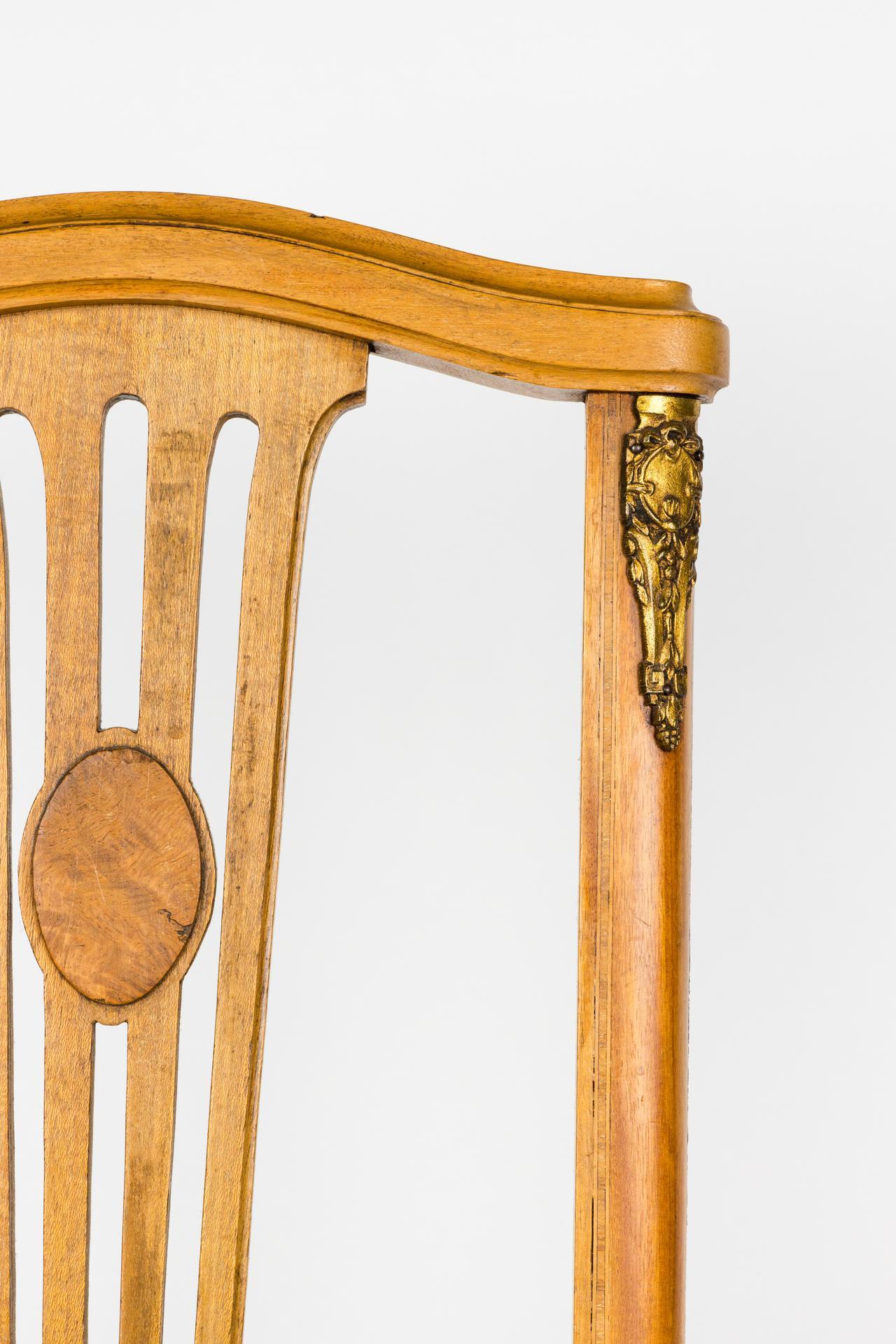
Each chair presents a distinctive enveloping structure, with a broad curved hoop-shaped upper rim forming a horseshoe, effectively describing almost a semicircle from the front uprights to the back of the backrest, serving simultaneously as a back and arm support.
The space between the upper hoop and the seat waist is filled by a regular succession of narrow vertical slats, creating an open and rhythmic backrest. This design gives the chairs an appearance that is both architectural and light, quite representative of the Arts & Crafts movement’s pursuit of constructive simplicity.
The upper hoop has a slightly arched profile, rising at the rear and gradually descending toward the arm supports.
The seats, designed approximately semi-circular/trapezoidal to follow the curvature of the frame, feature convex padding and are upholsetered in green fabric with gold geometric decoration, affixed to the hoop by a sequence of small decorative metal tacks.
The waist is simple and gently curved at the front, following the seat profile.
The four legs are tall, straight, and quadrangular in section, virtually undecorated, reinforcing the geometric simplicity of the design. They are joined by lower stretchers forming an X-shaped structure, a solution both functional and decorative.
It is precisely this combination of: semicircular backrest + vertical slats + straight lines + absence of historicist carving + geometric structure, that leads to classifying them within the British Arts & Crafts universe circa 1900.
Condition report - The condition is compatible with approximately 120 years of use. General wear to the finish is visible, including scratches, small abrasions, surface losses and color inconsistencies, mainly on the upper hoop, uprights, legs, and stretchers. The seat fabric shows wear and some loss of vitality, though it remains visually engaging. The upholstery is present and contributes to the period character. One chair has been restored, with an old, structurally appropriate intervention. There are also traces of xylophagous activity.
Pair of captain’s chairs / barrel-back chairs in walnut — Arts & Crafts, United Kingdom, c. 1900–1910.
Object: pair of armchairs / captain’s chairs
International designation: Pair of Arts & Crafts barrel-back / tub armchairs
Origin: England, United Kingdom
Era: early 20th century
Dating: c. 1900–1910
Style: Arts & Crafts / Edwardian, with some aesthetic proximity to the late Aesthetic Movement
Wood: walnut
Seat: upholstered, covered in green and gold-toned fabric/silk
Dimensions: 77 × 54 × 49 cm each
Pair of English barrel-back or tub chairs, made in darkened walnut, featuring upholstered seats and fabric with a silk-like appearance in olive green and gold tones.
Each chair presents a distinctive enveloping structure, with a broad curved hoop-shaped upper rim forming a horseshoe, effectively describing almost a semicircle from the front uprights to the back of the backrest, serving simultaneously as a back and arm support.
The space between the upper hoop and the seat waist is filled by a regular succession of narrow vertical slats, creating an open and rhythmic backrest. This design gives the chairs an appearance that is both architectural and light, quite representative of the Arts & Crafts movement’s pursuit of constructive simplicity.
The upper hoop has a slightly arched profile, rising at the rear and gradually descending toward the arm supports.
The seats, designed approximately semi-circular/trapezoidal to follow the curvature of the frame, feature convex padding and are upholsetered in green fabric with gold geometric decoration, affixed to the hoop by a sequence of small decorative metal tacks.
The waist is simple and gently curved at the front, following the seat profile.
The four legs are tall, straight, and quadrangular in section, virtually undecorated, reinforcing the geometric simplicity of the design. They are joined by lower stretchers forming an X-shaped structure, a solution both functional and decorative.
It is precisely this combination of: semicircular backrest + vertical slats + straight lines + absence of historicist carving + geometric structure, that leads to classifying them within the British Arts & Crafts universe circa 1900.
Condition report - The condition is compatible with approximately 120 years of use. General wear to the finish is visible, including scratches, small abrasions, surface losses and color inconsistencies, mainly on the upper hoop, uprights, legs, and stretchers. The seat fabric shows wear and some loss of vitality, though it remains visually engaging. The upholstery is present and contributes to the period character. One chair has been restored, with an old, structurally appropriate intervention. There are also traces of xylophagous activity.
Details
Era
1400-1900
Style subtype
Edwardian Style
Title additional information
Captain's chairs
Country of origin
United Kingdom
Manufacturer/brand
Barrel-back chairs
Material
Textile, Wood
Style
Antique
Condition
Good condition - used with small signs of aging & blemishes
Height
77 cm
Width
54 cm
Depth
49 cm
Estimated period
1850-1900
Sold by