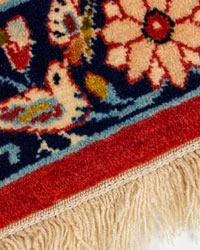
Embroidery - 140 cm - 140 cm


Starting bid
€ 1
Add to your favourites to get an alert when the auction starts.

Catawiki Buyer Protection
Your payment’s safe with us until you receive your object.View details
Trustpilot 4.4 | 141663 reviews
Rated Excellent on Trustpilot.
Description from the seller
Manila shawl, Cantanese, from the late 19th century (Qing era)
Monochrome embroidery in gold thread on black silk - 19th century
Era / Period: 19th century (late Qing Dynasty, approx. 1870-1890)
Origin: Canton, China (Intended for the Spanish export market)
Material: 100% natural silk crepe, embroidered with golden metallic threads (gold/plated silver thread).
Exceptional and very rare Manila Cantonese shawl from the late 19th century, made on a black natural silk crepe cloth. The piece stands out for its magnificent and profuse monochrome embroidery executed entirely in bright gold thread with great sheen.
The design features a rich symmetrical composition with large medallions and cartouches lavishly decorated with densely interwoven vegetal motifs, where imperial peonies, lotus flowers, and dense foliage with pronounced relief stand out. The needlework is of extreme meticulousness (needle painting), with a three-dimensional relief and texture that catch the light exceptionally. The four corners are richly finished, maintaining a perfect symmetry highly valued in high-era pieces. A textile piece of high collection value, suitable for collectors of historical clothing or Oriental textile art.
Bibliography:
Stone, Caroline (2013). The Silk Road: The Manila Shawl and Its Origins. This work is the international bible of textile trade between Canton, Manila and Spain during the Qing dynasty. It explains how pieces embroidered with monochrome metallic threads (gold) were reserved for luxury export and the European aristocracy.
Lama Hernández, Yolanda (2010). El Mantón de Manila: Historia y Evolución. Catalogue of the Museo del Traje de Madrid. Essential for dating peony motifs and the evolution of the macramé lattice in the fringes in the 19th century.
Sánchez de Lollano Prieto, Joaquín (2002). The Art of Embroidery in Canton and Its Projection in the Spanish Trade. A specific study on Chinese embroidery techniques of "needle painting" applied to Indian and Spanish tastes of the Isabeline era.
In the international art textile auction and collecting market, shawls embroidered in multicolored threads are the most common, but monochrome embroidery on black silk made entirely with golden metallic threads is considered highly valued rarities.
Note:
"To guarantee the safety and perfect condition of the work, depending on its volume and nature, transport and delivery may be arranged by the seller itself"
Manila shawl, Cantanese, from the late 19th century (Qing era)
Monochrome embroidery in gold thread on black silk - 19th century
Era / Period: 19th century (late Qing Dynasty, approx. 1870-1890)
Origin: Canton, China (Intended for the Spanish export market)
Material: 100% natural silk crepe, embroidered with golden metallic threads (gold/plated silver thread).
Exceptional and very rare Manila Cantonese shawl from the late 19th century, made on a black natural silk crepe cloth. The piece stands out for its magnificent and profuse monochrome embroidery executed entirely in bright gold thread with great sheen.
The design features a rich symmetrical composition with large medallions and cartouches lavishly decorated with densely interwoven vegetal motifs, where imperial peonies, lotus flowers, and dense foliage with pronounced relief stand out. The needlework is of extreme meticulousness (needle painting), with a three-dimensional relief and texture that catch the light exceptionally. The four corners are richly finished, maintaining a perfect symmetry highly valued in high-era pieces. A textile piece of high collection value, suitable for collectors of historical clothing or Oriental textile art.
Bibliography:
Stone, Caroline (2013). The Silk Road: The Manila Shawl and Its Origins. This work is the international bible of textile trade between Canton, Manila and Spain during the Qing dynasty. It explains how pieces embroidered with monochrome metallic threads (gold) were reserved for luxury export and the European aristocracy.
Lama Hernández, Yolanda (2010). El Mantón de Manila: Historia y Evolución. Catalogue of the Museo del Traje de Madrid. Essential for dating peony motifs and the evolution of the macramé lattice in the fringes in the 19th century.
Sánchez de Lollano Prieto, Joaquín (2002). The Art of Embroidery in Canton and Its Projection in the Spanish Trade. A specific study on Chinese embroidery techniques of "needle painting" applied to Indian and Spanish tastes of the Isabeline era.
In the international art textile auction and collecting market, shawls embroidered in multicolored threads are the most common, but monochrome embroidery on black silk made entirely with golden metallic threads is considered highly valued rarities.
Note:
"To guarantee the safety and perfect condition of the work, depending on its volume and nature, transport and delivery may be arranged by the seller itself"
Details
Era
1400-1900
Material
Silk
Country of origin
China
Dynastic style/period
Qing Dynasty (1644-1911)
Provenance
Private collection
Length
140 cm
Width
140 cm
Condition
Excellent condition: barely used with minimal signs of wear
Estimated period
1850-1900
Sold by