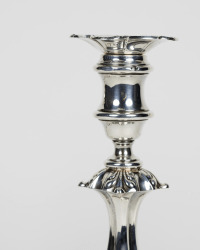
Figure - Figura de plata - .835 silver


07
days
14
hours
13
minutes
57
seconds
Current bid
€ 3
Reserve price not met

Expert
Selected by Inés Fernández
Specialised in Spanish and Portuguese silver with over 10 years in galleries and auctions.
Estimate € 220 - € 250
 | €3 | |
|---|---|---|
 | €2 | |
| €1 |
Catawiki Buyer Protection
Your payment’s safe with us until you receive your object.View details
Trustpilot 4.4 | 141255 reviews
Rated Excellent on Trustpilot.
Silver figure titled 'Figura de plata', made of 835 silver, origin Germany, dating to 1850–1900, dimensions 6 cm wide, 8 cm deep and 14 cm high, weight 108 g, in good used condition with minor signs of wear.
AI-assisted summary
Description from the seller
Elegant sculptural figure made of 835/1000 sterling silver, depicting a pheasant in an expressive dynamic pose, with wings spread and its characteristic long tail raised.
The piece stands out especially for the quality and richness of the silversmithing work. The plumage is meticulously reproduced through different types of engraving and chiselling, with the individual feathers of the wings, the body, and the long tail clearly discernible. The details of the head, eyes, beak, and legs contribute great expressiveness and realism to the figure.
The surface preserves an attractive natural patina, particularly visible in the recessed areas of the relief, creating a beautiful contrast with the lighter parts of the silver and enhancing the volume of the plumage.
The piece bears the hallmark of 835 silver, corresponding to silver of 835 thousandths, as well as other hallmarks of the silversmith/manufacturer, one of which is apparently identifiable as “Z11”, “Z II” or similar. Due to wear and the partial readability of these hallmarks, it is not currently possible to attribute the piece to a specific workshop with absolute certainty.
Based on the characteristics of the silver, the hallmarks, and the execution style, we consider this to be a work of continental European silversmithing, probably German or Belgian, from the 20th century.
Weight: 108 g
Dimensions: approx. 18 × 6 × 14 cm
Material: 835/1000 silver
Origin: Continental Europe, probably Germany or Belgium
Period: 20th century
Condition: good condition with patina and light signs of use and aging consistent with its age.
An especially decorative piece with beautiful execution, appealing both as a collectible item of European silverware and as a silver animal sculpture.
Note: the hallmarks are shown in detail in the photographs and are part of the description and attribution of the piece.
Elegant sculptural figure made of 835/1000 sterling silver, depicting a pheasant in an expressive dynamic pose, with wings spread and its characteristic long tail raised.
The piece stands out especially for the quality and richness of the silversmithing work. The plumage is meticulously reproduced through different types of engraving and chiselling, with the individual feathers of the wings, the body, and the long tail clearly discernible. The details of the head, eyes, beak, and legs contribute great expressiveness and realism to the figure.
The surface preserves an attractive natural patina, particularly visible in the recessed areas of the relief, creating a beautiful contrast with the lighter parts of the silver and enhancing the volume of the plumage.
The piece bears the hallmark of 835 silver, corresponding to silver of 835 thousandths, as well as other hallmarks of the silversmith/manufacturer, one of which is apparently identifiable as “Z11”, “Z II” or similar. Due to wear and the partial readability of these hallmarks, it is not currently possible to attribute the piece to a specific workshop with absolute certainty.
Based on the characteristics of the silver, the hallmarks, and the execution style, we consider this to be a work of continental European silversmithing, probably German or Belgian, from the 20th century.
Weight: 108 g
Dimensions: approx. 18 × 6 × 14 cm
Material: 835/1000 silver
Origin: Continental Europe, probably Germany or Belgium
Period: 20th century
Condition: good condition with patina and light signs of use and aging consistent with its age.
An especially decorative piece with beautiful execution, appealing both as a collectible item of European silverware and as a silver animal sculpture.
Note: the hallmarks are shown in detail in the photographs and are part of the description and attribution of the piece.
Details
Era
1400-1900
Gross weight
108 g
Silver type
.835 silver
Number of objects
1
Title
Figura de plata
Country of origin
Germany
Material
Silver
Condition
Good condition - used with small signs of aging & blemishes
Height
14 cm
Width
6 cm
Depth
8 cm
Estimated period
1850-1900
Sold by