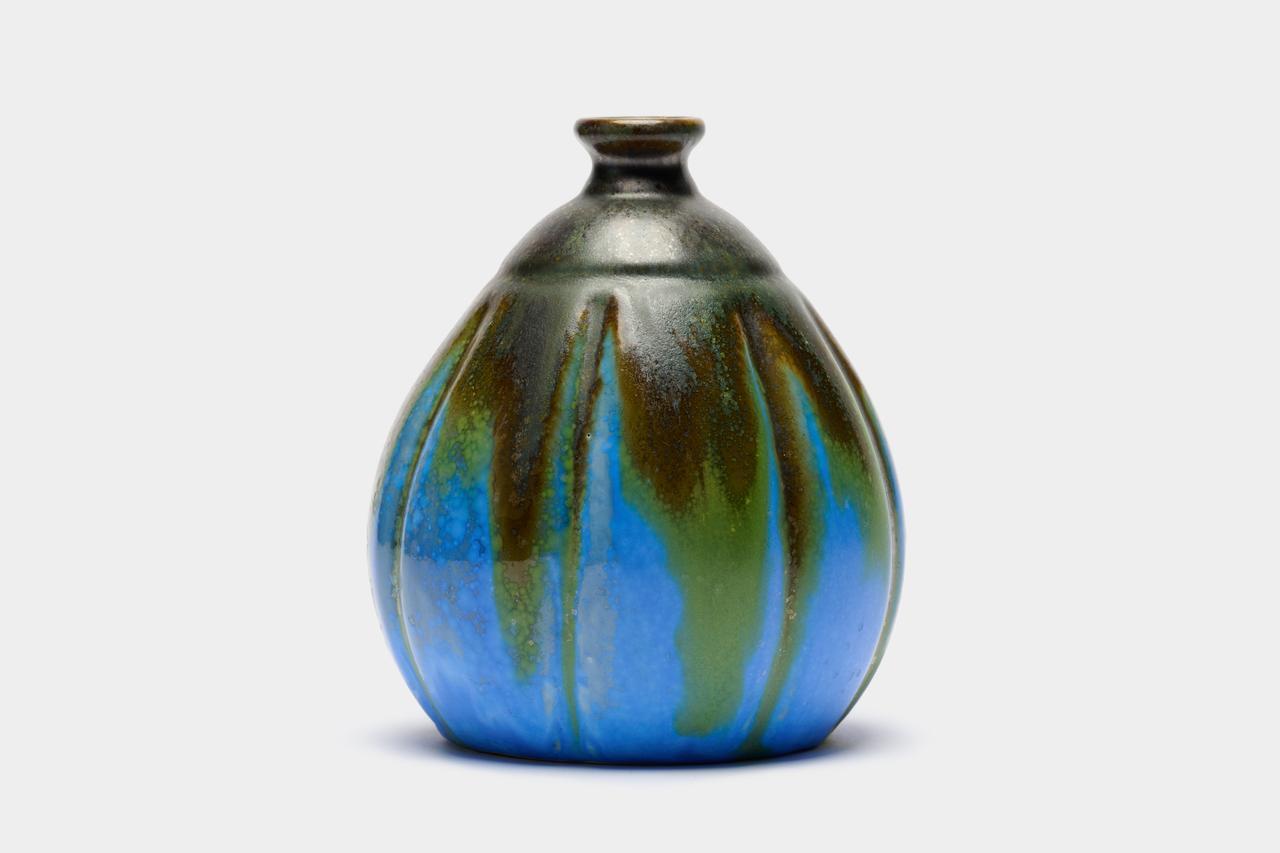
Jarrón Tango Art Déco - Vase - Glass


Starting bid
€ 1
Add to your favourites to get an alert when the auction starts.

Expert
Selected by Michel Karis
Art historian with extensive experience working at various auction houses in antiques.
Estimate € 150 - € 200
Catawiki Buyer Protection
Your payment’s safe with us until you receive your object.View details
Trustpilot 4.4 | 141582 reviews
Rated Excellent on Trustpilot.
Description from the seller
Art Deco Tango vase in Bohemian art glass. ca. 1920–1930. Inspired by the decorative language of Lötz/Loetz Ausführung 166.
I present this Tango vase from the Art Deco period, made of Bohemian art glass that radiates light and joy. Visually, the applied decoration of this piece recalls the compositional language of Lötz/Loetz Ausführung 166: monochrome body, applied glass thread and independent glass cabochons applied directly onto the body.
Tango Glass is characterized by the use of intensely colored glass masses and chromatic contrasts produced by means of applied decorative elements—rims, threads, buttons or cabochons—while the piece is still incandescent, in a plastic state.
DESCRIPTION:
The vase is handcrafted by blowing, as evidenced by the presence of air seeds consistent with the technology of the period.
It stands out for its bold and full flared silhouette, with a wide mouth of approximately 14 cm that opens audaciously over a short and elegantly narrowed neck. From there, the body develops into a suggestive inverted teardrop shape, massive and with a low base, giving it a stable and distinctly sculptural presence.
The piece lives from the contrast between the intensity of the yellow glass and the blue decorative elements, which visually structure the volume through a horizontal band of applied glass and a succession of raised cabochons. These elements provide a marked geometric rhythm to the fluidity of the blown form.
PONTIL & ATTRIBUTION
The base preserves the original fracture pontil mark (rough pontil mark), a characteristic vestige of the artisanal manufacturing process that this piece preserves, showing an irregular outline and rough texture, characteristic of a not completely polished pontil.
The piece could be situated within the production sphere of Bohemian manufacturers such as Welz, Kralik, Rückl or Rindskopf; however, it would not be rigorous or honest to make a specific attribution, since an important part of this production lacks a signature or identifying mark. Nor does the nature of the pontil alone allow an attribution to be established, since within the same manufactory pieces with both rough and polished pontils can be found.
Much of the glass produced during this period cannot currently be reliably attributed to a specific manufacturer, due to the loss of records, pattern books and industrial documentation, as well as the current lack of knowledge regarding the identity of certain glassworks.
DATING: Circa 1920-1930 (Interwar Period).
DIMENSIONS:
Height: 20 cm
Mouth diameter: 13.5 cm
Maximum body diameter: 16 cm
Base diameter: 9 cm
CONDITION:
Excellent, with no cracks or chips. It presents only a patina from historical settling and slight signs of historical friction consistent with its age.
ADDITIONAL NOTES:
• The photographs form part of the description.
• The final measurements and weight indicated correspond to the configuration of secure packaging, which is essential to ensure the proper protection of this piece during transport.
Art Deco Tango vase in Bohemian art glass. ca. 1920–1930. Inspired by the decorative language of Lötz/Loetz Ausführung 166.
I present this Tango vase from the Art Deco period, made of Bohemian art glass that radiates light and joy. Visually, the applied decoration of this piece recalls the compositional language of Lötz/Loetz Ausführung 166: monochrome body, applied glass thread and independent glass cabochons applied directly onto the body.
Tango Glass is characterized by the use of intensely colored glass masses and chromatic contrasts produced by means of applied decorative elements—rims, threads, buttons or cabochons—while the piece is still incandescent, in a plastic state.
DESCRIPTION:
The vase is handcrafted by blowing, as evidenced by the presence of air seeds consistent with the technology of the period.
It stands out for its bold and full flared silhouette, with a wide mouth of approximately 14 cm that opens audaciously over a short and elegantly narrowed neck. From there, the body develops into a suggestive inverted teardrop shape, massive and with a low base, giving it a stable and distinctly sculptural presence.
The piece lives from the contrast between the intensity of the yellow glass and the blue decorative elements, which visually structure the volume through a horizontal band of applied glass and a succession of raised cabochons. These elements provide a marked geometric rhythm to the fluidity of the blown form.
PONTIL & ATTRIBUTION
The base preserves the original fracture pontil mark (rough pontil mark), a characteristic vestige of the artisanal manufacturing process that this piece preserves, showing an irregular outline and rough texture, characteristic of a not completely polished pontil.
The piece could be situated within the production sphere of Bohemian manufacturers such as Welz, Kralik, Rückl or Rindskopf; however, it would not be rigorous or honest to make a specific attribution, since an important part of this production lacks a signature or identifying mark. Nor does the nature of the pontil alone allow an attribution to be established, since within the same manufactory pieces with both rough and polished pontils can be found.
Much of the glass produced during this period cannot currently be reliably attributed to a specific manufacturer, due to the loss of records, pattern books and industrial documentation, as well as the current lack of knowledge regarding the identity of certain glassworks.
DATING: Circa 1920-1930 (Interwar Period).
DIMENSIONS:
Height: 20 cm
Mouth diameter: 13.5 cm
Maximum body diameter: 16 cm
Base diameter: 9 cm
CONDITION:
Excellent, with no cracks or chips. It presents only a patina from historical settling and slight signs of historical friction consistent with its age.
ADDITIONAL NOTES:
• The photographs form part of the description.
• The final measurements and weight indicated correspond to the configuration of secure packaging, which is essential to ensure the proper protection of this piece during transport.
Details
Era
1900-2000
Specific region of origin
Bohemia
Number of objects
1
Country of origin
Czechia
Designer/artist/maker
Jarrón Tango Art Déco
Material
Glass
Style
Art Deco
Colour
Blue, Yellow
Condition
Excellent condition: barely used with minimal signs of wear
Height
20 cm
Width
16 cm
Depth
20 cm
Estimated period
1920-1930
Sold by