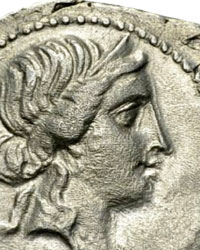
Antiquity Lotto de 4 monete Æ (No reserve price)


00
days
22
hours
58
minutes
20
seconds

 | €32 |
|---|
Catawiki Buyer Protection
Your payment’s safe with us until you receive your object.View details
Trustpilot 4.4 | 141948 reviews
Rated Excellent on Trustpilot.
Description from the seller
4 splendid ancient coins dating back to the Roman Empire
12) Tetrachalkon (or a unit of four bronze) minted at Antiochia on the Orontes in the late Hellenistic / autonomous period (1st century BC, specifically around 47–30 BC) - Bronze - Weight: 4.50 grams - Diameter: 19 millimeters - Obverse: Laureate head of Zeus facing right. The distinctive strands of beard and hair typical of Syrian-era art are recognizable. - Reverse (Back): The winged Nike (Victory) walking to the right, holding a garland and a palm. On the right, a five-pointed star is clearly visible. At the bottom, now heavily worn, was the Greek inscription of the city.
13) Roman provincial bronze (AE) minted at Antiochia on the Orontes (Syria) under the reign of Elagabalus (AD 218-222) - Severan dynasty - Roman provincial bronze coin (minor unit, often cataloged as AE18-20 or provincial semisse). - Weight: 3.97 grams - Obverse (Front): Laureate bust of Elagabalus facing right. The legend in Greek reads ΑVΤ ΚΑΙ Μ ΑV (Autokrator Kaisar Markos Aurelios), the official emperor’s name. - Reverse: Large Latin letters S • C (Senatus Consulto) centered and enclosed within a laurel wreath. Above are Greek letters Δ - Ε (Delta - Epsilon) and below a small eagle or crescent (partly visible due to wear and oxidation). - The coin appears in major international numismatic manuals under the following references: RPC VI, 8037 (or related variants in the Roman Provincial Coinage) - McAlee 788–790 / Butcher 468 (aids for the Antiochia mint).
14) Ancient bronze (commonly classified as tetrachalkon or AE20) - of Mithridates VI the Great, King of Pontus (historic region facing the Black Sea, in today’s Turkey) - Mint: Amisos (modern Samsun). - Weight: 8.65 g - Obverse (Face A): Shows an aegis (Athena’s shield) adorned in the center with the head of the Gorgon (Medusa) and radial scale motifs.
- Reverse (Face B): Depicts the goddess Nike (Victory) walking to the right, with wings spread, while clasping a stylized palm on the right shoulder.
15) Roman Emperor Antoninus Pius (reign: AD 138-161). - Roman provincial bronze coin (Æ), classifiable as Diassarius (or a two-assaria piece). - Mint: Laodicea ad Mare (modern Latakia, Syria). - Exact weight: 8.66 g (mid-small module, about 20–24 mm) - Obverse (Front): Profiles of Emperor Antoninus Pius facing right, with mature features and originally wearing an laurel wreath.
- Reverse: The deity Zeus Nikephoros (bearer of victory) seated on a throne facing left. In his right hand he holds the goddess Nike (Victory); with his left hand he rests on a staff, and at the throne’s feet is his loyal eagle. - Legend: On the right edge is legible the Greek inscription ΛΑΟΔΙΚΕΩΝ (Laodikeon), confirming the city’s authority of Laodicea.
4 splendid ancient coins dating back to the Roman Empire
12) Tetrachalkon (or a unit of four bronze) minted at Antiochia on the Orontes in the late Hellenistic / autonomous period (1st century BC, specifically around 47–30 BC) - Bronze - Weight: 4.50 grams - Diameter: 19 millimeters - Obverse: Laureate head of Zeus facing right. The distinctive strands of beard and hair typical of Syrian-era art are recognizable. - Reverse (Back): The winged Nike (Victory) walking to the right, holding a garland and a palm. On the right, a five-pointed star is clearly visible. At the bottom, now heavily worn, was the Greek inscription of the city.
13) Roman provincial bronze (AE) minted at Antiochia on the Orontes (Syria) under the reign of Elagabalus (AD 218-222) - Severan dynasty - Roman provincial bronze coin (minor unit, often cataloged as AE18-20 or provincial semisse). - Weight: 3.97 grams - Obverse (Front): Laureate bust of Elagabalus facing right. The legend in Greek reads ΑVΤ ΚΑΙ Μ ΑV (Autokrator Kaisar Markos Aurelios), the official emperor’s name. - Reverse: Large Latin letters S • C (Senatus Consulto) centered and enclosed within a laurel wreath. Above are Greek letters Δ - Ε (Delta - Epsilon) and below a small eagle or crescent (partly visible due to wear and oxidation). - The coin appears in major international numismatic manuals under the following references: RPC VI, 8037 (or related variants in the Roman Provincial Coinage) - McAlee 788–790 / Butcher 468 (aids for the Antiochia mint).
14) Ancient bronze (commonly classified as tetrachalkon or AE20) - of Mithridates VI the Great, King of Pontus (historic region facing the Black Sea, in today’s Turkey) - Mint: Amisos (modern Samsun). - Weight: 8.65 g - Obverse (Face A): Shows an aegis (Athena’s shield) adorned in the center with the head of the Gorgon (Medusa) and radial scale motifs.
- Reverse (Face B): Depicts the goddess Nike (Victory) walking to the right, with wings spread, while clasping a stylized palm on the right shoulder.
15) Roman Emperor Antoninus Pius (reign: AD 138-161). - Roman provincial bronze coin (Æ), classifiable as Diassarius (or a two-assaria piece). - Mint: Laodicea ad Mare (modern Latakia, Syria). - Exact weight: 8.66 g (mid-small module, about 20–24 mm) - Obverse (Front): Profiles of Emperor Antoninus Pius facing right, with mature features and originally wearing an laurel wreath.
- Reverse: The deity Zeus Nikephoros (bearer of victory) seated on a throne facing left. In his right hand he holds the goddess Nike (Victory); with his left hand he rests on a staff, and at the throne’s feet is his loyal eagle. - Legend: On the right edge is legible the Greek inscription ΛΑΟΔΙΚΕΩΝ (Laodikeon), confirming the city’s authority of Laodicea.
Details
Era
Before 1400
Weight
40 g
Culture/region
Antiquity
Theme
History
Number of items
4
Denomination
Lotto de 4 monete Æ
Metal
Æ
Condition
Ungraded
Sold by