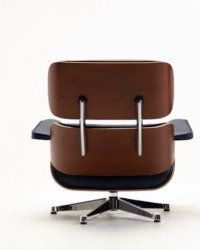
Bernini - Massimo Vignelli - Armchair (2) - Meeting 5080 - Leather


04
days
15
hours
24
minutes
23
seconds
Starting bid
€ 1
Reserve price not met

Expert
Selected by Alexander Fahl
Art historian with over 10 years' experience and expertise in Italian design.
Estimate € 1,100 - € 1,400
No bids placed
Catawiki Buyer Protection
Your payment’s safe with us until you receive your object.View details
Trustpilot 4.4 | 141104 reviews
Rated Excellent on Trustpilot.
Description from the seller
Couple of Armchairs «Incontro 5080» Massimo & Lella Vignelli for Bernini, 1991 – Italy
Exquisite pair of armchairs model "Incontro 5080" designed by Massimo & Lella Vignelli for Bernini. Simple structure characteristic of Italian modern design. Bernini has worked since its foundation with precious woods, as in this case, since the main body is formed with curved walnut veneers. The black leather is used for the interior of the seat, backrest, and armrests. At the bottom, four wheels with a metal frame for greater practicality. The Italian designers used new industrial technologies, combining functionality with simplicity, to create all kinds of objects, from buildings to furniture or various household items, many of which have become iconic designs.
Massimo Vignelli (1931 - 2014) and his wife Lella (1934 - 2016) worked as graphic designers and advertising consultants for Knoll during the 1970s, achieving worldwide recognition. Moreover, this couple collaborated on numerous furniture projects. Their studio, "Vignelli Associates", based in New York, applies a modern aesthetic that reflects clarity, beauty, and functionality.
Bernini
Founded in 1904 in Libiola, Italy, Bernini began by producing mainly tools, hardware, and wooden furniture, always demonstrating a deep knowledge of carpentry. After World War I the firm began working with architects such as Giovanni Muzio or Gio Ponti to produce bespoke artisanal pieces. By the late 1950s Bernini started mass-producing furniture and obtained various licenses to manufacture products following designs by great artists. The collaboration with Gianfranco Frattini generated Bernini’s first own furniture collection (1960), which included tables, chairs and bookcases, creating a link between traditional typologies and modern forms. Even before moving in 1965 to Carate Brianza, Bernini had begun expanding its range of innovative plastic furniture. One of the earliest designs in this category was the Nastro CL9 armchair by Cesare Leonardi and Franca Stagi (1961). The modular Quattro quarti table by Rodolfo Bonetto (1969) and Gaetano Pesce’s deliberately imperfect Broadway chairs (1993) attest to a continued interest in new, unconventional materials and forms. Yet the company’s preferred material remained precious woods. They were used for Joe Colombo’s Combi-Center (1963/64), as well as for the modular cabinet Rampa (1965) by the Castiglioni brothers. Bernini embarked on a major collaboration with architect Carlo Scarpa in the 1960s and continues to produce many of its furniture designs today. The more recent designers for this house include Karim Rashid and Toshiyuki Kita. In addition to mass-produced furniture, the Bernini Museum Workshop brand also makes exhibition products specialized for museums.
Dimensions: 94 x 62 x 60 cm.
The shipment of the product will be paid by the buyer according to the dimensions, weight, and destination. Shipping costs include professional, custom-made packaging; and the shipment is personalized, with tracking number and warranty. DUE TO THE PIECE’S DIMENSIONS, IT IS PREFERRED TO ARRANGE SHIPPING WITH THE BUYER. SHIPPING COSTS ARE ESTIMATED.
Seller's Story
- ABOUT US - Fragonard Interiors is a company with experience for more than 30 years, with a team of experts specialized in antiques, design pieces, works of art and interior design projects.
We always seek excellence and originality in each of the pieces, chasing as much customer satisfaction as possible.
By giving a new life to the pieces and works of art, we manage to perpetuate their soul and activate a circular economy of objects.
FOLLOW US ON INSTAGRAM: fragonard_interiors
The packaging is professional and adapted to each piece, with tracking number and shipping insurance. 100% AUTHENTICITY AND QUALITY CONTROL. Each item sold is analyzed, studied and authenticated by experts.
WORLD DELIVERY We ship to all countries served by international courier service providers such as DHL, UPS ...
You can also arrange for yourself to pick up at our physical location.
Translated by Google TranslateCouple of Armchairs «Incontro 5080» Massimo & Lella Vignelli for Bernini, 1991 – Italy
Exquisite pair of armchairs model "Incontro 5080" designed by Massimo & Lella Vignelli for Bernini. Simple structure characteristic of Italian modern design. Bernini has worked since its foundation with precious woods, as in this case, since the main body is formed with curved walnut veneers. The black leather is used for the interior of the seat, backrest, and armrests. At the bottom, four wheels with a metal frame for greater practicality. The Italian designers used new industrial technologies, combining functionality with simplicity, to create all kinds of objects, from buildings to furniture or various household items, many of which have become iconic designs.
Massimo Vignelli (1931 - 2014) and his wife Lella (1934 - 2016) worked as graphic designers and advertising consultants for Knoll during the 1970s, achieving worldwide recognition. Moreover, this couple collaborated on numerous furniture projects. Their studio, "Vignelli Associates", based in New York, applies a modern aesthetic that reflects clarity, beauty, and functionality.
Bernini
Founded in 1904 in Libiola, Italy, Bernini began by producing mainly tools, hardware, and wooden furniture, always demonstrating a deep knowledge of carpentry. After World War I the firm began working with architects such as Giovanni Muzio or Gio Ponti to produce bespoke artisanal pieces. By the late 1950s Bernini started mass-producing furniture and obtained various licenses to manufacture products following designs by great artists. The collaboration with Gianfranco Frattini generated Bernini’s first own furniture collection (1960), which included tables, chairs and bookcases, creating a link between traditional typologies and modern forms. Even before moving in 1965 to Carate Brianza, Bernini had begun expanding its range of innovative plastic furniture. One of the earliest designs in this category was the Nastro CL9 armchair by Cesare Leonardi and Franca Stagi (1961). The modular Quattro quarti table by Rodolfo Bonetto (1969) and Gaetano Pesce’s deliberately imperfect Broadway chairs (1993) attest to a continued interest in new, unconventional materials and forms. Yet the company’s preferred material remained precious woods. They were used for Joe Colombo’s Combi-Center (1963/64), as well as for the modular cabinet Rampa (1965) by the Castiglioni brothers. Bernini embarked on a major collaboration with architect Carlo Scarpa in the 1960s and continues to produce many of its furniture designs today. The more recent designers for this house include Karim Rashid and Toshiyuki Kita. In addition to mass-produced furniture, the Bernini Museum Workshop brand also makes exhibition products specialized for museums.
Dimensions: 94 x 62 x 60 cm.
The shipment of the product will be paid by the buyer according to the dimensions, weight, and destination. Shipping costs include professional, custom-made packaging; and the shipment is personalized, with tracking number and warranty. DUE TO THE PIECE’S DIMENSIONS, IT IS PREFERRED TO ARRANGE SHIPPING WITH THE BUYER. SHIPPING COSTS ARE ESTIMATED.
Seller's Story
- ABOUT US - Fragonard Interiors is a company with experience for more than 30 years, with a team of experts specialized in antiques, design pieces, works of art and interior design projects.
We always seek excellence and originality in each of the pieces, chasing as much customer satisfaction as possible.
By giving a new life to the pieces and works of art, we manage to perpetuate their soul and activate a circular economy of objects.
FOLLOW US ON INSTAGRAM: fragonard_interiors
The packaging is professional and adapted to each piece, with tracking number and shipping insurance. 100% AUTHENTICITY AND QUALITY CONTROL. Each item sold is analyzed, studied and authenticated by experts.
WORLD DELIVERY We ship to all countries served by international courier service providers such as DHL, UPS ...
You can also arrange for yourself to pick up at our physical location.
Translated by Google TranslateDetails
Era
1900-2000
Number of objects
2
Country of origin
Italy
Manufacturer/brand
Bernini
Model
Meeting 5080
Designer/artist/maker
Massimo Vignelli
Material
Leather
Style
Mid-century modern
Colour
Brown
Condition
Good condition - used with small signs of aging & blemishes
Height
94 cm
Width
62 cm
Depth
62 cm
Estimated period
1990-2000
Sold by