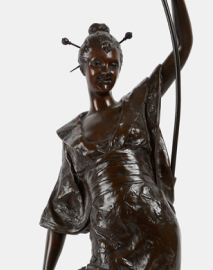
Pier. A. de Groot - Statue, Vrouwtje van Stavoren - 24.5 cm - polystone


09
days
18
hours
36
minutes
58
seconds

No bids placed
Catawiki Buyer Protection
Your payment’s safe with us until you receive your object.View details
Trustpilot 4.4 | 141331 reviews
Rated Excellent on Trustpilot.
Pier. A. de Groot, Vrouwtje van Stavoren, a polystone sculpture from the Netherlands, measuring 5.5 cm wide, 24.5 cm high and 5.5 cm deep, signed in the plate, in good condition.
AI-assisted summary
Description from the seller
For overall condition see images
In Stavoren lived a wealthy and arrogant widow of a merchant. One day the woman sent a skipper out to fetch for her the “most precious thing in the world.” The skipper took his task very seriously and began a long search. After visiting numerous harbors, he finally landed in Danzig (Gdańsk), where he discovered the finest wheat he had ever seen. Satisfied, the skipper decided to take the wheat to the merchant’s widow. At last he had found the most precious thing in the world.
Back in Friesland, however, his client was anything but pleased with the goods he had retrieved. And although the poor people begged her not to do it, the widow ordered the valuable wheat to be cast into the sea. An old man who witnessed the event turned to the widow and spoke:
You shall be punished for your arrogance! There will come a time when you will beg!
The Stavoren woman glared scornfully at the old man. She removed a gold ring from her finger and then threw it into the sea, saying:
As sure as this ring will never come back from the sea, so surely I shall not fall to the level of a beggar.
Shortly afterwards, the maid discovered the golden ring in the guts of a fish she was preparing for lunch. Startled, the maid showed the ring to her mistress. Soon misfortune struck. A few days after the ring was found, the widow received the bad news that all of her ships had sunk. The Lady of Stavoren never recovered from that blow, and thus the old man’s prophecy came true. The harbor of the town fell into decline, and the grain on the sandbanks grew—the grain that the widow had cast into the sea.
The legend of the Lady of Stavoren is regarded as a so‑called etiological tale. The digital women’s lexicon of the Huygens Institute says about it:
“The name of the sandbank off Stavoren was ‘Vrouwenzand,’ or ‘Us leaffrouwe,’ named after Maria, the patroness of the monastery of Saint Odulfus near Starum. When the origin of the name had faded from memory, the story of the Lady arose.”
The story also symbolizes the decline of Stavoren from around the thirteenth century, on the one hand due to the harbor silting up and, on the other, due to the shift of the center of trade to the west, especially Amsterdam. The French period did not help the harbor either. With the introduction of the continental system, commerce with England was forbidden. The earliest written tales about the Lady of Stavoren date from the sixteenth century. The earliest versions do not yet mention the thrown-away ring that is later found in a fish. The ring first appears in stories from around 1810.
Shipping with Track and Trace
For overall condition see images
In Stavoren lived a wealthy and arrogant widow of a merchant. One day the woman sent a skipper out to fetch for her the “most precious thing in the world.” The skipper took his task very seriously and began a long search. After visiting numerous harbors, he finally landed in Danzig (Gdańsk), where he discovered the finest wheat he had ever seen. Satisfied, the skipper decided to take the wheat to the merchant’s widow. At last he had found the most precious thing in the world.
Back in Friesland, however, his client was anything but pleased with the goods he had retrieved. And although the poor people begged her not to do it, the widow ordered the valuable wheat to be cast into the sea. An old man who witnessed the event turned to the widow and spoke:
You shall be punished for your arrogance! There will come a time when you will beg!
The Stavoren woman glared scornfully at the old man. She removed a gold ring from her finger and then threw it into the sea, saying:
As sure as this ring will never come back from the sea, so surely I shall not fall to the level of a beggar.
Shortly afterwards, the maid discovered the golden ring in the guts of a fish she was preparing for lunch. Startled, the maid showed the ring to her mistress. Soon misfortune struck. A few days after the ring was found, the widow received the bad news that all of her ships had sunk. The Lady of Stavoren never recovered from that blow, and thus the old man’s prophecy came true. The harbor of the town fell into decline, and the grain on the sandbanks grew—the grain that the widow had cast into the sea.
The legend of the Lady of Stavoren is regarded as a so‑called etiological tale. The digital women’s lexicon of the Huygens Institute says about it:
“The name of the sandbank off Stavoren was ‘Vrouwenzand,’ or ‘Us leaffrouwe,’ named after Maria, the patroness of the monastery of Saint Odulfus near Starum. When the origin of the name had faded from memory, the story of the Lady arose.”
The story also symbolizes the decline of Stavoren from around the thirteenth century, on the one hand due to the harbor silting up and, on the other, due to the shift of the center of trade to the west, especially Amsterdam. The French period did not help the harbor either. With the introduction of the continental system, commerce with England was forbidden. The earliest written tales about the Lady of Stavoren date from the sixteenth century. The earliest versions do not yet mention the thrown-away ring that is later found in a fish. The ring first appears in stories from around 1810.
Shipping with Track and Trace
Details
Era
1900-2000
Country of origin
Netherlands
Material
polystone
Artist
Pier. A. de Groot
Title of artwork
Vrouwtje van Stavoren
Signature
Plate signed
Condition
Good condition
Height
24.5 cm
Width
5.5 cm
Depth
5.5 cm