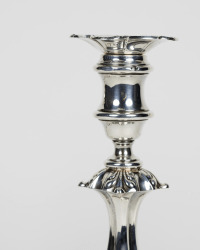
Cutlery set (12) - .750 silver


04
days
16
hours
17
minutes
38
seconds
Starting bid
€ 1
Reserve price not met

Expert
Selected by Inés Fernández
Specialised in Spanish and Portuguese silver with over 10 years in galleries and auctions.
Estimate € 220 - € 250
No bids placed
Catawiki Buyer Protection
Your payment’s safe with us until you receive your object.View details
Trustpilot 4.4 | 141948 reviews
Rated Excellent on Trustpilot.
Set of 12 silver items in a box, made of 750-silver from Austria, dating to ca. 1850–1900, in good used condition with minor signs of wear, dimensions approx. 34.4 cm wide, 11.5 cm high and 4.5 cm deep, total gross weight about 5 kg.
AI-assisted summary
Description from the seller
Size 1 holder cm W x D x H 8.9 x 4.6 x 4
12 holders in one box
Weight 1 holder 34.65 g x12 holders = 415.8 g
75% of 415.8 g is 311.85 g 750 silver, the remaining 25% mostly copper
Silver value currently € 1.06/g x 311.85 g is € 330.56 !!!
Before Austria switched to the metric system in 1867 (such as 800 or 900) and to head symbols (like the Diana head), the silver content was given in lots (Loth). The assignment for an Austrian collector’s piece in this system looks as follows: Number 12 stands for 12-lot silver. This corresponds, when converted, to a fineness of 750/1000 parts silver (i.e., 75% pure silver, then the usual minimum standard for everyday silver).
In this hallmark, it is not an animal, but a traditional Loth fineness stamp from Austria-Hungary.
The supposed “animal head” or animal silhouette is actually the artistically formed city or control stamp of a historic guaranteeing office of the Habsburg monarchy.
Details about the punch: The number 12 stands for the historical fineness in the unit Loth. A fineness of 12 Loth equals 750/1000 parts (75% pure silver).
The symbol designates the responsible testing office (the official control authority). Before the transition to the more familiar metric system with the Diana head in 1867, the cities in Austria, Hungary and the crown lands used individual symbols or ornate coat-of-arms shields (such as the Viennese double eagle) into which the year and the fineness were integrated.
The age: Because of the Loth system, the depicted item (an antique T-grip, as commonly found on corkscrews, elegant canes, or serving utensils) can be dated precisely to the period before 1867.
1. Ancient solid silver: The “12 Lot” alloy (750 fineness)
Before the introduction of today’s thousandth system (like 800 or 925) in 1888, silver content in German-speaking areas of Europe was given in lots. The scale went up to a maximum of 16 lots (pure fine silver).
• Meaning: An impressed “12” (often also referred to as 12 Lot or 12 Löthig) means the piece consists of 12/16 parts pure silver.
• Current fineness: This corresponds exactly to 750 silver (75% pure silver and 25% copper as an hardener).
• Age: Objects with this stamp are usually historically valuable antiques from the period before 1888 (often from the Biedermeier era or the Baroque).
Size 1 holder cm W x D x H 8.9 x 4.6 x 4
12 holders in one box
Weight 1 holder 34.65 g x12 holders = 415.8 g
75% of 415.8 g is 311.85 g 750 silver, the remaining 25% mostly copper
Silver value currently € 1.06/g x 311.85 g is € 330.56 !!!
Before Austria switched to the metric system in 1867 (such as 800 or 900) and to head symbols (like the Diana head), the silver content was given in lots (Loth). The assignment for an Austrian collector’s piece in this system looks as follows: Number 12 stands for 12-lot silver. This corresponds, when converted, to a fineness of 750/1000 parts silver (i.e., 75% pure silver, then the usual minimum standard for everyday silver).
In this hallmark, it is not an animal, but a traditional Loth fineness stamp from Austria-Hungary.
The supposed “animal head” or animal silhouette is actually the artistically formed city or control stamp of a historic guaranteeing office of the Habsburg monarchy.
Details about the punch: The number 12 stands for the historical fineness in the unit Loth. A fineness of 12 Loth equals 750/1000 parts (75% pure silver).
The symbol designates the responsible testing office (the official control authority). Before the transition to the more familiar metric system with the Diana head in 1867, the cities in Austria, Hungary and the crown lands used individual symbols or ornate coat-of-arms shields (such as the Viennese double eagle) into which the year and the fineness were integrated.
The age: Because of the Loth system, the depicted item (an antique T-grip, as commonly found on corkscrews, elegant canes, or serving utensils) can be dated precisely to the period before 1867.
1. Ancient solid silver: The “12 Lot” alloy (750 fineness)
Before the introduction of today’s thousandth system (like 800 or 925) in 1888, silver content in German-speaking areas of Europe was given in lots. The scale went up to a maximum of 16 lots (pure fine silver).
• Meaning: An impressed “12” (often also referred to as 12 Lot or 12 Löthig) means the piece consists of 12/16 parts pure silver.
• Current fineness: This corresponds exactly to 750 silver (75% pure silver and 25% copper as an hardener).
• Age: Objects with this stamp are usually historically valuable antiques from the period before 1888 (often from the Biedermeier era or the Baroque).
Details
Era
1400-1900
Gross weight
5 kg
Silver type
.750 silver
Number of objects
12
Country of origin
Austria
Material
Silver
Colour
Silver
Condition
Good condition - used with small signs of aging & blemishes
Height
11.5 cm
Width
34.4 cm
Depth
4.5 cm
Estimated period
1850-1900
Sold by