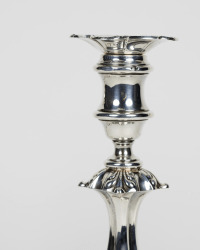
Samuel Tipograf, Warschau - Kiddush cup - Silver


05
days
00
hours
44
minutes
25
seconds
Starting bid
€ 1
Reserve price not met

Expert
Selected by Inés Fernández
Specialised in Spanish and Portuguese silver with over 10 years in galleries and auctions.
Estimate € 160 - € 200
No bids placed
Catawiki Buyer Protection
Your payment’s safe with us until you receive your object.View details
Trustpilot 4.4 | 141255 reviews
Rated Excellent on Trustpilot.
Antique silver Kiddush cup from Warsaw dating ca. 1899–1908, by Samuel Tipograf, with Cyrillic mark СТ and assay marks, height 4 cm, diameter 3.5 cm, weight 16.7 g, in good used condition with minor signs of age.
AI-assisted summary
Description from the seller
Antique silver Kiddush cup – Warsaw, ca. 1899–1908
This fine Kiddush cup is an authentic piece of Jewish silverware from Warsaw, dating from the period 1899–1908. The object bears the master mark СТ in Cyrillic, associated with Самуил Типограф (Samuel Tipograf), a silversmith active in Warsaw at the beginning of the 20th century.
The applicable assay marks confirm the dating within these years. To the right of the inspected head are the initials АР, referring to Александр Романов (Alexander Romanov), manager of the Warsaw Mutual Office between 1899 and 1904. This marking underscores the official inspection and authenticity of the piece.
This Kiddush cup combines religious significance with historical and collectible value. Suitable for use during Shabbat and holidays, but also highly attractive for Judaica collectors and antique East European silver enthusiasts.
A characterful object with clear hallmarks and a rich cultural background.
Height: 4 cm. Diameter: 3.5 cm.
Weight: 16.7 g.
Provenance: From the collection of Devotionalia.
What is Kiddush?
Kiddush ("sanctification") is a short ceremony in which, in the evening at the start of Shabbat and other holidays, a prayer is recited over a cup of wine. The prayer is spoken by the head of the household in the presence of the whole family, immediately after returning from the synagogue, before the evening meal, and is repeated the following morning. The prayer consists of two blessings: one over the wine and one over the Sabbath or another holiday. The father uses the Kiddush cup with the appropriate content, and all family members have their own smaller Kiddush cups. This is considered healthier than drinking directly from the same large, shared Kiddush cup.
The Aish Rabbi responds: The reason for sharing wine (or grape juice) is that the Wise Ones recommend participating in a "cup of blessing" (kos shel bracha) – that is, a cup that has been used for a mitzvah (commandment). Thus the "blessing" is shared with the other attendees. Therefore, after reciting the Kiddush, someone usually pours a bit of wine from their own cup, which is then poured into smaller cups for those present.
It is important to share the wine properly. The host should pour some wine from his own cup before he begins drinking. Not only is drinking from someone else’s cup off-putting to many, but only pure wine may be shared. Once someone has taken a sip, the wine is considered pagum (literally: defective) and is no longer valid for Kiddush – and only valid wine blesses when shared. Alternatively, the person who recites the Kiddush may pass his own cup after drinking. Although wine has already been drunk from it, since it remains in the original cup, it is not pagum and may be shared.
If the host pours wine from his own cup before he starts drinking, he must ensure that he pours only a small amount – so that even after pouring, he still has the full required amount of a quarter-of-a-revi’it in his cup. (See this earlier answer about the required amount of wine.) If his cup is small and there are many guests, a common solution is to pre-pour a quantity of wine from the bottle into a separate cup and then pour a small amount of Kiddush wine into that cup before it is shared with others.
Finally, the attendees should wait to drink the wine they have received until the host himself begins to drink. In fact, after the host has poured some wine from his cup into a second cup, he should drink it immediately before sharing the poured wine with others."
Antique silver Kiddush cup – Warsaw, ca. 1899–1908
This fine Kiddush cup is an authentic piece of Jewish silverware from Warsaw, dating from the period 1899–1908. The object bears the master mark СТ in Cyrillic, associated with Самуил Типограф (Samuel Tipograf), a silversmith active in Warsaw at the beginning of the 20th century.
The applicable assay marks confirm the dating within these years. To the right of the inspected head are the initials АР, referring to Александр Романов (Alexander Romanov), manager of the Warsaw Mutual Office between 1899 and 1904. This marking underscores the official inspection and authenticity of the piece.
This Kiddush cup combines religious significance with historical and collectible value. Suitable for use during Shabbat and holidays, but also highly attractive for Judaica collectors and antique East European silver enthusiasts.
A characterful object with clear hallmarks and a rich cultural background.
Height: 4 cm. Diameter: 3.5 cm.
Weight: 16.7 g.
Provenance: From the collection of Devotionalia.
What is Kiddush?
Kiddush ("sanctification") is a short ceremony in which, in the evening at the start of Shabbat and other holidays, a prayer is recited over a cup of wine. The prayer is spoken by the head of the household in the presence of the whole family, immediately after returning from the synagogue, before the evening meal, and is repeated the following morning. The prayer consists of two blessings: one over the wine and one over the Sabbath or another holiday. The father uses the Kiddush cup with the appropriate content, and all family members have their own smaller Kiddush cups. This is considered healthier than drinking directly from the same large, shared Kiddush cup.
The Aish Rabbi responds: The reason for sharing wine (or grape juice) is that the Wise Ones recommend participating in a "cup of blessing" (kos shel bracha) – that is, a cup that has been used for a mitzvah (commandment). Thus the "blessing" is shared with the other attendees. Therefore, after reciting the Kiddush, someone usually pours a bit of wine from their own cup, which is then poured into smaller cups for those present.
It is important to share the wine properly. The host should pour some wine from his own cup before he begins drinking. Not only is drinking from someone else’s cup off-putting to many, but only pure wine may be shared. Once someone has taken a sip, the wine is considered pagum (literally: defective) and is no longer valid for Kiddush – and only valid wine blesses when shared. Alternatively, the person who recites the Kiddush may pass his own cup after drinking. Although wine has already been drunk from it, since it remains in the original cup, it is not pagum and may be shared.
If the host pours wine from his own cup before he starts drinking, he must ensure that he pours only a small amount – so that even after pouring, he still has the full required amount of a quarter-of-a-revi’it in his cup. (See this earlier answer about the required amount of wine.) If his cup is small and there are many guests, a common solution is to pre-pour a quantity of wine from the bottle into a separate cup and then pour a small amount of Kiddush wine into that cup before it is shared with others.
Finally, the attendees should wait to drink the wine they have received until the host himself begins to drink. In fact, after the host has poured some wine from his cup into a second cup, he should drink it immediately before sharing the poured wine with others."
Details
Era
1900-2000
Gross weight
16.7 g
Country of origin
Poland
Designer/artist/maker
Samuel Tipograf, Warschau
Material
Silver
Colour
Silver
Condition
Good condition - used with small signs of ageing
Height
4 cm
Width
3.5 cm
Depth
0 cm
Estimated period
1900-1910
Sold by