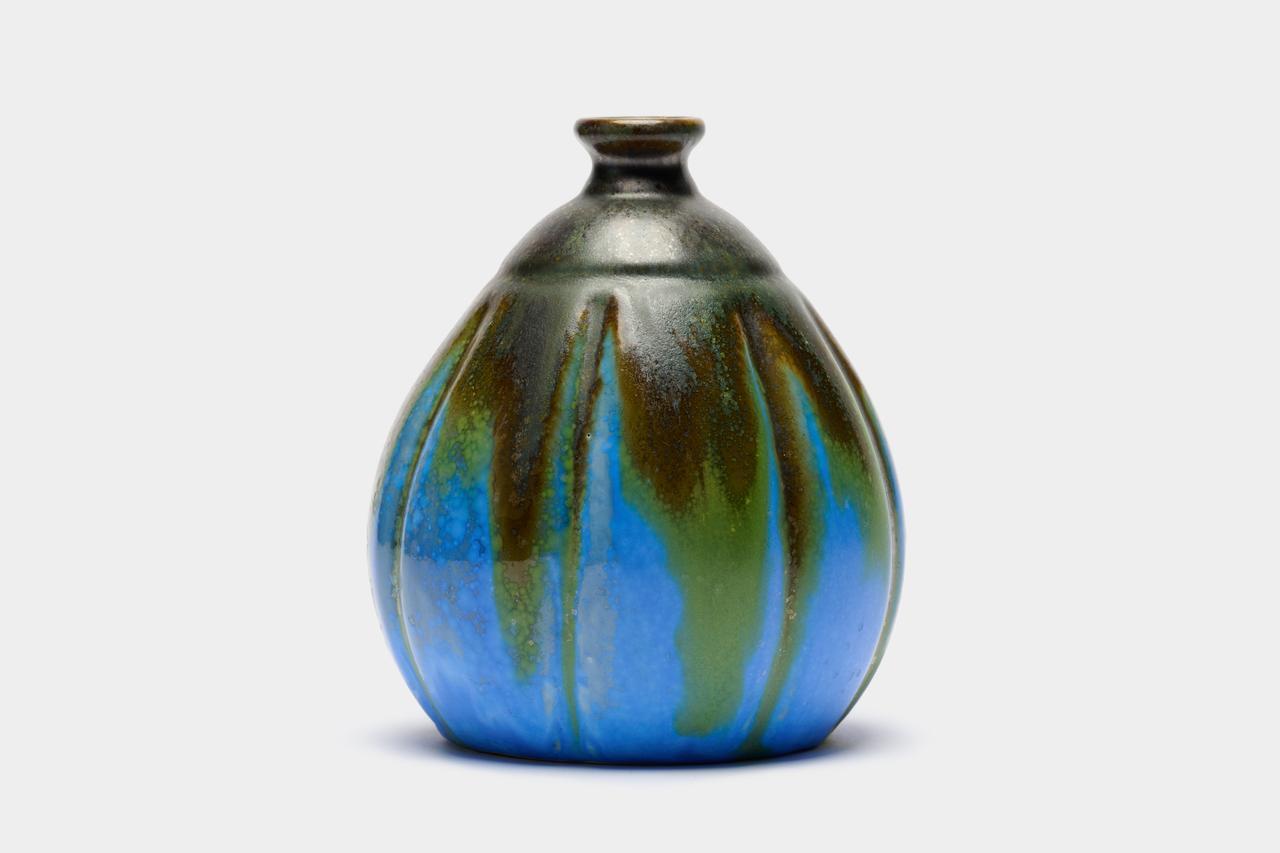
Vase - .Loetz vase Art Nouveau Phänomen Genre 6893 Creta iridescent glass 1898 - Bohemia Johann Loetz


01
day
08
hours
39
minutes
41
seconds
Current bid
€ 288
Reserve price not met

Expert
Selected by Michel Karis
Art historian with extensive experience working at various auction houses in antiques.
Estimate € 500 - € 550
 | €288 | |
|---|---|---|
 | €268 | |
 | €246 | |
Catawiki Buyer Protection
Your payment’s safe with us until you receive your object.View details
Trustpilot 4.4 | 142038 reviews
Rated Excellent on Trustpilot.
Unsigned 19th‑century Loetz Bohemian glass vase attributed to Johann Loetz Witwe of Klostermühle, with iridescent Creta Phänomen Genre 6893 decoration on a green Creta ground, measuring 165 × 105 × 105 mm.
AI-assisted summary
Description from the seller
Unsigned, as is the case with the majority of Loetz's Jugendstil artistic production; the attribution derives from comparison with the documented Creta Phänomen Genre 6893.
refined Jugendstil vase in blown and iridescent artistic glass, attributable to the famous Bohemian manufactory Johann Loetz Witwe of Klostermühle.
The decoration “Phänomen Genre 6893”, introduced by Loetz in 1898: on the Creta green background slender silvery filaments are combed and drawn in a wavy movement, with splendid iridescent reflections of blue, pink, violet and gold
Material: blown and iridescent artistic glass
perfect no cracks chips restoration
.............................................................................................................................................................
Loetz did not sign the majority of its Jugendstil glasses, including important and expensive specimens. The engraved mark “Loetz Austria” appears mainly on some pieces destined for export, particularly in the approximate period 1899–1903. Consequently, many objects sold in the Austro-Hungarian market remained unsigned.
The specialist source, however, emphasizes that there was no precise and documented company rule establishing which pieces should be marked. Therefore:
a Loetz without a signature can be perfectly authentic;
a piece exported could be signed “Loetz Austria”, but not necessarily;
the absence of the signature alone does not prove or exclude authenticity;
what matters most is the correspondence with decoration, archival form, colors, pontil mark, and quality of workmanship.
The same specialized guide explicitly states that Loetz did not sign the majority of its Art Nouveau glasses. Loetz.com – signatures and marks before 1918,
Unsigned, as is the case with the majority of Loetz's Jugendstil artistic production; the attribution derives from comparison with the documented Creta Phänomen Genre 6893.
refined Jugendstil vase in blown and iridescent artistic glass, attributable to the famous Bohemian manufactory Johann Loetz Witwe of Klostermühle.
The decoration “Phänomen Genre 6893”, introduced by Loetz in 1898: on the Creta green background slender silvery filaments are combed and drawn in a wavy movement, with splendid iridescent reflections of blue, pink, violet and gold
Material: blown and iridescent artistic glass
perfect no cracks chips restoration
.............................................................................................................................................................
Loetz did not sign the majority of its Jugendstil glasses, including important and expensive specimens. The engraved mark “Loetz Austria” appears mainly on some pieces destined for export, particularly in the approximate period 1899–1903. Consequently, many objects sold in the Austro-Hungarian market remained unsigned.
The specialist source, however, emphasizes that there was no precise and documented company rule establishing which pieces should be marked. Therefore:
a Loetz without a signature can be perfectly authentic;
a piece exported could be signed “Loetz Austria”, but not necessarily;
the absence of the signature alone does not prove or exclude authenticity;
what matters most is the correspondence with decoration, archival form, colors, pontil mark, and quality of workmanship.
The same specialized guide explicitly states that Loetz did not sign the majority of its Art Nouveau glasses. Loetz.com – signatures and marks before 1918,
Details
Era
1400-1900
Glass type
.Loetz vase Art Nouveau Phänomen Genre 6893 Creta iridescent glass 1898
Specific region of origin
boemia
Title additional information
Bohemia Johann Loetz
Country of origin
Austria
Material
Glass
Condition
Excellent condition: barely used with minimal signs of wear
Height
165 mm
Width
105 mm
Depth
105 mm
Estimated period
1890 1910, 1850-1900
Sold by