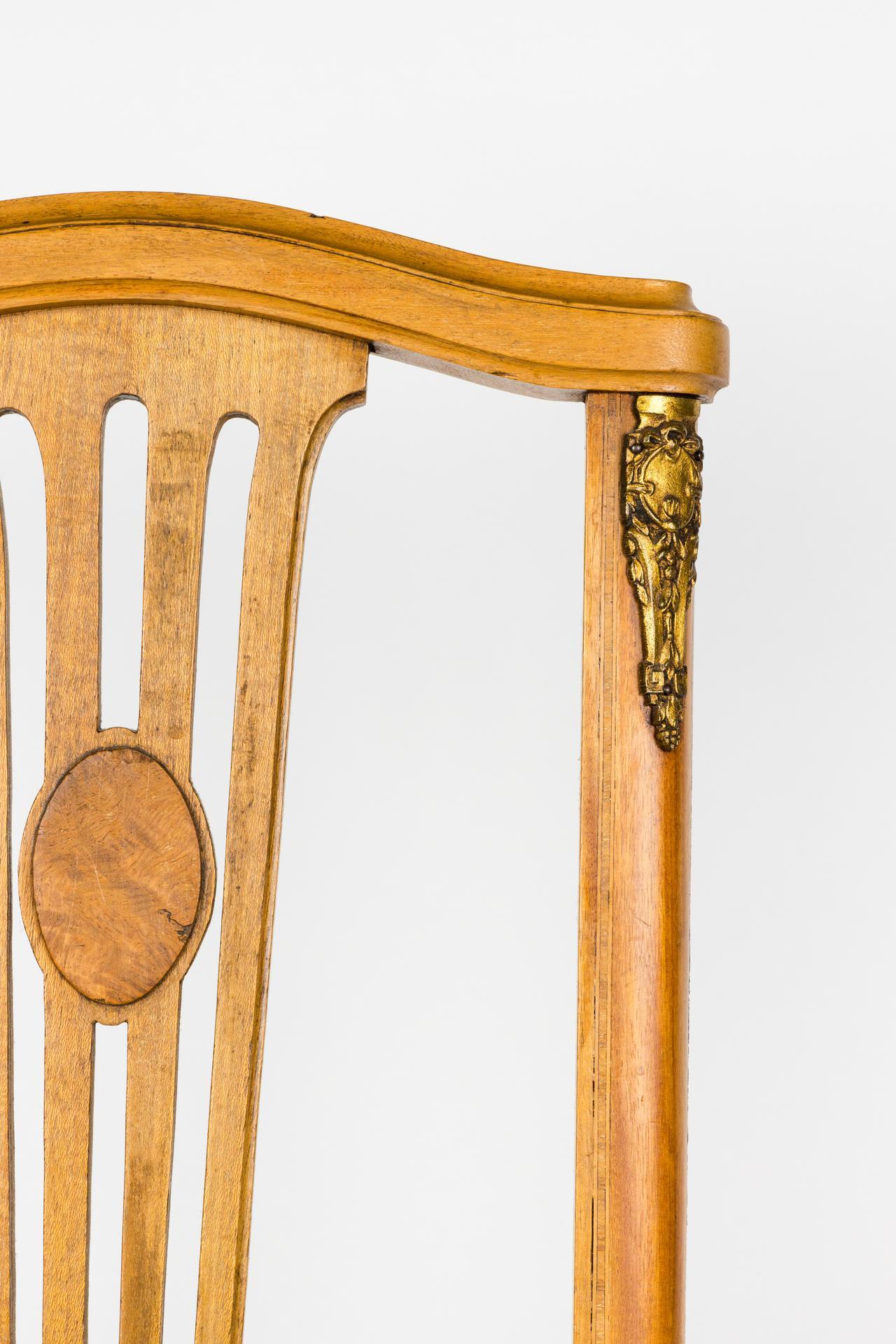
Games table - Mahogany, Polychrome wood


05
days
04
hours
45
minutes
44
seconds

No bids placed
Catawiki Buyer Protection
Your payment’s safe with us until you receive your object.View details
Trustpilot 4.4 | 141384 reviews
Rated Excellent on Trustpilot.
Angular mahogany game table with fluted legs and floral inlays in Dutch/Flemish marquetry; hinged sides open to form a square playing surface, dating to the late 19th century, made in the Netherlands, and in good condition with minor signs of age and stains.
AI-assisted summary
Description from the seller
Corner game table; the foot openings are on the underside. The hinges are made of wood, a very precise testimony that the table has been kept as much as possible in its original state, and the ingenuity that folds back onto itself as in the photo.
Corner table in mahogany with fluted legs, inlaid with floral motifs; by opening the two sides of the table hinged together, it becomes square in cross-section and transforms into a gaming table. Of Flemish origin,
This type of floral and naturalistic inlay, historically known as Dutch inlay (or Dutch marquetry), originated and reached its peak diffusion in the 17th and 18th centuries (from the late 1600s through the 1700s).
The history and evolution of this style unfold through clearly defined stages:
Origin and the Golden Age (Late ’60s - ’70s)
• The influence of painters: This style was born in the Netherlands, directly inspired by the still lifes of the great masters of Flemish painting. The meaning: The complex floral bouquets with birds, butterflies and insects were not merely decorative, but symbolized wealth, nature itself.
Corner game table; the foot openings are on the underside. The hinges are made of wood, a very precise testimony that the table has been kept as much as possible in its original state, and the ingenuity that folds back onto itself as in the photo.
Corner table in mahogany with fluted legs, inlaid with floral motifs; by opening the two sides of the table hinged together, it becomes square in cross-section and transforms into a gaming table. Of Flemish origin,
This type of floral and naturalistic inlay, historically known as Dutch inlay (or Dutch marquetry), originated and reached its peak diffusion in the 17th and 18th centuries (from the late 1600s through the 1700s).
The history and evolution of this style unfold through clearly defined stages:
Origin and the Golden Age (Late ’60s - ’70s)
• The influence of painters: This style was born in the Netherlands, directly inspired by the still lifes of the great masters of Flemish painting. The meaning: The complex floral bouquets with birds, butterflies and insects were not merely decorative, but symbolized wealth, nature itself.
Details
Era
1400-1900
Over 200 years old
Yes
Number of objects
1
Country of origin
Netherlands
Material
Mahogany, Polychrome wood
Condition
Good condition - used with small signs of aging & blemishes
Height
75 cm
Width
79 cm
Depth
79 cm
Estimated period
late 19th century