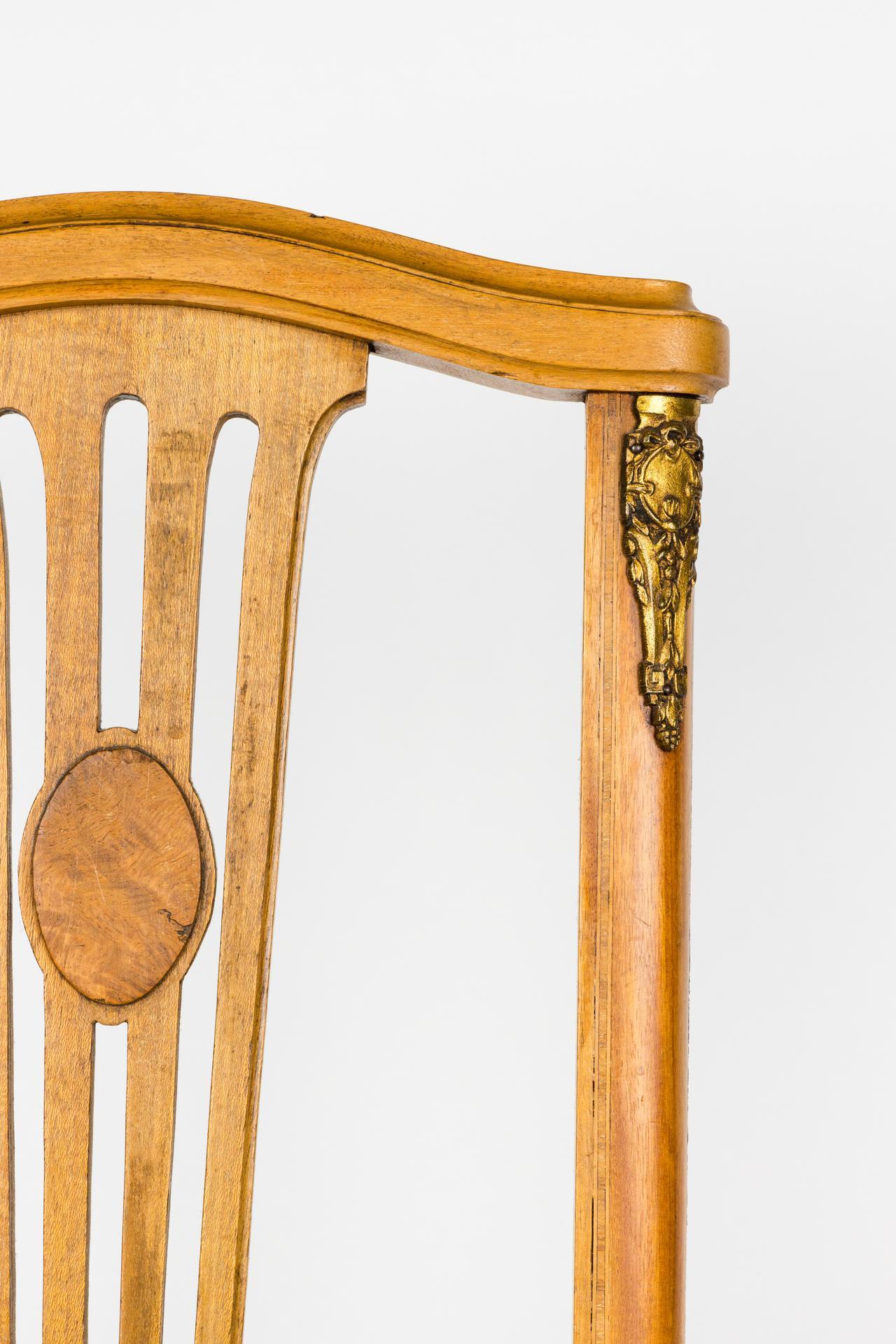
Games table - Wood - System “pull-out action”


05
days
13
hours
41
minutes
25
seconds

No bids placed
Catawiki Buyer Protection
Your payment’s safe with us until you receive your object.View details
Trustpilot 4.4 | 141331 reviews
Rated Excellent on Trustpilot.
French mahogany game table in Louis XV Revival style with a serpentine, extendable top and a pull-out action mechanism, dating to roughly 1850–1870 and expanding from 40 cm to 80 cm in depth when opened.
AI-assisted summary
Description from the seller
French mahogany gaming table with a “pull-out action” system — Louis XV / Rococo Revival style, c. 1850–1870.
Object: gaming/card table, foldable
Origin: France
Dating: c. 1850–1870, probably c. 1860
Style: Louis XV Revival / Rococo Revival
Historical period: Second French Empire
Wood: mahogany and, possibly, a veneer of mahogany on some surfaces
Interior: playing surface covered with green fabric/felt
Mechanism: pull-out action, with extendable framework and rear legs
Closed dimensions: 72 × 80 × 40 cm
Open dimensions: 72 × 80 × 80 cm
Elegant nineteenth-century French gaming table, executed in mahogany, serpentine in form and inspired by Louis XV, featuring a foldable top and an unusual pull-out action extending mechanism.
When closed, it assumes the appearance of an elegant side or console table, with a depth of only 40 cm. The rectangular top presents a pronounced serpentine design, rounded corners and successive peripheral moldings.
The tabletop wood exhibits a pleasant figure and a deep reddish-brown hue, with patina acquired through use.
The front waist follows the movement of the top, describing a wavy line with a slight central drop. At the center is a decorative, carved and pierced composition, consisting of a central flower, leaves, volutes and symmetrical scrolls.
At the bases of the front legs, carved flowers and vegetal elements also appear, establishing continuity between the waist and supports.
The four legs are tall, elegant and strongly curved, cabriole type, ending in narrow feet with slight scrolls. The design is very characteristic of the nineteenth-century revival of French Louis XV furniture.
The mechanism — one of the piece’s strong points: this is where the table becomes most interesting. The top consists of two halves hinged together. To transform the table:
- the rear frame is pulled horizontally;
- the two rear legs move together with that frame;
- the depth increases from approximately 40 cm to 80 cm;
- the top is opened over the expanded frame;
- a nearly square gaming table is obtained, 80 × 80 cm.
This mechanism is documented in nineteenth-century French furniture, described as pull-out action, serpentine top, cabriole legs with carved flowers and a central adorned frieze.
Interior: Open, the top reveals the gaming surface covered in blue/green fabric, bounded by the mahogany frame itself. Signs of use and tonal alteration on the covering are visible.
Louis XV characteristics are evident in: cabriole legs; curves and counter-curves; serpentine waist; carved flowers; volutes and vegetal motifs; light, elegant design.
The historical context is predominantly the Second French Empire, when Louis XV and Louis XVI styles returned to fashion with renewed strength.
The combination of construction, mechanism, moldings, carving, proportions, type of legs and aging is consistent with the latter half of the early nineteenth century.
Condition - The piece shows visible signs of use and aging but preserves the original reading and elegance very well.
French mahogany gaming table with a “pull-out action” system — Louis XV / Rococo Revival style, c. 1850–1870.
Object: gaming/card table, foldable
Origin: France
Dating: c. 1850–1870, probably c. 1860
Style: Louis XV Revival / Rococo Revival
Historical period: Second French Empire
Wood: mahogany and, possibly, a veneer of mahogany on some surfaces
Interior: playing surface covered with green fabric/felt
Mechanism: pull-out action, with extendable framework and rear legs
Closed dimensions: 72 × 80 × 40 cm
Open dimensions: 72 × 80 × 80 cm
Elegant nineteenth-century French gaming table, executed in mahogany, serpentine in form and inspired by Louis XV, featuring a foldable top and an unusual pull-out action extending mechanism.
When closed, it assumes the appearance of an elegant side or console table, with a depth of only 40 cm. The rectangular top presents a pronounced serpentine design, rounded corners and successive peripheral moldings.
The tabletop wood exhibits a pleasant figure and a deep reddish-brown hue, with patina acquired through use.
The front waist follows the movement of the top, describing a wavy line with a slight central drop. At the center is a decorative, carved and pierced composition, consisting of a central flower, leaves, volutes and symmetrical scrolls.
At the bases of the front legs, carved flowers and vegetal elements also appear, establishing continuity between the waist and supports.
The four legs are tall, elegant and strongly curved, cabriole type, ending in narrow feet with slight scrolls. The design is very characteristic of the nineteenth-century revival of French Louis XV furniture.
The mechanism — one of the piece’s strong points: this is where the table becomes most interesting. The top consists of two halves hinged together. To transform the table:
- the rear frame is pulled horizontally;
- the two rear legs move together with that frame;
- the depth increases from approximately 40 cm to 80 cm;
- the top is opened over the expanded frame;
- a nearly square gaming table is obtained, 80 × 80 cm.
This mechanism is documented in nineteenth-century French furniture, described as pull-out action, serpentine top, cabriole legs with carved flowers and a central adorned frieze.
Interior: Open, the top reveals the gaming surface covered in blue/green fabric, bounded by the mahogany frame itself. Signs of use and tonal alteration on the covering are visible.
Louis XV characteristics are evident in: cabriole legs; curves and counter-curves; serpentine waist; carved flowers; volutes and vegetal motifs; light, elegant design.
The historical context is predominantly the Second French Empire, when Louis XV and Louis XVI styles returned to fashion with renewed strength.
The combination of construction, mechanism, moldings, carving, proportions, type of legs and aging is consistent with the latter half of the early nineteenth century.
Condition - The piece shows visible signs of use and aging but preserves the original reading and elegance very well.
Details
Era
1400-1900
Style subtype
Louis XV Style
Title additional information
System “pull-out action”
Country of origin
France
Material
Wood
Style
Antique
Condition
Good condition - used with small signs of aging & blemishes
Height
72 cm
Width
80 cm
Depth
80 cm
Estimated period
1850-1900
Sold by