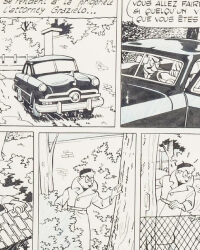
Gomez Esteban - 1 Original colour drawing - Romántica - 1964


Starting bid
€ 1
Add to your favourites to get an alert when the auction starts.

Catawiki Buyer Protection
Your payment’s safe with us until you receive your object.View details
Trustpilot 4.4 | 141663 reviews
Rated Excellent on Trustpilot.
Description from the seller
A draftsman who developed a large part of his work for the foreign market through an agency during the 1950s and 1960s, mainly in romance and adventure comics, with later forays into the horror genre.
Gómez Esteban was born in Barcelona in 1939. At 17 he joined the drawing team at Editorial Bruguera, carrying out numerous works of various genres for the agency Creaciones Editoriales, belonging to the publisher itself, for both the national market and the foreign one, especially the English market. There he immediately clicked with other artists his age, such as Luis Martínez Roca and Pedro Martínez Henares and especially with Enrique Montserrat Boj.
Already in those years Gómez Esteban stood out for his skill and ease in drawing the female figure, which led his career to favor the romantic genre. Part of the material produced for agencies was later recovered in Spanish publications, such as in the collection generically called Sissi. Novelas Gráficas (from Bruguera) or Rosas Blancas and Brigada Secreta from Toray.
In 1959 he was recruited by José María Arman, founder of Ibero Mundial de Ediciones (IMDE), as a fundamental illustrator in the publisher’s early publications, under very favorable financial conditions (though never as good as those offered by Fleetway through Selecciones Ilustradas or Bardon Art) and given all the freedom of action he required. Thus, he became one of the main authors of the Claro de Luna collection, in which he signed hundreds of episodes first as M. G. Esteban and then as Est., sharing top billing with the other star IMDE artist, Carmen Barbará. He also participated in other romantic genres catalogs, such as Lilian, Azafata del Aire and Romántica. The illustrator achieved great popularity in this genre, becoming a figure sought after by fans across the country; the publisher received weekly a large number of letters praising the artist, requesting writings, sentimental consultations, drawings and dedicated photographs. According to statements from professionals who knew him, he was considered on par with the other great girl illustrator, Pepe González, who worked for SI and the English market, while Gómez Esteban did so for IMDE and the Spanish market.
Gómez Esteban was a meticulous draftsman, very secure in freezing a pose and in seeking dynamic page layouts despite the small number of panels. In his romantic comics he experimented with foggy atmospheres and diffused outlines to speed up the figures, and in his covers he conceived perfect, clean, very attractive compositions. Surprisingly, and in contrast, he would also prove to be an effective horror artist, as he dirtyed the backgrounds with skill and crafted expressions of pain or malice like no other.
In 1962 Gómez Esteban opened a studio on Consejo de Ciento Street in Barcelona with his friend Blas Gallego, who, coming from the world of advertising, began at that time as a comics artist. In 1965 they closed the studio and stopped working together. From then on, he carried out occasional work for other IMDE publications, such as Gringo and Delta 99. In 1968, fed up with the romantic genre, Gómez Esteban took a radical turn in his career and devoted himself entirely to horror and terror, in the magazines Dossier Negro first and then Vampus, Rufus and Vampirella, all of them under the IMDE label (later published by Garbo). He adopted the pseudonym Michael G. Esteban to tackle some of these comics, and the alias Mauvais to also work in horror for Ediciones Vilmar magazines (Pánico and Escorpión), though this signature also appears in occasional works destined for other titles. Some of these stories would be recovered after the author’s death in publications such as Morbo (from Bruguera) and Delta.
In the mid-1970s there is a noticeable weariness and lack of interest in Gómez Esteban’s work, perhaps as a consequence of his progressive alcoholism.
A draftsman who developed a large part of his work for the foreign market through an agency during the 1950s and 1960s, mainly in romance and adventure comics, with later forays into the horror genre.
Gómez Esteban was born in Barcelona in 1939. At 17 he joined the drawing team at Editorial Bruguera, carrying out numerous works of various genres for the agency Creaciones Editoriales, belonging to the publisher itself, for both the national market and the foreign one, especially the English market. There he immediately clicked with other artists his age, such as Luis Martínez Roca and Pedro Martínez Henares and especially with Enrique Montserrat Boj.
Already in those years Gómez Esteban stood out for his skill and ease in drawing the female figure, which led his career to favor the romantic genre. Part of the material produced for agencies was later recovered in Spanish publications, such as in the collection generically called Sissi. Novelas Gráficas (from Bruguera) or Rosas Blancas and Brigada Secreta from Toray.
In 1959 he was recruited by José María Arman, founder of Ibero Mundial de Ediciones (IMDE), as a fundamental illustrator in the publisher’s early publications, under very favorable financial conditions (though never as good as those offered by Fleetway through Selecciones Ilustradas or Bardon Art) and given all the freedom of action he required. Thus, he became one of the main authors of the Claro de Luna collection, in which he signed hundreds of episodes first as M. G. Esteban and then as Est., sharing top billing with the other star IMDE artist, Carmen Barbará. He also participated in other romantic genres catalogs, such as Lilian, Azafata del Aire and Romántica. The illustrator achieved great popularity in this genre, becoming a figure sought after by fans across the country; the publisher received weekly a large number of letters praising the artist, requesting writings, sentimental consultations, drawings and dedicated photographs. According to statements from professionals who knew him, he was considered on par with the other great girl illustrator, Pepe González, who worked for SI and the English market, while Gómez Esteban did so for IMDE and the Spanish market.
Gómez Esteban was a meticulous draftsman, very secure in freezing a pose and in seeking dynamic page layouts despite the small number of panels. In his romantic comics he experimented with foggy atmospheres and diffused outlines to speed up the figures, and in his covers he conceived perfect, clean, very attractive compositions. Surprisingly, and in contrast, he would also prove to be an effective horror artist, as he dirtyed the backgrounds with skill and crafted expressions of pain or malice like no other.
In 1962 Gómez Esteban opened a studio on Consejo de Ciento Street in Barcelona with his friend Blas Gallego, who, coming from the world of advertising, began at that time as a comics artist. In 1965 they closed the studio and stopped working together. From then on, he carried out occasional work for other IMDE publications, such as Gringo and Delta 99. In 1968, fed up with the romantic genre, Gómez Esteban took a radical turn in his career and devoted himself entirely to horror and terror, in the magazines Dossier Negro first and then Vampus, Rufus and Vampirella, all of them under the IMDE label (later published by Garbo). He adopted the pseudonym Michael G. Esteban to tackle some of these comics, and the alias Mauvais to also work in horror for Ediciones Vilmar magazines (Pánico and Escorpión), though this signature also appears in occasional works destined for other titles. Some of these stories would be recovered after the author’s death in publications such as Morbo (from Bruguera) and Delta.
In the mid-1970s there is a noticeable weariness and lack of interest in Gómez Esteban’s work, perhaps as a consequence of his progressive alcoholism.
Details
Item
Original colour drawing
Number of objects
1
Series
Romántica
Condition
Good condition
Artist
Gomez Esteban
Year
1964
Width
27 cm
Height
37 cm
Sold by