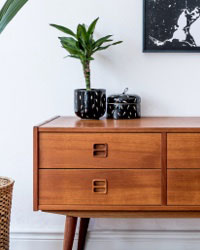
Bureau cabinet - Maple, Burr walnut - Inlaid trumeau.


03
days
21
hours
26
minutes
53
seconds
Current bid
€ 200
Reserve price not met

Expert
Selected by Constance Rousseau
Master marquetry craftswoman with 4 years' expert experience. Trainee auctioneer at Sotheby's Paris.
Estimate € 450 - € 500
 | €200 | |
|---|---|---|
| €15 | |
| €10 |
Catawiki Buyer Protection
Your payment’s safe with us until you receive your object.View details
Trustpilot 4.4 | 142553 reviews
Rated Excellent on Trustpilot.
Italian trumeau in two sections with rich walnut burl inlay and contrasting maple, in the Luigi XVI style dating to 1960–1970, measuring 220 cm high by 90 cm wide by 45 cm deep and with lockable doors and a secretaire, in good used condition with small signs of age and stains.
AI-assisted summary
Description from the seller
refined Italian double-body trumeau in the Louis XVI style (produced or inspired by models from the second half of the 20th century).
Mobile Features
Materials and Finish: It is built with a walnut wood veneer enriched by elaborate cabinetmaking works. It features precious geometric and floral inlays created in contrast with light woods (such as maple or fruitwoods), visible over the entire front surface.
Upper Body: It unfolds as a display cabinet or two-panel glazed cupboard, entirely decorated with a prominent inlaid motif of candelabra and botanical ramage that extends symmetrically on both sides.
Lower Body (Ribalta and Drawers): The central section is equipped with a calatoia (or ribalta) also inlaid, which, when opened, serves as a writing desk (secretaire) and usually conceals a small internal compartment with little drawers and document compartments. The base hosts three large external drawers stacked, enriched by geometric fillets and inlaid bands with continuous foliate patterns.
Supports: The piece rests on elegant tall, sinuous sabre legs, typical of the baroque revival design or transitional styles, which elongate its substantial silhouette, making it light and graceful.
scarbattolo della ribalta, revealing the secret compartment of the trumeau once the calatoia is opened.
Interior Details
The Central Small Drawers: In the center of the niche there are two stacked drawers, also finished with geometric fillets and delicate inlay of mirrored vegetal scrolls on the front.
Document Compartments: On the sides of the drawers open two open compartments with a wavy upper profile (gala), typical of classical cabinetry for archiving letters and documents.
The Writing Surface: The inner part of the hinged door reveals a rich central inlay with spiral motifs and very dense floral sprigs that reprise the external neoclassical style and embellish the working area.
refined Italian double-body trumeau in the Louis XVI style (produced or inspired by models from the second half of the 20th century).
Mobile Features
Materials and Finish: It is built with a walnut wood veneer enriched by elaborate cabinetmaking works. It features precious geometric and floral inlays created in contrast with light woods (such as maple or fruitwoods), visible over the entire front surface.
Upper Body: It unfolds as a display cabinet or two-panel glazed cupboard, entirely decorated with a prominent inlaid motif of candelabra and botanical ramage that extends symmetrically on both sides.
Lower Body (Ribalta and Drawers): The central section is equipped with a calatoia (or ribalta) also inlaid, which, when opened, serves as a writing desk (secretaire) and usually conceals a small internal compartment with little drawers and document compartments. The base hosts three large external drawers stacked, enriched by geometric fillets and inlaid bands with continuous foliate patterns.
Supports: The piece rests on elegant tall, sinuous sabre legs, typical of the baroque revival design or transitional styles, which elongate its substantial silhouette, making it light and graceful.
scarbattolo della ribalta, revealing the secret compartment of the trumeau once the calatoia is opened.
Interior Details
The Central Small Drawers: In the center of the niche there are two stacked drawers, also finished with geometric fillets and delicate inlay of mirrored vegetal scrolls on the front.
Document Compartments: On the sides of the drawers open two open compartments with a wavy upper profile (gala), typical of classical cabinetry for archiving letters and documents.
The Writing Surface: The inner part of the hinged door reveals a rich central inlay with spiral motifs and very dense floral sprigs that reprise the external neoclassical style and embellish the working area.
Details
Era
1900-2000
Weight
120 g
Wood type
Rosewood, Burr walnut, Maple, Rosewood
Title additional information
Inlaid trumeau.
Number of objects
1
Country of origin
Italy
Material
Wood
Condition
Good condition - used with small signs of aging & blemishes
Height
220 cm
Width
90 cm
Depth
45 cm
Estimated period
1960-1970
Can Be Locked
Yes
Sold by