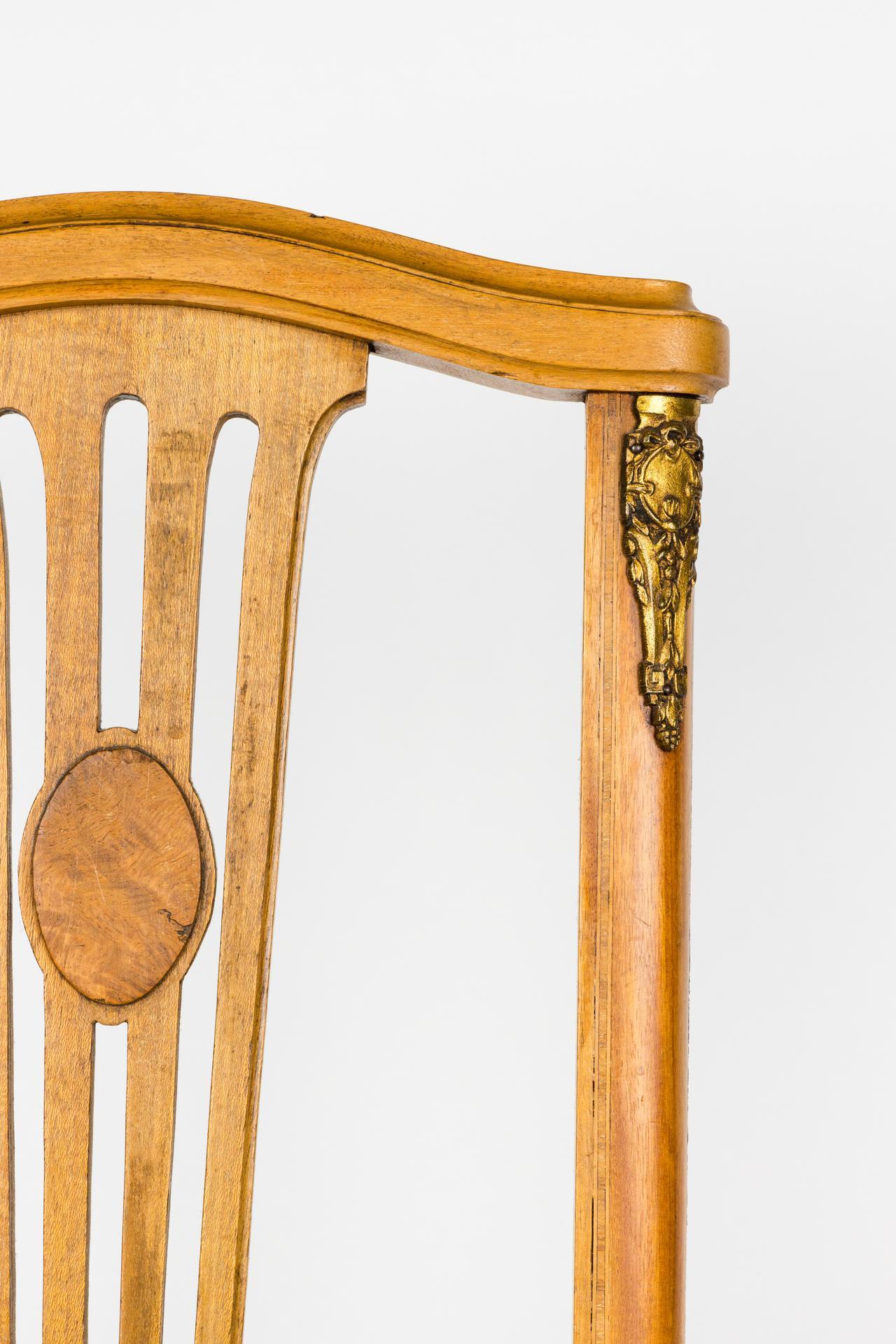
Jacob Frères Rue Meslée - Stool - Mahogany, mahogany veneer - Consulate Era


05
days
00
hours
05
minutes
14
seconds
Current bid
€ 140
Reserve price not met

Expert
Selected by Dési van Rhee
Over 20 years' experience in antiques with a background in art history.
Estimate € 2,800 - € 3,200
 | €140 | |
|---|---|---|
 | €130 | |
| €120 | |
Catawiki Buyer Protection
Your payment’s safe with us until you receive your object.View details
Trustpilot 4.4 | 141948 reviews
Rated Excellent on Trustpilot.
A mahogany stool with mahogany burl veneer dating to the Consulate period (c. 1800–1850), stamped Jacob Frères Rue Meslée, measuring 47 cm high, 43.5 cm wide and 37.5 cm deep, in good condition with age‑related wear and stains and leopard‑print velvet upholstery.
AI-assisted summary
Description from the seller
Elegant mahogany stool with mahogany veneer, resting on four tapered, Greek-style legs inspired directly by the Klismos. Each leg ends with a fine leaf motif carved in a cartouche.
This type of seat, from the archaeological current, was brought up to date by the architects Charles Percier and François Fontaine in their “Recueil de décorations intérieures.” The Jacob brothers carried out the production in several variants.
The seat features leopard-patterned velvet, evoking the appeal of exotism and “the wild,” already perceptible in aristocratic interiors of the late 18th century. A trait nourished by travel narratives, cabinets of curiosities, and commercial exchanges with Africa, Asia, and the Americas. The skins of big cats were then seen as prestige objects associated with power, domination, antiquity (mythological scenes).
A similar model, from a series of four, was delivered by Jacob Frères for General Moreau’s boudoir around 1802. Currently preserved at the Château de Fontainebleau (“Mobilier français Consulat et Empire,” Jean-Pierre Samoyault, p.54, fig.68).
This stool perfectly illustrates the Neoclassical aesthetic inspired by Antiquity, very fashionable in Paris at the end of the 18th century / very early 19th century.
Stamped Jacob Frères Rue Meslée.
Consulate period.
Very good state of conservation.
Restored by a master cabinetmaker.
Seat reupholstered using traditional horsehair stuffing.
Bibliography :
-“Mobilier français Consulat et Empire,” Jean-Pierre Samoyault, éditions Gourcuff Gradenigo, p.54, fig.68.
Elegant mahogany stool with mahogany veneer, resting on four tapered, Greek-style legs inspired directly by the Klismos. Each leg ends with a fine leaf motif carved in a cartouche.
This type of seat, from the archaeological current, was brought up to date by the architects Charles Percier and François Fontaine in their “Recueil de décorations intérieures.” The Jacob brothers carried out the production in several variants.
The seat features leopard-patterned velvet, evoking the appeal of exotism and “the wild,” already perceptible in aristocratic interiors of the late 18th century. A trait nourished by travel narratives, cabinets of curiosities, and commercial exchanges with Africa, Asia, and the Americas. The skins of big cats were then seen as prestige objects associated with power, domination, antiquity (mythological scenes).
A similar model, from a series of four, was delivered by Jacob Frères for General Moreau’s boudoir around 1802. Currently preserved at the Château de Fontainebleau (“Mobilier français Consulat et Empire,” Jean-Pierre Samoyault, p.54, fig.68).
This stool perfectly illustrates the Neoclassical aesthetic inspired by Antiquity, very fashionable in Paris at the end of the 18th century / very early 19th century.
Stamped Jacob Frères Rue Meslée.
Consulate period.
Very good state of conservation.
Restored by a master cabinetmaker.
Seat reupholstered using traditional horsehair stuffing.
Bibliography :
-“Mobilier français Consulat et Empire,” Jean-Pierre Samoyault, éditions Gourcuff Gradenigo, p.54, fig.68.
Details
Era
1400-1900
Title additional information
Consulate Era
Number of objects
1
Country of origin
France
Designer/artist/maker
Jacob Frères Rue Meslée
Material
mahogany veneer, Mahogany
Condition
Good condition - used with small signs of aging & blemishes
Height
47 cm
Width
43.5 cm
Depth
37.5 cm
Estimated period
1800-1850