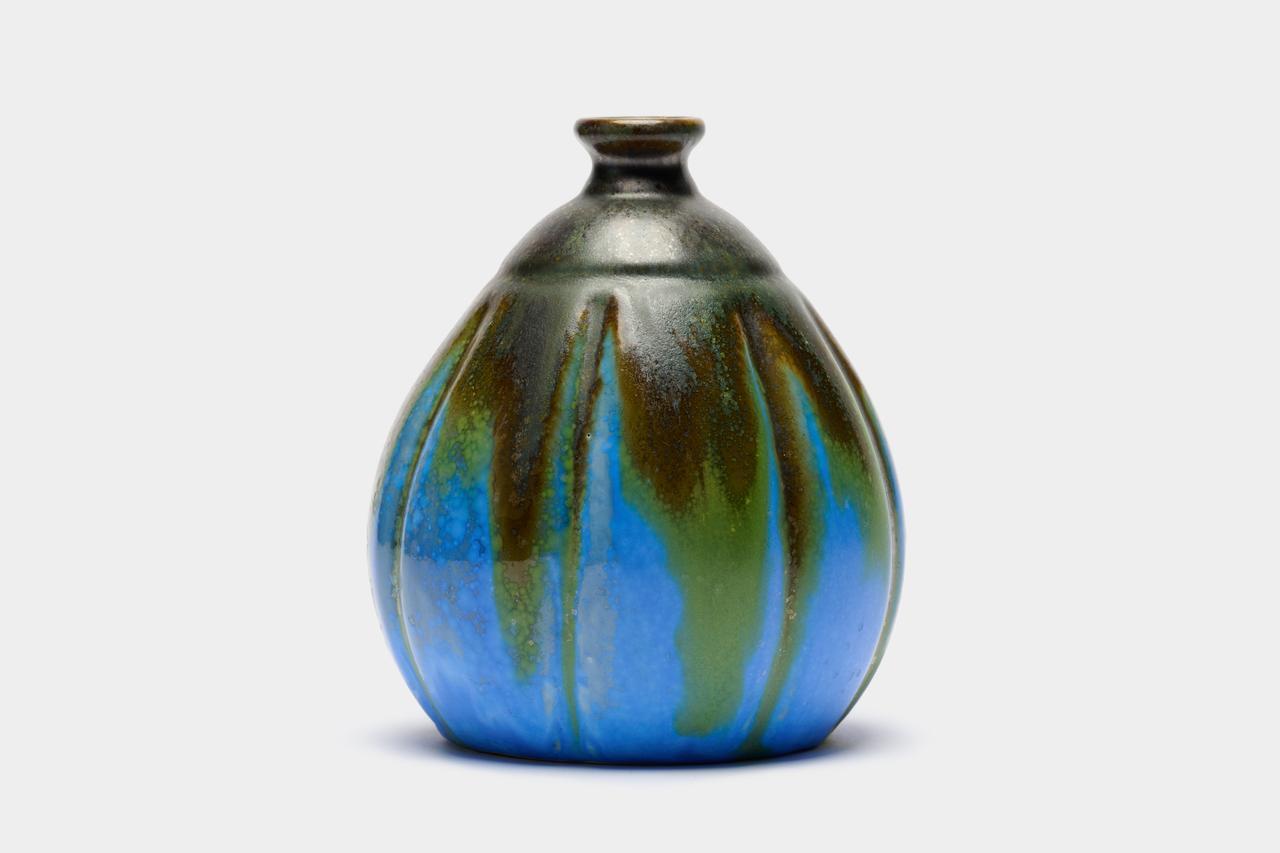
Vase - Millefiori vase on Tango-orange glass • circle of Kralik • Bohemia • c. 1920–1938 - Glass


04
days
03
hours
17
minutes
56
seconds
Current bid
€ 5
No reserve price

Expert
Selected by Michel Karis
Art historian with extensive experience working at various auction houses in antiques.
Estimate € 150 - € 200
 | €5 | |
|---|---|---|
 | €4 | |
| €3 | |
Catawiki Buyer Protection
Your payment’s safe with us until you receive your object.View details
Trustpilot 4.4 | 142824 reviews
Rated Excellent on Trustpilot.
Bohemian Art Deco millefiori vase in tango orange glass with a Kralik motif, trumpet foot, ca. 1920–1938, height 20 cm, diameter 8.5 cm, weight 305 g; good vintage condition with minor signs of use and spots.
AI-assisted summary
Description from the seller
Millefiori vase in Tango-orange glass • circle of Kralik • Bohemia • ca. 1920–1938
Tumbler vase on a trumpet foot in Tango-orange glass, the upper half speckled with pulled millefiori. Unnoticed; the decor is of the Kralik-type, the form is not listed among the documented Kralik shapes.
A Bohemian goblet vase in Tango-orange glass, from the Kralik circle, ca. 1920-1938. On the upper half there are murrine slices with a dark core and a pink and white ring. When the form is stretched, they are elongated into flames that run from the shoulder to the stem. The lower half remains a flat, orange and glossy.
In one glance:
Material: opaque orange glass with millefiori, free-blown
Dimensions: h 20 x diameter 8.5 cm
Weight: 305 grams
Brand: unobtrusive
Dating: ca. 1920–1938
Provenance: from a collection; probably manufactured in Bohemia
Description and context:
A broad trumpet foot carries a slender stem, above which the vase widens into a conical body with a pinched shoulder and a flat-faceted mouth. The murrine are slices from assembled glass rods. They are incorporated into the hot glass and then pulled with the form. This creates a motion from top to bottom, like a flame descending. After World War I, Kralik in Eleonorhain produced a series of millefiori decors on colored ground; this decor belongs to that type.
Condition:
Good vintage. Inner rim: minimal signs of use. Foot: light wear scratches on the contact surface. A few small dark inclusions in the foot are part of hand-blown glass and are not damage. No chips, hairlines, or restorations. Complete. See the photos.
In the interior:
A vivid color accent on a windowsill or sideboard. In backlighting, the orange glows, and the pink flames are sharply defined. Suits Art Deco, mid-century, and eclectic styles.
Shipping:
Professionally packed in a sturdy box with cushioning material, for fragile objects a double box. Always shipped insured with Track and Trace. See feedback from previous buyers.
Attribution and sources:
Kring of Kralik. The technique and decor correspond to Kralik millefiori on orange ground in the decor index of kralik-glass.com; the form is not documented there, hence no full attribution. Wellz and Steinwald are ruled out: they worked with spat glass without incised murrine. The name Clichy is excluded, since that factory closed in 1885.
You can follow me above by bookmarking my page and clicking the follow (heart) next to 'DECADERS Gallery'.
Seller's Story
Decaders Gallery
Region Eindhoven, Netherlands
Our passion lies in 20th-century applied art and design, with a particular focus on the periods Art Nouveau, Art Deco and Mid-Century Modern. But styles from the sixties, seventies, and later also capture our attention. Each decade has made a unique contribution to the art world, which perfectly reflects our name – Decaders Gallery.
Thanks to our love for art and design, we present new, exceptional decorative objects weekly. In addition, we have a broad interest in Asian art, antiques, and collectibles.
Our scavenges across Europe have led to a valuable network of like-minded enthusiasts who help us track down unique finds. This network has paid off: we are proud to have supplied artworks to renowned museums, including:
Museums & collections
Netherlands:
• CODA Museum, Apeldoorn
• Drents Museum, Assen
• National Textile Museum, Tilburg
• National Glass Museum, Leerdam
• Museum 'Amsterdam School' ('t Schip), Amsterdam
• PSV Football Museum, Eindhoven
• National War Museum, Overloon
Belgium:
• Musée de la Famenne, Marche-en-Famenne
• Museum of Natural Sciences, Belgium
Spain:
• Maritime Museum, Barcelona
---
We warmly invite you to visit our auctions with surprising artworks and to follow us on Instagram. Discover your favorite decade at Decaders Gallery!
Marc van der Heijden
Decaders Gallery, Netherlands.
Translated by Google TranslateMillefiori vase in Tango-orange glass • circle of Kralik • Bohemia • ca. 1920–1938
Tumbler vase on a trumpet foot in Tango-orange glass, the upper half speckled with pulled millefiori. Unnoticed; the decor is of the Kralik-type, the form is not listed among the documented Kralik shapes.
A Bohemian goblet vase in Tango-orange glass, from the Kralik circle, ca. 1920-1938. On the upper half there are murrine slices with a dark core and a pink and white ring. When the form is stretched, they are elongated into flames that run from the shoulder to the stem. The lower half remains a flat, orange and glossy.
In one glance:
Material: opaque orange glass with millefiori, free-blown
Dimensions: h 20 x diameter 8.5 cm
Weight: 305 grams
Brand: unobtrusive
Dating: ca. 1920–1938
Provenance: from a collection; probably manufactured in Bohemia
Description and context:
A broad trumpet foot carries a slender stem, above which the vase widens into a conical body with a pinched shoulder and a flat-faceted mouth. The murrine are slices from assembled glass rods. They are incorporated into the hot glass and then pulled with the form. This creates a motion from top to bottom, like a flame descending. After World War I, Kralik in Eleonorhain produced a series of millefiori decors on colored ground; this decor belongs to that type.
Condition:
Good vintage. Inner rim: minimal signs of use. Foot: light wear scratches on the contact surface. A few small dark inclusions in the foot are part of hand-blown glass and are not damage. No chips, hairlines, or restorations. Complete. See the photos.
In the interior:
A vivid color accent on a windowsill or sideboard. In backlighting, the orange glows, and the pink flames are sharply defined. Suits Art Deco, mid-century, and eclectic styles.
Shipping:
Professionally packed in a sturdy box with cushioning material, for fragile objects a double box. Always shipped insured with Track and Trace. See feedback from previous buyers.
Attribution and sources:
Kring of Kralik. The technique and decor correspond to Kralik millefiori on orange ground in the decor index of kralik-glass.com; the form is not documented there, hence no full attribution. Wellz and Steinwald are ruled out: they worked with spat glass without incised murrine. The name Clichy is excluded, since that factory closed in 1885.
You can follow me above by bookmarking my page and clicking the follow (heart) next to 'DECADERS Gallery'.
Seller's Story
Decaders Gallery
Region Eindhoven, Netherlands
Our passion lies in 20th-century applied art and design, with a particular focus on the periods Art Nouveau, Art Deco and Mid-Century Modern. But styles from the sixties, seventies, and later also capture our attention. Each decade has made a unique contribution to the art world, which perfectly reflects our name – Decaders Gallery.
Thanks to our love for art and design, we present new, exceptional decorative objects weekly. In addition, we have a broad interest in Asian art, antiques, and collectibles.
Our scavenges across Europe have led to a valuable network of like-minded enthusiasts who help us track down unique finds. This network has paid off: we are proud to have supplied artworks to renowned museums, including:
Museums & collections
Netherlands:
• CODA Museum, Apeldoorn
• Drents Museum, Assen
• National Textile Museum, Tilburg
• National Glass Museum, Leerdam
• Museum 'Amsterdam School' ('t Schip), Amsterdam
• PSV Football Museum, Eindhoven
• National War Museum, Overloon
Belgium:
• Musée de la Famenne, Marche-en-Famenne
• Museum of Natural Sciences, Belgium
Spain:
• Maritime Museum, Barcelona
---
We warmly invite you to visit our auctions with surprising artworks and to follow us on Instagram. Discover your favorite decade at Decaders Gallery!
Marc van der Heijden
Decaders Gallery, Netherlands.
Translated by Google TranslateDetails
Era
1900-2000
Weight
305 g
Country of origin
Czechia
Model
Millefiori vase on Tango-orange glass • circle of Kralik • Bohemia • c. 1920–1938
Material
Glass
Style
Art Deco
Colour
Multicolour
Condition
Good condition - used with small signs of aging & blemishes
Height
20 cm
Width
8.5 cm
Depth
8.5 cm
Diameter
8.5 cm
Estimated period
1920-1930
Sold by