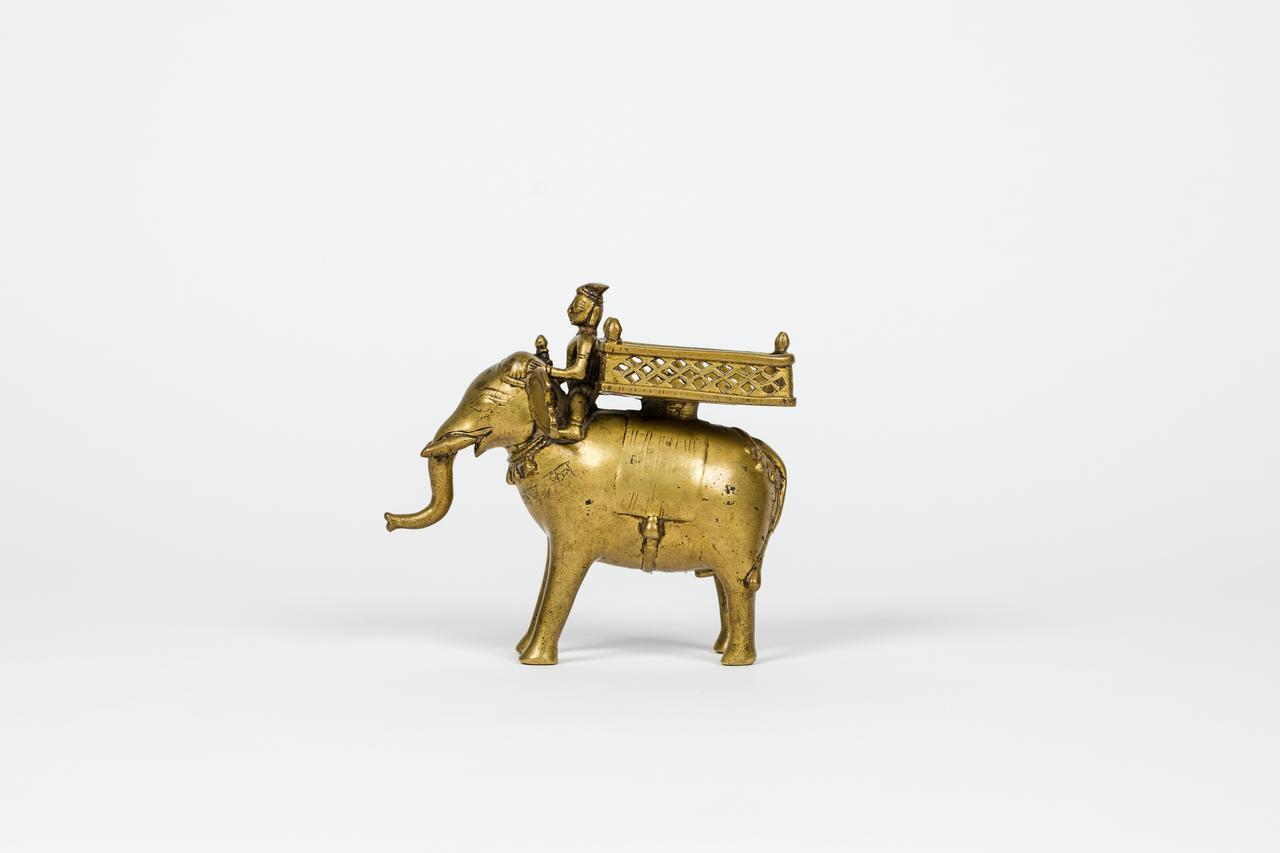
Eight Auspicious Symbols - Antique - Agni, the ritual Fire, a precious testimony to the complex liturgy of Jainism - 1850-1900 British Raj (1858-1947) - Flame of Illumination


00
days
16
hours
49
minutes
17
seconds
Current bid
€ 58
Reserve price not met

Expert
Selected by Sarah Le Helley
Studied Asian art and art market management; researched art in Taipei; worked in auctions.
Estimate € 150 - € 200
 | €58 | |
|---|---|---|
 | €53 | |
| €43 |
Catawiki Buyer Protection
Your payment’s safe with us until you receive your object.View details
Trustpilot 4.4 | 142038 reviews
Rated Excellent on Trustpilot.
Description from the seller
Agni, the Jain devotional ritual fire, wooden painted figure with Ashtamangala symbols – Gujarat/Rajasthan, India, 19th century.
A rare and evocative ritual/de votional object that constitutes a precious and extremely rare testimony to the complex Jain liturgy and cosmology in India, attributable with certainty to a time frame spanning from the mid-19th century to the very early years of the 20th, during the artistic transition between the late Mughal period and the regional Maratha influences. The work is handmade and presents itself as a sumptuous and evocative sculptural representation of the Sacred Fire, a symbol of utmost ritual significance related to the purification of the soul and the illumination of supreme knowledge of the Tirthankaras. Within the core of the Ashtamangala, the eight auspicious Jain symbols, this splendid creation directly connects to the concept of Dipa दीप or Agni अग्नि, the eternal flame of spiritual illumination that destroys the darkness of karmic ignorance, sometimes stylized in the complex flame-geometries of the Nandavarta नन्दावर्त. The compositional structure of the artifact rises with extraordinary balance from a solid circular celadon-base, decorated along its surface with rich and detailed painting of floral and geometric motifs, characterized by sinuous petals finely drawn in the traditional tones of vivid red and black on a gold ground. From the summit of this basin, a dense and elaborate corona of three-dimensional pointed flames unfurls, reproducing the dynamic, ascending shape of ritual tongues of fire. Each conical element is painted at the base with a vibrant red-orange color transition and culminates upward in a series of precious gold highlights, originally laid to reflect the flickering light of Indian temples, thereby simulating the real splendor of a sacred fire. At the geometric center of the sculpture stands a supporting wooden pillar that culminates at the apex with an ancient wrought-iron ring, a contemporary structural device historically used for the ceremonial suspension of the piece or for its movement during solemn processions within the temple sacred zones.
The condition is good and consistent for a wooden work of this antiquity and nature, showing a patina of time that enhances the vivacity of the original natural pigments and the delicacy of the superficial gold leaf. The small, physiological losses of color detectable on the reliefs of the tips merely attest to the piece’s historical authenticity and its actual devotional use, substantially increasing its historical appeal and antiquarian interest.
Agni, the Jain devotional ritual fire, wooden painted figure with Ashtamangala symbols – Gujarat/Rajasthan, India, 19th century.
A rare and evocative ritual/de votional object that constitutes a precious and extremely rare testimony to the complex Jain liturgy and cosmology in India, attributable with certainty to a time frame spanning from the mid-19th century to the very early years of the 20th, during the artistic transition between the late Mughal period and the regional Maratha influences. The work is handmade and presents itself as a sumptuous and evocative sculptural representation of the Sacred Fire, a symbol of utmost ritual significance related to the purification of the soul and the illumination of supreme knowledge of the Tirthankaras. Within the core of the Ashtamangala, the eight auspicious Jain symbols, this splendid creation directly connects to the concept of Dipa दीप or Agni अग्नि, the eternal flame of spiritual illumination that destroys the darkness of karmic ignorance, sometimes stylized in the complex flame-geometries of the Nandavarta नन्दावर्त. The compositional structure of the artifact rises with extraordinary balance from a solid circular celadon-base, decorated along its surface with rich and detailed painting of floral and geometric motifs, characterized by sinuous petals finely drawn in the traditional tones of vivid red and black on a gold ground. From the summit of this basin, a dense and elaborate corona of three-dimensional pointed flames unfurls, reproducing the dynamic, ascending shape of ritual tongues of fire. Each conical element is painted at the base with a vibrant red-orange color transition and culminates upward in a series of precious gold highlights, originally laid to reflect the flickering light of Indian temples, thereby simulating the real splendor of a sacred fire. At the geometric center of the sculpture stands a supporting wooden pillar that culminates at the apex with an ancient wrought-iron ring, a contemporary structural device historically used for the ceremonial suspension of the piece or for its movement during solemn processions within the temple sacred zones.
The condition is good and consistent for a wooden work of this antiquity and nature, showing a patina of time that enhances the vivacity of the original natural pigments and the delicacy of the superficial gold leaf. The small, physiological losses of color detectable on the reliefs of the tips merely attest to the piece’s historical authenticity and its actual devotional use, substantially increasing its historical appeal and antiquarian interest.
Details
Specific region of origin
India nord-occidentale
Object name
Eight Auspicious Symbols
Era
1400-1900
Title additional information
Flame of Illumination
Number of objects
1
Material
Agni, the ritual Fire, a precious testimony to the complex liturgy of Jainism
Country of origin
India
Height
17.5 cm
Dynastic style/period
British Raj (1858-1947)
Width
9 cm
Provenance
Private collection
Depth
9 cm
Condition
Good condition - used with small signs of aging & blemishes
Attribution
Original
Style
Antique
Sold with stand
No
Estimated period
1850-1900
Sold by