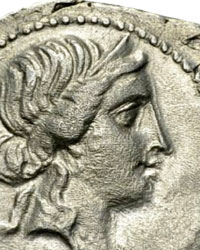
Roman Empire. Domitian (AD 81-96). Aureus AD 77-78


02
days
15
hours
03
minutes
09
seconds
Current bid
€ 2,675
Reserve price not met

Expert
Selected by Carmen Vera Gutiérrez
Experienced antique appraiser specialising in Spanish coins with deep knowledge of ancient currency.
Estimate € 5,000 - € 6,100
 | €2,675 | |
|---|---|---|
 | €2,475 | |
| €2,275 | |
Catawiki Buyer Protection
Your payment’s safe with us until you receive your object.View details
Trustpilot 4.4 | 142038 reviews
Rated Excellent on Trustpilot.
Roman Empire aureus of Domitian as Caesar, struck in Rome in AD 77–78, AV gold, 7.16 g, 19 mm in diameter, ungraded.
AI-assisted summary
Description from the seller
RARE
Domitian, as Caesar,
AV Aureus. Rome, AD 77-78.
OBV: CAESAR AVG F DOMITIANVS, laureate head to right
Rev: Parthian captive kneeling to right, offering up standard with vexillum; COS V in exergue.
RIC II.1 959 (Vespasian); C. 48; BMCRE 231 (Vespasian); Calicó 819
7,16g 19mm
Beautiful ancient patina. RARE
*Shipping only into EU
As part of a policy to promote the new Flavian dynasty, Vespasian gave a greater share of coin obverses to his sons than any of his predecessors had given to their family members before him. In this way he could promote notions of dynastic longevity and seamless succession after his passing. As seen here on this coin minted under Vespasian, his son Domitian represents the imperial family. This was during a time when Domitian's role in the Flavian dynasty was to a large extent ceremonial; he held only honorary titles including Caesar and Princeps Iuventutis as well as several priesthoods: augur, pontifex, frater arvalis, magister frater arvalium, and sacerdos collegiorum omnium, but not yet any office with imperium.
Not only did Vespasian look to the future to strengthen his dynasty, but he also turned to the past in the hope of aligning his rule with other highly regarded emperors. This is evidenced by the reverse of this coin, part of a new series that used antiquarian designs. In this case a kneeling Parthian man offering up a standard is depicted, recalling a famous type minted by the moneyers Turpilianus, Florus, and Durmius c. 19/18 BC under Augustus, to commemorate the return of the Parthian standards. Furthermore, Mattingly suggests that there is a definite topical reference in the choice to re-use this particular type: the Parthians had again been pressuring Rome for help against the Alani (Harold Mattingly, 1966, Coins of the Roman Empire in the British Museum Volume II).
RARE
Domitian, as Caesar,
AV Aureus. Rome, AD 77-78.
OBV: CAESAR AVG F DOMITIANVS, laureate head to right
Rev: Parthian captive kneeling to right, offering up standard with vexillum; COS V in exergue.
RIC II.1 959 (Vespasian); C. 48; BMCRE 231 (Vespasian); Calicó 819
7,16g 19mm
Beautiful ancient patina. RARE
*Shipping only into EU
As part of a policy to promote the new Flavian dynasty, Vespasian gave a greater share of coin obverses to his sons than any of his predecessors had given to their family members before him. In this way he could promote notions of dynastic longevity and seamless succession after his passing. As seen here on this coin minted under Vespasian, his son Domitian represents the imperial family. This was during a time when Domitian's role in the Flavian dynasty was to a large extent ceremonial; he held only honorary titles including Caesar and Princeps Iuventutis as well as several priesthoods: augur, pontifex, frater arvalis, magister frater arvalium, and sacerdos collegiorum omnium, but not yet any office with imperium.
Not only did Vespasian look to the future to strengthen his dynasty, but he also turned to the past in the hope of aligning his rule with other highly regarded emperors. This is evidenced by the reverse of this coin, part of a new series that used antiquarian designs. In this case a kneeling Parthian man offering up a standard is depicted, recalling a famous type minted by the moneyers Turpilianus, Florus, and Durmius c. 19/18 BC under Augustus, to commemorate the return of the Parthian standards. Furthermore, Mattingly suggests that there is a definite topical reference in the choice to re-use this particular type: the Parthians had again been pressuring Rome for help against the Alani (Harold Mattingly, 1966, Coins of the Roman Empire in the British Museum Volume II).
Details
Era
Before 1400
Culture/region
Roman Empire
Year/period and variation
AD 77-78
Ruler
Domitian (AD 81-96)
Denomination
Aureus
Metal
AV
Condition
Ungraded
Weight
7.16 g
Number of objects
1