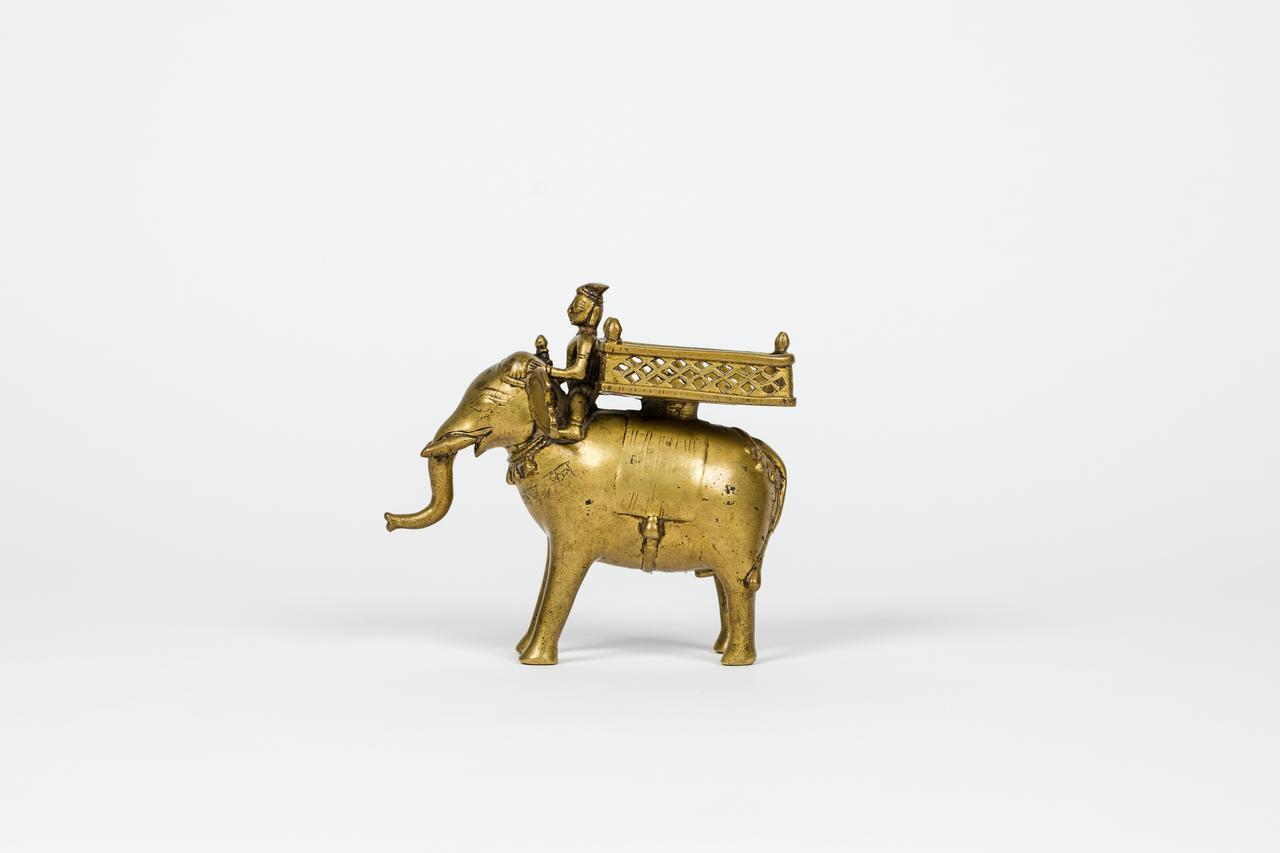
Statue, Krishna Venugopala - Orissa - 13 cm - Bronze


05
days
05
hours
42
minutes
54
seconds
Current bid
€ 111
Reserve price not met

Expert
Selected by Sarah Le Helley
Studied Asian art and art market management; researched art in Taipei; worked in auctions.
Estimate € 450 - € 500
 | €111 | |
|---|---|---|
 | €1 |
Catawiki Buyer Protection
Your payment’s safe with us until you receive your object.View details
Trustpilot 4.4 | 141835 reviews
Rated Excellent on Trustpilot.
Krishna Venugopala - Orissa, a 17th‑century bronze statue from India, H 13 cm × W 6 cm × D 7 cm, provenance Galerie/Antiquaire, in good condition and unsigned.
AI-assisted summary
Description from the seller
Krishna Venugopala
Orissa, eastern India, 17th century
Bronze
H. 13 × L. 6 × W. 7 cm
Bronze statuette depicting Krishna in the form of Venugopala, 'the flute-playing cowherd', one of the most popular manifestations of the deity in the Vaishnava tradition.
The deity is shown standing in a dancing, highly rhythmic pose, the body animated by a succession of bends that give the silhouette remarkable liveliness. One leg bears most of the weight while the other, bent and drawn back, accentuates the movement. Both arms are raised in front of the torso, the hands originally arranged to evoke the characteristic gesture of Krishna playing the flute (venu), the attribute that defines him.
The face, full and serene, presents stylized features with elongated eyes, a straight nose and a slightly smiling mouth. The ears are prominent and the skull is crowned with a topknot gathered into a bun, topped by a globular element. The relatively stripped-down treatment of the anatomy contrasts with the richness of the bronze surface, deeply marked by casting irregularities, wear, and traces of patina.
Krishna wears a short garment tied around the hips, whose folds and central knot accompany the movement of the legs. The figure rests on a small circular base carried by an outward-sloping pedestal decorated with radiating lotus petals, edged with a frieze of pearls or rounded petals. This stepped construction, both architectural and floral, places the deity in a ritual space.
The reverse, fully worked, confirms the artwork’s design as a sculpture meant to be viewed in the round. The surface retains an old brown-gold patina, punctuated by darker areas, oxidation, and substantial signs of wear. The underside of the plinth, left raw and irregular, also bears deposits and ancient corrosion products.
Through its robust modeling, spontaneous expression, and the dynamic stylization of the posture, this small devotional image belongs to the tradition of ritual bronzes from Orissa (present-day Odisha). Its small size suggests use in private devotion or a domestic shrine, where the image could be handled and offered with ritual offerings; some of the visible wear today may correspond to such uses.
Conservation status: significant surface wear and abrasions, local losses of patina and apparent gilding, oxidations and ancient deposits. Flute absent. Small gaps inherent to the casting and the object's age. Beautiful patina of use.
Provenance: Kanaka The Collection, Portugal
Shipped with UPS and insured.
Seller's Story
Kanaka The Collection is a Portugal-based web gallery specialising in Asian art, with a particular focus on the arts of Southeast Asia.
With over 20 years of experience and passion for Asian art, we offer a carefully curated selection of sculptures, ceramics and works of art from across Asia, chosen for their artistic quality, authenticity and historical interest.
Every piece is professionally packed, and we ship worldwide to collectors and institutions.
We remain personally available to collectors before and after each acquisition.
Translated by Google TranslateKrishna Venugopala
Orissa, eastern India, 17th century
Bronze
H. 13 × L. 6 × W. 7 cm
Bronze statuette depicting Krishna in the form of Venugopala, 'the flute-playing cowherd', one of the most popular manifestations of the deity in the Vaishnava tradition.
The deity is shown standing in a dancing, highly rhythmic pose, the body animated by a succession of bends that give the silhouette remarkable liveliness. One leg bears most of the weight while the other, bent and drawn back, accentuates the movement. Both arms are raised in front of the torso, the hands originally arranged to evoke the characteristic gesture of Krishna playing the flute (venu), the attribute that defines him.
The face, full and serene, presents stylized features with elongated eyes, a straight nose and a slightly smiling mouth. The ears are prominent and the skull is crowned with a topknot gathered into a bun, topped by a globular element. The relatively stripped-down treatment of the anatomy contrasts with the richness of the bronze surface, deeply marked by casting irregularities, wear, and traces of patina.
Krishna wears a short garment tied around the hips, whose folds and central knot accompany the movement of the legs. The figure rests on a small circular base carried by an outward-sloping pedestal decorated with radiating lotus petals, edged with a frieze of pearls or rounded petals. This stepped construction, both architectural and floral, places the deity in a ritual space.
The reverse, fully worked, confirms the artwork’s design as a sculpture meant to be viewed in the round. The surface retains an old brown-gold patina, punctuated by darker areas, oxidation, and substantial signs of wear. The underside of the plinth, left raw and irregular, also bears deposits and ancient corrosion products.
Through its robust modeling, spontaneous expression, and the dynamic stylization of the posture, this small devotional image belongs to the tradition of ritual bronzes from Orissa (present-day Odisha). Its small size suggests use in private devotion or a domestic shrine, where the image could be handled and offered with ritual offerings; some of the visible wear today may correspond to such uses.
Conservation status: significant surface wear and abrasions, local losses of patina and apparent gilding, oxidations and ancient deposits. Flute absent. Small gaps inherent to the casting and the object's age. Beautiful patina of use.
Provenance: Kanaka The Collection, Portugal
Shipped with UPS and insured.
Seller's Story
Kanaka The Collection is a Portugal-based web gallery specialising in Asian art, with a particular focus on the arts of Southeast Asia.
With over 20 years of experience and passion for Asian art, we offer a carefully curated selection of sculptures, ceramics and works of art from across Asia, chosen for their artistic quality, authenticity and historical interest.
Every piece is professionally packed, and we ship worldwide to collectors and institutions.
We remain personally available to collectors before and after each acquisition.
Translated by Google TranslateDetails
Era
1400-1900
Over 200 years old
Yes
Country of origin
India
Material
Bronze
Title of artwork
Krishna Venugopala - Orissa
Dynastic style/period
17th century - Orissa
Signature
Not signed
Provenance
Gallery / Antique dealer
Condition
Good condition
Sold with stand
No
Height
13 cm
Width
6 cm
Depth
7 cm
Sold by