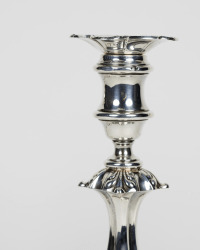
Georg Roth e Co - Platter - .925 silver - 1902


03
days
10
hours
17
minutes
01
second
Current bid
€ 60
Reserve price not met

Expert
Selected by Inés Fernández
Specialised in Spanish and Portuguese silver with over 10 years in galleries and auctions.
Estimate € 650 - € 750
 | €60 | |
|---|---|---|
| €55 | |
| €50 | |
Catawiki Buyer Protection
Your payment’s safe with us until you receive your object.View details
Trustpilot 4.4 | 141835 reviews
Rated Excellent on Trustpilot.
Description from the seller
Rare and highly sought-after antique replica in 925 silver - 321 g, 21.8 cm.
This splendid antique piece is a circular plate in solid 925 silver, repoussé and chiseled, made in the very early years of the 20th century in a Neoclassical and Historicist style.
The Front (Preston) Design of the plate develops from the center toward the edge through three main sections: at the center of the mirror (the flat bottom) is engraved a large and refined monogram of intertwined initials in cursive English style. The letters, rich in swirls and knots of love, represent the initials of the newborn or godchild who received the plate as a baptism or birthday gift in 1902.
The Decorated Rim (The Wide Border): This is the richest and most theatrical part of the plate. It features a symmetrical decoration composed of 8 oval cameos, interspersed with elegant garlands of leaves and embossed ribbons.
The Portraits in the Medallions: Inside each medallion is depicted the profile (alternating right and left) of historical figures in 18th-century attire and coiffures. One recognizes curled wigs typical of the era of Louis XIV or Louis XV, which give the plate a noble and evocative air of European classicism.
The Outer Border: The plate is finished along the entire circumference with a cross-hatched beading (godronage) motif that simulates a ribbon wrapped around a staff, a detail typical of high-quality silverware that provides visual stability and elegance to the structure.
The back of the plate, with a smoother satin finish, houses the authentic historical identity card of the object. At the top there is an inscription from the period in a beautiful cursive script, incised by hand, reading: "From his Godfather / Jonathan Bulkley / Oct. 5, 1902" (From his Godfather, Jonathan Bulkley, October 5, 1902).
("Jonathan Bulkley" 1902) (1857–1939) was a famous and extremely wealthy magnate of the New York paper industry. He owned a renowned residence on Park Avenue in Manhattan (today the premises of the Swedish Consulate) and a historic estate in Ridgefield. In 1902 Bulkley purchased this plate to give to his godchild on the occasion of a baptism or a significant anniversary.
Breathers of the Manufacture: Just a little below the center, impressed into the metal, are the four small symbols (the fake marks of the German company Georg Roth & Co. of Hanau, Germany, famous in the late 19th century precisely for producing high-quality historical replicas in Baroque and Rococo style, legally marked with these "fake marks" of the era: the crowned letter "A", the crowned "P", the heraldic lily, and the shield with the company initials. You can notice some very slight handwritten inscriptions (inventory graffiti or notes by old goldsmiths regarding weight) and a beautiful natural patina that, if not over-polished, testifies to its more than 120 years of history."
Rare and highly sought-after antique replica in 925 silver - 321 g, 21.8 cm.
This splendid antique piece is a circular plate in solid 925 silver, repoussé and chiseled, made in the very early years of the 20th century in a Neoclassical and Historicist style.
The Front (Preston) Design of the plate develops from the center toward the edge through three main sections: at the center of the mirror (the flat bottom) is engraved a large and refined monogram of intertwined initials in cursive English style. The letters, rich in swirls and knots of love, represent the initials of the newborn or godchild who received the plate as a baptism or birthday gift in 1902.
The Decorated Rim (The Wide Border): This is the richest and most theatrical part of the plate. It features a symmetrical decoration composed of 8 oval cameos, interspersed with elegant garlands of leaves and embossed ribbons.
The Portraits in the Medallions: Inside each medallion is depicted the profile (alternating right and left) of historical figures in 18th-century attire and coiffures. One recognizes curled wigs typical of the era of Louis XIV or Louis XV, which give the plate a noble and evocative air of European classicism.
The Outer Border: The plate is finished along the entire circumference with a cross-hatched beading (godronage) motif that simulates a ribbon wrapped around a staff, a detail typical of high-quality silverware that provides visual stability and elegance to the structure.
The back of the plate, with a smoother satin finish, houses the authentic historical identity card of the object. At the top there is an inscription from the period in a beautiful cursive script, incised by hand, reading: "From his Godfather / Jonathan Bulkley / Oct. 5, 1902" (From his Godfather, Jonathan Bulkley, October 5, 1902).
("Jonathan Bulkley" 1902) (1857–1939) was a famous and extremely wealthy magnate of the New York paper industry. He owned a renowned residence on Park Avenue in Manhattan (today the premises of the Swedish Consulate) and a historic estate in Ridgefield. In 1902 Bulkley purchased this plate to give to his godchild on the occasion of a baptism or a significant anniversary.
Breathers of the Manufacture: Just a little below the center, impressed into the metal, are the four small symbols (the fake marks of the German company Georg Roth & Co. of Hanau, Germany, famous in the late 19th century precisely for producing high-quality historical replicas in Baroque and Rococo style, legally marked with these "fake marks" of the era: the crowned letter "A", the crowned "P", the heraldic lily, and the shield with the company initials. You can notice some very slight handwritten inscriptions (inventory graffiti or notes by old goldsmiths regarding weight) and a beautiful natural patina that, if not over-polished, testifies to its more than 120 years of history."
Details
Era
1900-2000
Style subtype
Louis XV
Gross weight
321 g
Silver type
.925 silver
Title additional information
1902
Number of objects
1
Material
Silver
Designer/artist/maker
Georg Roth e Co
Country of origin
Germany
Style
Antique
Condition
Excellent condition: barely used with minimal signs of wear
Height
1.8 cm
Width
21.8 cm
Depth
1.5 cm
Estimated period
1900-1910
Sold by