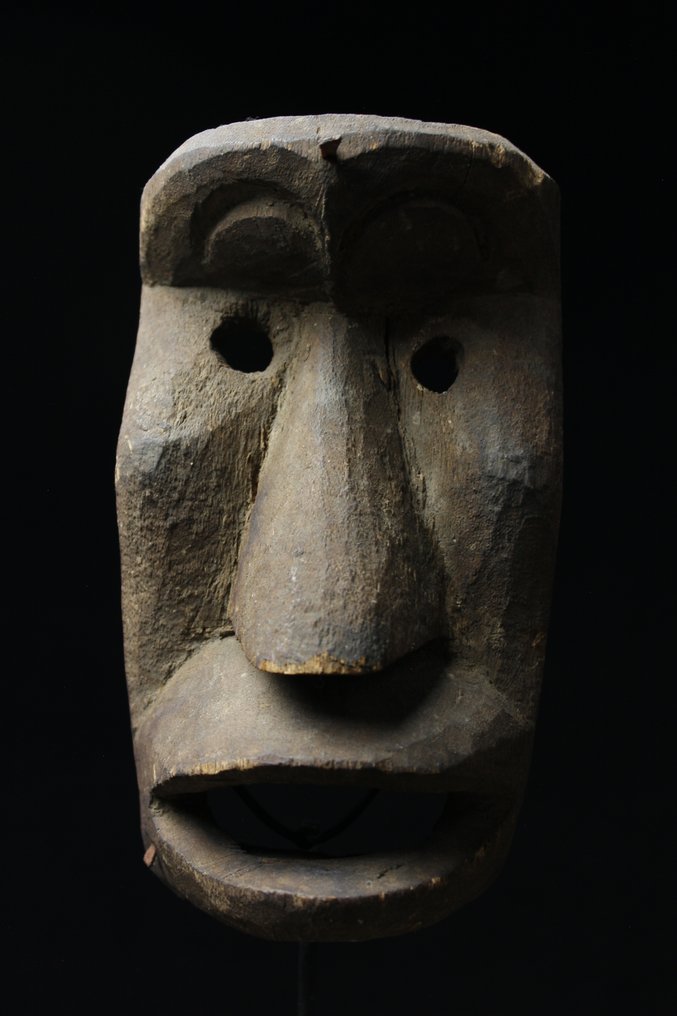
Mask - Kagle - Kran - Liberia



04
days
18
hours
42
minutes
39
seconds
Starting bid
€ 1
Reserve price not met

Expert
Selected by Julien Gauthier
A decade of experience in historical arms, armour, and African art.
Estimate € 450 - € 500
No bids placed
Catawiki Buyer Protection
Your payment’s safe with us until you receive your object.View details
Trustpilot 4.4 | 142376 reviews
Rated Excellent on Trustpilot.
Kagle mask of the Kran people from Liberia (also associated with Côte d'Ivoire), dating to the early 20th century, carved wood with iron pins, 22 cm high, 13 cm wide, 11 cm deep, 320 g; provenance Gallery / Antique dealer; authentic, original.
AI-assisted summary
Description from the seller
Kagle mask of the Kran people from Liberia or Côte d'Ivoire. Ex. Private collection, Belgium. Ex. Cooper Evans, New York. The previous owner's name is available upon request.
The number stamp on the back of the mask likely indicates that it originates from the legendary George Harley collection. The mask exhibits the distinctive characteristics of Kagle masks: a protruding, semicircular forehead, deep-set eyes, a broad, prominent nose positioned between protruding triangular cheeks, and the signature wide, protruding, open chimpanzee snout. Crafted from light wood and dyed brown, the mask features fastening eyelets along its outer edges for the mask costume. Two iron pins, commonly found on Kagle masks, are attached to the mask—one in the center of the forehead and another on the right side of the mouth.
Kagle masks of the Kran people, from Liberia and Côte d'Ivoire, are carved wooden masks with bold, striking features that often depict human or animal faces. These masks are used in ceremonies such as funerals, initiations, and other rites of passage. The primary purpose of Kagle masks is to represent spiritual entities or ancestors, helping to maintain order, protect the community, and guide individuals through significant life transitions. They also serve as a means of preserving cultural identity and reinforcing social values within the Kran community.
The Kran people are an ethnic group primarily found in Liberia and parts of Côte d'Ivoire. They are part of the larger Kru-speaking group and are known for their rich cultural traditions, including their intricate wood carving, particularly of masks used in rituals and ceremonies. The Kran are also recognized for their deep connection to ancestral and spiritual practices, which play a central role in their social structure. Additionally, they are skilled farmers and hunters, with a history of resistance to colonial influence, valuing their autonomy and cultural preservation.
Seller's Story
At Tribal Art Finland, we are dedicated to providing our customers with authentic and high-quality African tribal art at reasonable prices. Ensuring the authenticity of our products is our highest priority, and we source our artworks from trusted collectors of African art.
What is Authentic African Art?
In the traditional framework embraced by collectors and dealers, authentic African art—such as a mask—is typically defined as an object that has been used in cultural practices, such as dance or shrine decoration. This traditional use is often understood as ritual use, indicating a role in religious or magical ceremonies. Additionally, decorated furniture or household items, crafted with cultural significance and artistic skill, are also considered authentic forms of African art.
Kagle mask of the Kran people from Liberia or Côte d'Ivoire. Ex. Private collection, Belgium. Ex. Cooper Evans, New York. The previous owner's name is available upon request.
The number stamp on the back of the mask likely indicates that it originates from the legendary George Harley collection. The mask exhibits the distinctive characteristics of Kagle masks: a protruding, semicircular forehead, deep-set eyes, a broad, prominent nose positioned between protruding triangular cheeks, and the signature wide, protruding, open chimpanzee snout. Crafted from light wood and dyed brown, the mask features fastening eyelets along its outer edges for the mask costume. Two iron pins, commonly found on Kagle masks, are attached to the mask—one in the center of the forehead and another on the right side of the mouth.
Kagle masks of the Kran people, from Liberia and Côte d'Ivoire, are carved wooden masks with bold, striking features that often depict human or animal faces. These masks are used in ceremonies such as funerals, initiations, and other rites of passage. The primary purpose of Kagle masks is to represent spiritual entities or ancestors, helping to maintain order, protect the community, and guide individuals through significant life transitions. They also serve as a means of preserving cultural identity and reinforcing social values within the Kran community.
The Kran people are an ethnic group primarily found in Liberia and parts of Côte d'Ivoire. They are part of the larger Kru-speaking group and are known for their rich cultural traditions, including their intricate wood carving, particularly of masks used in rituals and ceremonies. The Kran are also recognized for their deep connection to ancestral and spiritual practices, which play a central role in their social structure. Additionally, they are skilled farmers and hunters, with a history of resistance to colonial influence, valuing their autonomy and cultural preservation.
Seller's Story
At Tribal Art Finland, we are dedicated to providing our customers with authentic and high-quality African tribal art at reasonable prices. Ensuring the authenticity of our products is our highest priority, and we source our artworks from trusted collectors of African art.
What is Authentic African Art?
In the traditional framework embraced by collectors and dealers, authentic African art—such as a mask—is typically defined as an object that has been used in cultural practices, such as dance or shrine decoration. This traditional use is often understood as ritual use, indicating a role in religious or magical ceremonies. Additionally, decorated furniture or household items, crafted with cultural significance and artistic skill, are also considered authentic forms of African art.
Details
Indigenous object name
Kagle
Number of objects
1
Ethnic group/ culture
Kran
Country of Origin
Liberia
Period
Early 20th century
Material
Iron (cast), Wood
Sold with stand
No
Condition
Excellent condition
Title of artwork
Mask
Height
22 cm
Width
13 cm
Depth
11 cm
Weight
320 g
Provenance
Gallery / Antique dealer
Authenticity
Original/official
Sold by
