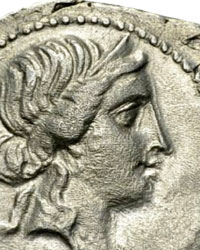
Roman Republic. Julius Caesar. Sestertius Southern Italy


07
days
00
hours
27
minutes
00
seconds
Current bid
€ 750
Reserve price not met

Expert
Selected by Carmen Vera Gutiérrez
Experienced antique appraiser specialising in Spanish coins with deep knowledge of ancient currency.
Estimate € 1,700 - € 1,900
 | €750 | |
|---|---|---|
| €1 |
Catawiki Buyer Protection
Your payment’s safe with us until you receive your object.View details
Trustpilot 4.4 | 141835 reviews
Rated Excellent on Trustpilot.
Ungraded Æ sestertius from the Roman Republic issued in Southern Italy, with obverse CAESAR DIVI F and a bust of Augustus and reverse DIVOS IVLIVS with a graduated bust of Julius Caesar, weight 21.88 g, RPC I: 620; Crawford 535/1.
AI-assisted summary
Description from the seller
JULIUS CAESAR
sestercio. Around the year 38 a. C., Czech of southern Italy.
Obverse: CAESAR DIVI F, bust of Augustus pointing back. Reverse: DIVOS IVLIVS, graduated bust of Julius Caesar pointing back. 21.88 g. RPC I: 620; Crawford: 535/1.
Smooth and Tooled
Gaius Octavius was the great-nephew of Julius Caesar on his mother's side. He first caught Caesar's attention when he joined him for the campaign against the Pompeians in Hispania in 46 BC—having made a daring journey through hostile territory—though political opponents insinuated that he had curried favor with his great-uncle by other means. In any event, Caesar named Octavius his principal heir in his will, and upon Caesar's assassination in 44 BC, the young man officially became his adopted son, taking the name Gaius Julius Caesar Octavianus.
Seller's Story
Please remember. We do not ship outside the European Union. Nor to Norway, the United Kingdom, Switzerland and the Canary Islands, due to the difficulties that customs pose in releasing shipments.
Due to restrictions and the imposition of duties we cannot guarantee shipments to other countries outside the EU. We only ship to Europe with the exception of Norway, United Kingdom, Switzerland and the Canary Islands .. Please read our terms before bidding since in case of adjudication your purchase would be canceled.
Translated by Google TranslateJULIUS CAESAR
sestercio. Around the year 38 a. C., Czech of southern Italy.
Obverse: CAESAR DIVI F, bust of Augustus pointing back. Reverse: DIVOS IVLIVS, graduated bust of Julius Caesar pointing back. 21.88 g. RPC I: 620; Crawford: 535/1.
Smooth and Tooled
Gaius Octavius was the great-nephew of Julius Caesar on his mother's side. He first caught Caesar's attention when he joined him for the campaign against the Pompeians in Hispania in 46 BC—having made a daring journey through hostile territory—though political opponents insinuated that he had curried favor with his great-uncle by other means. In any event, Caesar named Octavius his principal heir in his will, and upon Caesar's assassination in 44 BC, the young man officially became his adopted son, taking the name Gaius Julius Caesar Octavianus.
Seller's Story
Please remember. We do not ship outside the European Union. Nor to Norway, the United Kingdom, Switzerland and the Canary Islands, due to the difficulties that customs pose in releasing shipments.
Due to restrictions and the imposition of duties we cannot guarantee shipments to other countries outside the EU. We only ship to Europe with the exception of Norway, United Kingdom, Switzerland and the Canary Islands .. Please read our terms before bidding since in case of adjudication your purchase would be canceled.
Translated by Google TranslateDetails
Era
Before 1400
Culture/region
Roman Republic
Year/period and variation
Southern Italy
Ruler
Julius Caesar
Denomination
Sestertius
Metal
Æ
Condition
Ungraded
Sold by