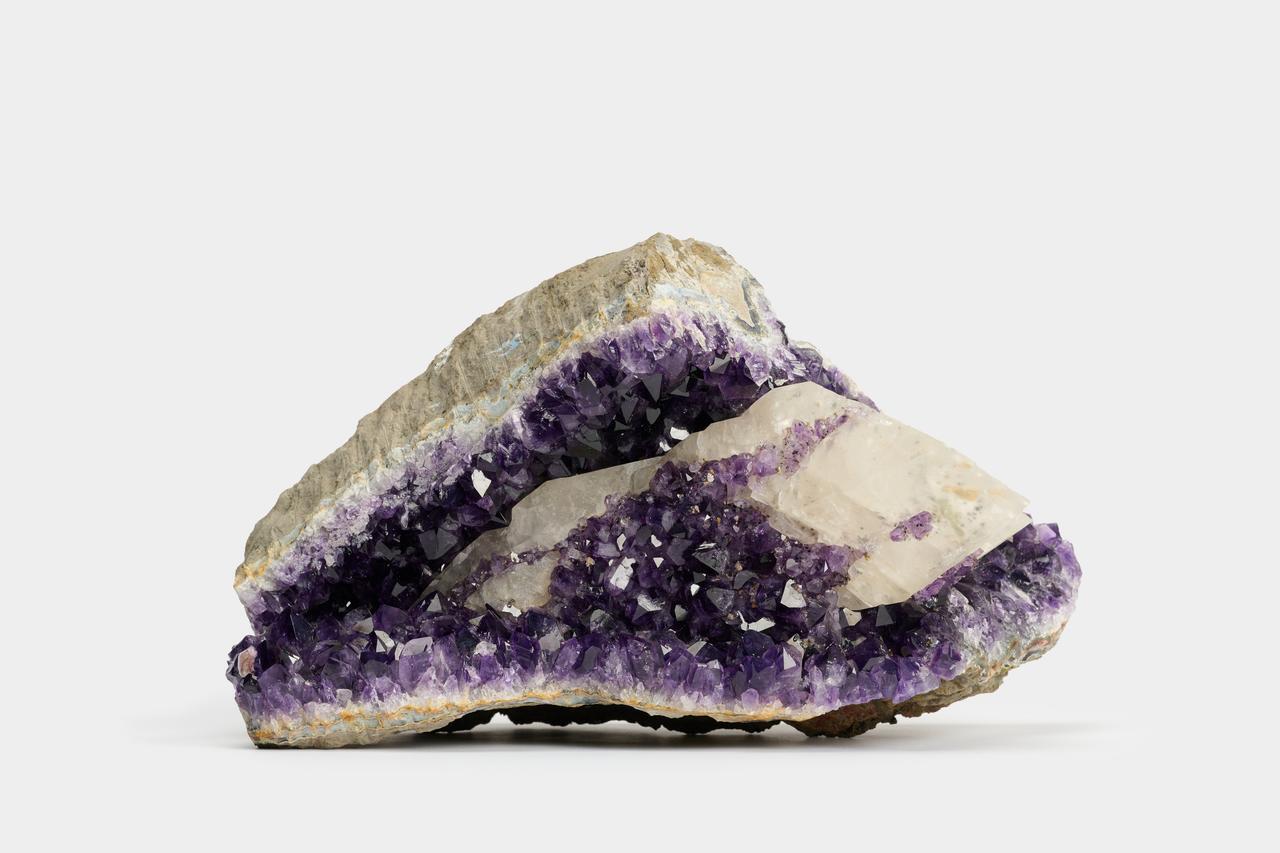
White Calcite Cluster with a Striking Natural Geometric Window - Sparkling Crystals Forming a Unique Druse Formation - Height: 141 mm - Width: 56 mm- 234 g - (1)


04
days
06
hours
02
minutes
02
seconds
Starting bid
€ 1
Reserve price not met

Expert
Selected by Georgia Foteinou
Holds BSc in geology and post-graduate qualifications in geochemistry.
Estimate € 150 - € 200
No bids placed
Catawiki Buyer Protection
Your payment’s safe with us until you receive your object.View details
Trustpilot 4.4 | 142876 reviews
Rated Excellent on Trustpilot.
White Calcite Cluster with a Striking Natural Geometric Window, a sparking crystals druse from Brazil, weighing 234 g and measuring 141 × 56 × 40 mm, mounted on a black metal base.
AI-assisted summary
Description from the seller
Calcite Druze with Crystal Formation — We present an intriguing Calcite druze from Brazil, a specimen that combines the classic crystal beauty of the mineral with a morphology entirely singular. Mounted on an elegant black metal base, the piece immediately stands out for the presence of a natural “window,” a cavity with geometry almost perfect that traverses the crystal structure, making it a piece of great scientific and aesthetic interest. The specimen consists of a dense aggregate of scalenohedral Calcite crystals. Their color ranges from translucent white to nearly transparent, with a vitreous luster that catches the light, creating sparkles on the multitude of crystal faces. The surface is dotted with tiny darker mineral inclusions, which add a subtle contrast and attest to the authenticity of the natural growth process. The overall structure is compact yet dynamic, with crystals rising in a formation that recalls a spire or a miniature tower. The most exceptional element of this piece is the geometric perforation that runs through it. This cavity, polygonal in shape, is itself edged by well-defined crystal faces, as if nature had framed the void. Inside this window, a second generation of microcrystals can be observed, characterized by a delicate orange hue. This color contrast between the white outer crystals and the warmer inner ones adds depth and another level of visual complexity, transforming the specimen into a genuine geological sculpture. Calcite, a calcium carbonate (CaCO3), is one of the most abundant minerals on Earth, known for its incredible variety of forms. Druses like this typically form inside cavities or geodes in rock, where hydrothermal fluids rich in dissolved minerals crystallize slowly over time. The singular “window” could be the result of a complex growth and selective dissolution process, perhaps the growth of Calcite around another crystal (an epimorph) that was subsequently dissolved, leaving this extraordinary hollow imprint. This specimen is not only a beautiful mineral, but also a piece for conversation and a natural curiosity. Its presentation on a base makes it immediately ready for display, perfect for enriching a mineralogical collection, a professional study, or a modern Cabinet of Curiosities. Its unusual shape and the geological narrative it carries make it a subject of great fascination, capable of uniting scientific rigor with pure aesthetic pleasure. It is a perfect example of how natural processes can create forms of almost architectural beauty.
Seller's Story
The Mineral Art Gallery offers minerals, fossils, shells and natural elements.
Born in Italy in 2017, today she collaborates with international galleries and collectors, she is a direct importer of large minerals and naturalistic collectible elements; deals with the processing to insert them inside the living space. A section of the gallery was dedicated to the Wunderkammer, "chamber of wonders or cabinet of curiosities" in which Mirabilia elements are presented: naturalia and italiania, a union between "the present is the past".
All lots are shipped via DHL Express and Fercam couriers, with insured parcel and tracking.
Translated by Google TranslateCalcite Druze with Crystal Formation — We present an intriguing Calcite druze from Brazil, a specimen that combines the classic crystal beauty of the mineral with a morphology entirely singular. Mounted on an elegant black metal base, the piece immediately stands out for the presence of a natural “window,” a cavity with geometry almost perfect that traverses the crystal structure, making it a piece of great scientific and aesthetic interest. The specimen consists of a dense aggregate of scalenohedral Calcite crystals. Their color ranges from translucent white to nearly transparent, with a vitreous luster that catches the light, creating sparkles on the multitude of crystal faces. The surface is dotted with tiny darker mineral inclusions, which add a subtle contrast and attest to the authenticity of the natural growth process. The overall structure is compact yet dynamic, with crystals rising in a formation that recalls a spire or a miniature tower. The most exceptional element of this piece is the geometric perforation that runs through it. This cavity, polygonal in shape, is itself edged by well-defined crystal faces, as if nature had framed the void. Inside this window, a second generation of microcrystals can be observed, characterized by a delicate orange hue. This color contrast between the white outer crystals and the warmer inner ones adds depth and another level of visual complexity, transforming the specimen into a genuine geological sculpture. Calcite, a calcium carbonate (CaCO3), is one of the most abundant minerals on Earth, known for its incredible variety of forms. Druses like this typically form inside cavities or geodes in rock, where hydrothermal fluids rich in dissolved minerals crystallize slowly over time. The singular “window” could be the result of a complex growth and selective dissolution process, perhaps the growth of Calcite around another crystal (an epimorph) that was subsequently dissolved, leaving this extraordinary hollow imprint. This specimen is not only a beautiful mineral, but also a piece for conversation and a natural curiosity. Its presentation on a base makes it immediately ready for display, perfect for enriching a mineralogical collection, a professional study, or a modern Cabinet of Curiosities. Its unusual shape and the geological narrative it carries make it a subject of great fascination, capable of uniting scientific rigor with pure aesthetic pleasure. It is a perfect example of how natural processes can create forms of almost architectural beauty.
Seller's Story
The Mineral Art Gallery offers minerals, fossils, shells and natural elements.
Born in Italy in 2017, today she collaborates with international galleries and collectors, she is a direct importer of large minerals and naturalistic collectible elements; deals with the processing to insert them inside the living space. A section of the gallery was dedicated to the Wunderkammer, "chamber of wonders or cabinet of curiosities" in which Mirabilia elements are presented: naturalia and italiania, a union between "the present is the past".
All lots are shipped via DHL Express and Fercam couriers, with insured parcel and tracking.
Translated by Google TranslateDetails
Number of objects
1
Main mineral
White Calcite Cluster with a Striking Natural Geometric Window -
Mineral form
Sparkling Crystals Forming a Unique Druse Formation
Supplement
Rare Brazilian Calcite 'Window' Specimen
Weight
234 g
Country of origin
Brazil
Height
141 mm
Width
56 mm
Depth
40 mm
Sold by