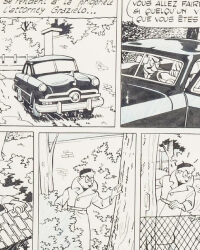
BARBE (ANDRÉ BARBE, DIT) - 1 Original page - EROTIQUE - - - 1998


05
days
12
hours
38
minutes
12
seconds

 | €3 | |
|---|---|---|
 | €1 |
Catawiki Buyer Protection
Your payment’s safe with us until you receive your object.View details
Trustpilot 4.4 | 142358 reviews
Rated Excellent on Trustpilot.
Description from the seller
ANDRÉ BARBE, known as Barbe
(1936-2014)
Humor, erotica and comic book artist
Member of Les Humoristes Associés
Worked for “Le Rire”, “Pilote”, “Hara Kiri”, Charlie Hebdo
Illustrator of numerous works including the “Cantique des Cantiques” (Ed. La Musardine), “Don Juan, Mozart, Da Ponte, full text of the opera” (Ed. La Découverte)
This rhodoid is a unique piece. It consists of 6 strips of rhodoid glued onto a sheet of the same material in view of the definitive insolation (see below the technical aspect). Suggestion: before framing, one can detach these strips and glue them onto a glass plate and place the whole on a colored background for a beautiful decorative effect (see photo example).
The rhodoid will be carefully packaged.
In offset printing, the rhodoid (or transparent acetate/polyester film) historically referred to the transparent sheet that served as an intermediate support for transferring the image before the final engraving of the printing plates.
In the jargon of printers from the era of traditional prepress (before digital), people often spoke of the “film” or the rhodoid.
Here are its two major historical and technical functions:
1. Mounting and insolation of the plates (Traditional Era)
Before the arrival of today’s digital technologies, the creation of an offset printing plate involved a step of manual assembly:
* The negative or positive film: Texts and images were first flashed onto transparent films (often mistakenly referred to as rhodoids).
* The assembly: The prepress operator mounted and taped these transparent films onto a stable transparent support (astralon) to compose the final page.
* The insolation: This transparent assembly was placed against the insolation plate (light-sensitive) in an insolation frame. Ultraviolet light passed through the transparent areas of the “rhodoïd” to fix the image onto the metal plate.
2. Color control and registration (The “Blue” or Cromalin)
Since offset printing relies on the superposition of several colors (the four-color process: Cyan, Magenta, Yellow, Black), the rhodoid played a crucial verification role:
* Each color had its own transparent film.
* By superimposing the different rhodoids one over the other through transparency, the printer could check the registration (whether elements were properly aligned) and obtain a preview of the final result before starting the machines.
What has changed today: CTP (Computer to Plate)
Today, the use of rhodoid in offset printing has almost entirely disappeared in favor of CTP technology (Computer to Plate).
ANDRÉ BARBE, known as Barbe
(1936-2014)
Humor, erotica and comic book artist
Member of Les Humoristes Associés
Worked for “Le Rire”, “Pilote”, “Hara Kiri”, Charlie Hebdo
Illustrator of numerous works including the “Cantique des Cantiques” (Ed. La Musardine), “Don Juan, Mozart, Da Ponte, full text of the opera” (Ed. La Découverte)
This rhodoid is a unique piece. It consists of 6 strips of rhodoid glued onto a sheet of the same material in view of the definitive insolation (see below the technical aspect). Suggestion: before framing, one can detach these strips and glue them onto a glass plate and place the whole on a colored background for a beautiful decorative effect (see photo example).
The rhodoid will be carefully packaged.
In offset printing, the rhodoid (or transparent acetate/polyester film) historically referred to the transparent sheet that served as an intermediate support for transferring the image before the final engraving of the printing plates.
In the jargon of printers from the era of traditional prepress (before digital), people often spoke of the “film” or the rhodoid.
Here are its two major historical and technical functions:
1. Mounting and insolation of the plates (Traditional Era)
Before the arrival of today’s digital technologies, the creation of an offset printing plate involved a step of manual assembly:
* The negative or positive film: Texts and images were first flashed onto transparent films (often mistakenly referred to as rhodoids).
* The assembly: The prepress operator mounted and taped these transparent films onto a stable transparent support (astralon) to compose the final page.
* The insolation: This transparent assembly was placed against the insolation plate (light-sensitive) in an insolation frame. Ultraviolet light passed through the transparent areas of the “rhodoïd” to fix the image onto the metal plate.
2. Color control and registration (The “Blue” or Cromalin)
Since offset printing relies on the superposition of several colors (the four-color process: Cyan, Magenta, Yellow, Black), the rhodoid played a crucial verification role:
* Each color had its own transparent film.
* By superimposing the different rhodoids one over the other through transparency, the printer could check the registration (whether elements were properly aligned) and obtain a preview of the final result before starting the machines.
What has changed today: CTP (Computer to Plate)
Today, the use of rhodoid in offset printing has almost entirely disappeared in favor of CTP technology (Computer to Plate).
Details
Item
Original page
Number of objects
1
Series
EROTIQUE
Condition
Good condition
Artist
BARBE (ANDRÉ BARBE, DIT)
Title of artwork
-
Year
1998
Width
60 cm
Height
40 cm
Sold by