Baoulé / Koulango / Abron / Attié? - Côte d'Ivoire

07
days
04
hours
31
minutes
05
seconds
Current bid
€ 17
Reserve price not met

Expert
Selected by Dimitri André
Holds a postgraduate degree in African studies and 15 years experience in African art.
Estimate € 3,300 - € 3,900
 | €17 | |
|---|---|---|
 | €1 |
Catawiki Buyer Protection
Your payment’s safe with us until you receive your object.View details
Trustpilot 4.4 | 142358 reviews
Rated Excellent on Trustpilot.
Description from the seller
Ivory Coast
Baoulé / Koulango / Abron / Attié?
Wood and beads
Height: 295 mm + base 10 mm
Width: 70 mm
Depth: 60 mm
Weight: 300 g
Female figure Koulango — Ivory Coast
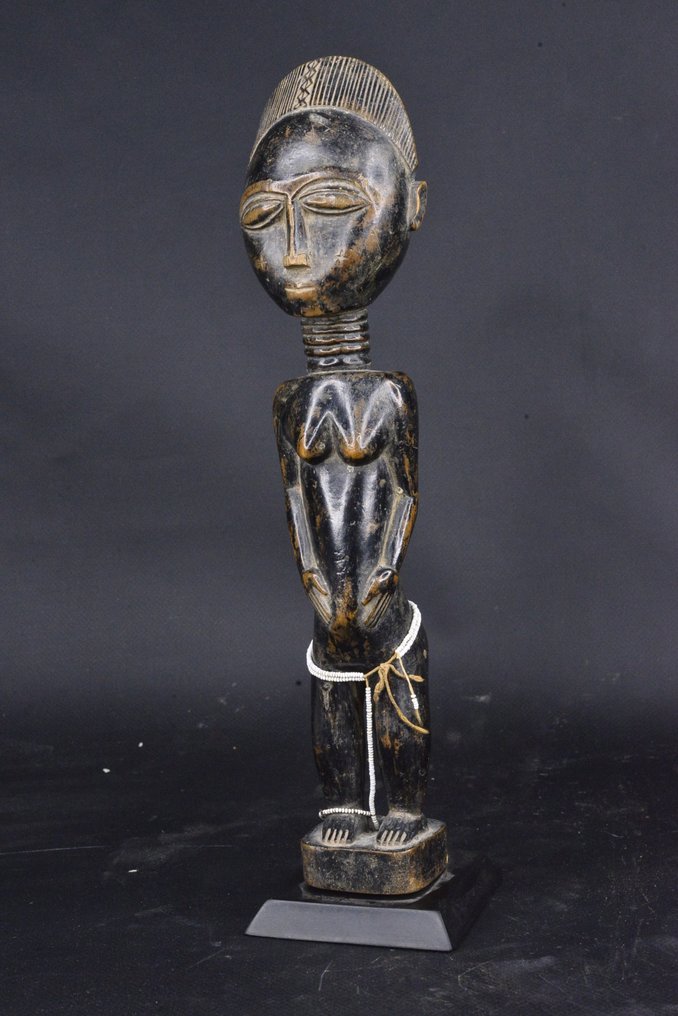
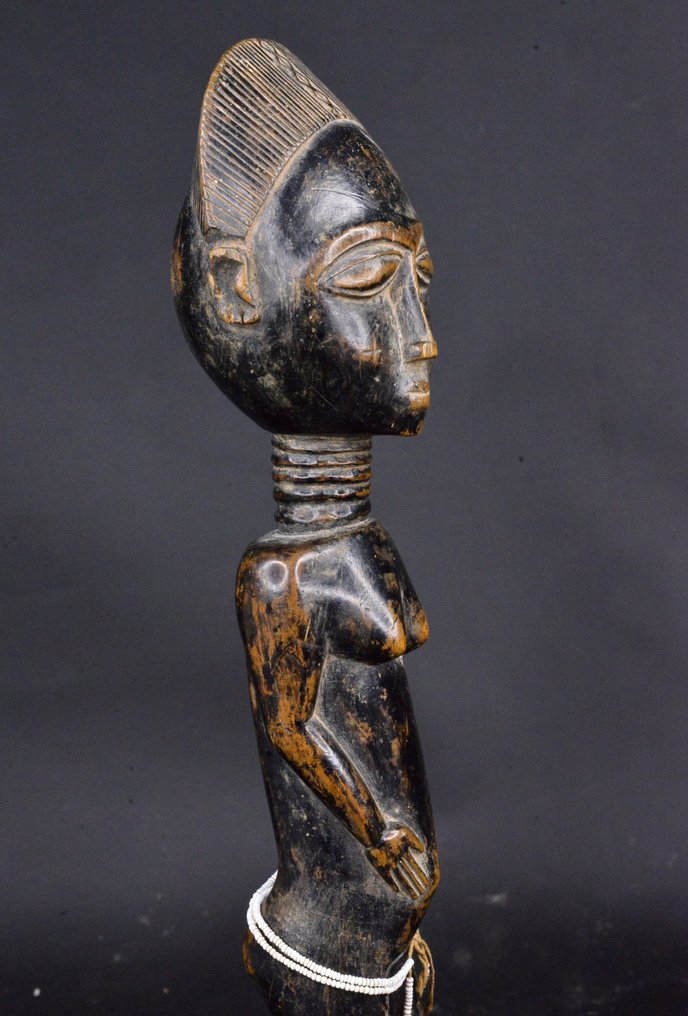
Analysis of the different views shows a standing feminine sculpture characterized by a very slender silhouette, a heavily annulated neck, an oval head, a crest-like coiffure with fine striations, and a highly geometric construction of the body.
The Koulango attribution is consistent with several works preserved at the Metropolitan Museum of Art and the Smithsonian National Museum of African Art. The Met notably preserves a Koulango female figure in wood, beads and pigment, while the Smithsonian documents several female figures attributed to the Koulango that share the same formal vocabulary.
Geographical origin
Ivory Coast — Bondoukou region
The Bondoukou region constitutes one of the main stylistic centers associated with Koulango sculpture. Smithsonian collections identify several figures of this type as coming from Ivory Coast, particularly from the Bondoukou area.
Ethnicity / culture
Koulango (Kulango)
The sculpture presents several characteristics of the so‑called “classic Koulango” corpus: dark wood, slightly puffy volumes, flattened and strongly structured face, elongated eyes, stylized limbs and a highly graphic treatment of the body. Smithsonian precisely uses these stylistic criteria to characterize a set of figures traditionally grouped under the label Koulango.
Type of object
Standing female figure in wood
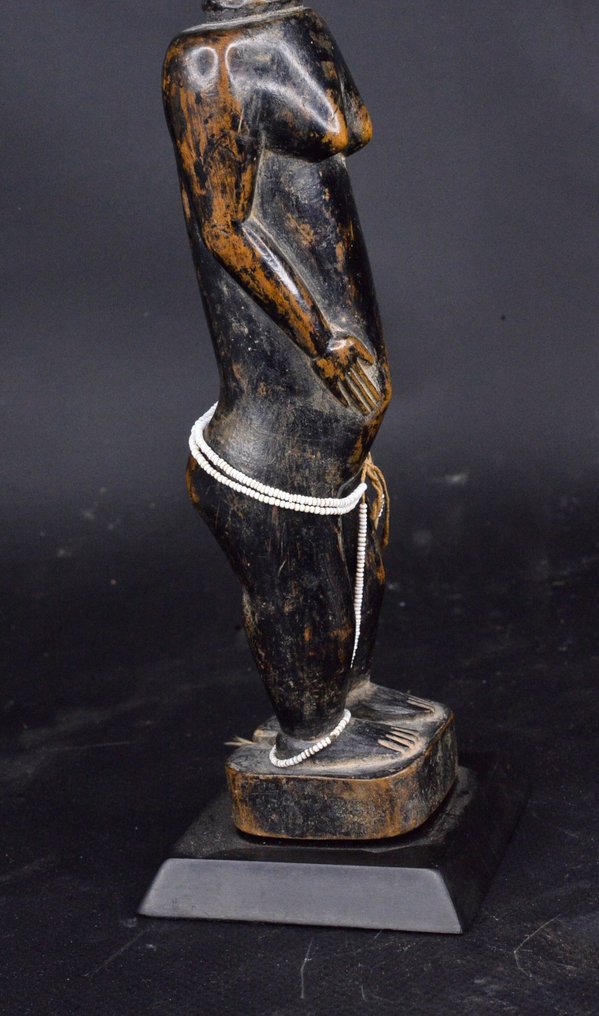
The figure is represented frontally, in a perfectly vertical posture. The hands hang down in front of the lower body, while the legs are separated and rest on a rectangular base integrated into the sculpture.
Artistical and stylistic description
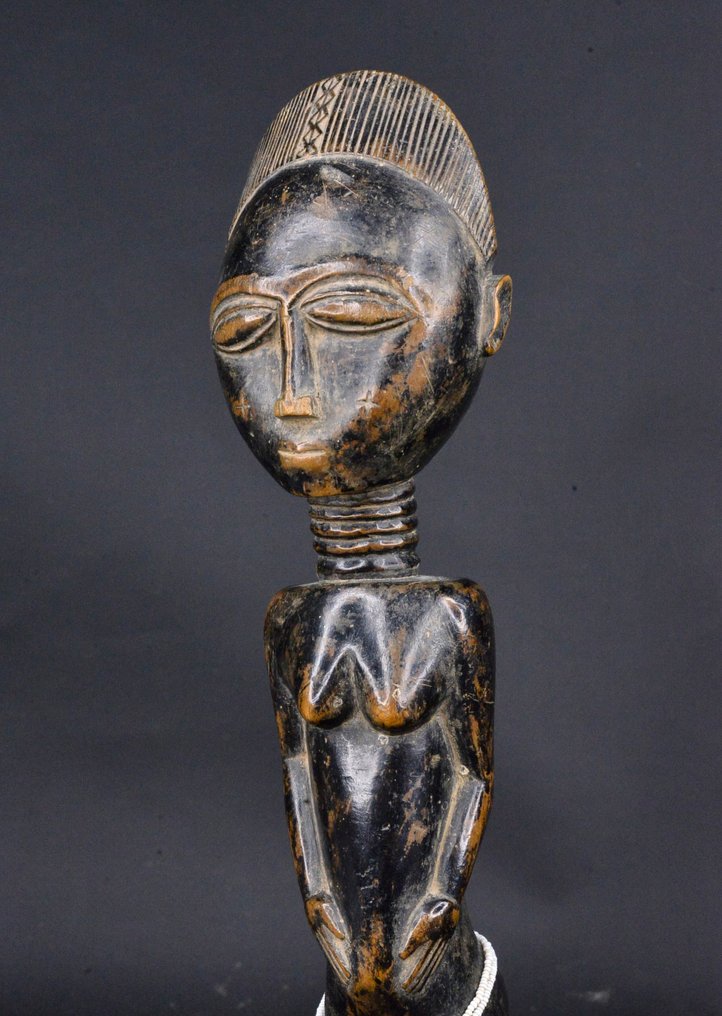
The head, oval in shape, is relatively large in relation to the body. The face features a high forehead, almond-shaped eyes that are very stretched, a straight and narrow nose, a small mouth, and ears treated in a simplified manner.
The neck is particularly remarkable: it consists of several horizontally engraved rings, forming a very graphic transition between the head and the torso.
The coiffure forms a high rounded crest, entirely covered with fine parallel striations. A central band adorned with a geometric diamond motif interrupts the regularity of the hairstyle.
The chest is long and narrow. The breasts are strongly modeled, while the arms follow the sides closely and end in stylized hands placed in front of the lower abdomen.
The treatment of the legs is also very characteristic: they are long, relatively massive in their upper part and separated down to the feet. The toes are indicated by fine incisions.
The whole is covered with a very dark patina, brown-black and shiny, with occasional warm brown nuances that accentuate the relief of the sculpture.
Materials and technique
Carved wood, pigment/patina and glass beads
The sculpture is carved in dense wood, with a very smooth finish and a heavily patinated surface. Rows of small white beads surround the waist and descend onto the front of the legs.
The presence of beads on Koulango female figures is documented in Smithsonian and Met collections.
Symbolism
The representation emphasizes several elements traditionally associated with the depiction of the female body in sculpture from this region: elaborate hairstyle, chest, waist, hips, and body adornment.
The strong stylization of the body and the emphasis given to the hairstyle and ornaments contribute to a codified conception of body beauty.
Function / ritual use
Koulango anthropomorphic figures from the Bondoukou region are often associated in Western collections with religious practices and cult spaces.
However, the Smithsonian notes that the precise function of many figures in this corpus remains difficult to establish due to a lack of historical documentation on their context of use. It is therefore preferable to identify here as a Koulango female figure without attributing a specific undocumented ritual function.
Cultural context
The Bondoukou region is an important cultural crossroads where Koulango, Abron, Baoulé, Senufo and Lobi traditions meet. Museums emphasize that this proximity explains some stylistic similarities between sculptures of different groups.
Nevertheless, the corpus identified as “classic Koulango” has a plastic vocabulary sufficiently characteristic to constitute a recognized category in museum collections.
Comparisons with museum pieces and documented collections
The Metropolitan Museum of Art houses a Koulango female figure in wood, beads and pigment, 42.2 cm tall, whose overall treatment provides a direct comparison with this sculpture.
The Smithsonian National Museum of African Art also houses a 36.3 cm Koulango female figure with an elaborately worked coiffure, a flattened face, elongated eyes and glass beads around the waist.
Another figure at the Smithsonian, from the Bondoukou region, features a particularly elongated tubular neck and a striped coiffure with a central crest, two elements very close to the formal vocabulary observed here.
Finally, a Koulango figure sold at Lyon Enchères was adjudicated at €3,400, for a height of 37 cm, confirming the presence of this type of sculpture on the specialized market.
Bibliography / sources
• Metropolitan Museum of Art, Female Figure, Kulango artist, inv. 1982.494.
• Smithsonian National Museum of African Art, Female Figure, Kulango artist, inv. nmafa_2016-14-2.
• Smithsonian National Museum of African Art, Female Figure, Bondoukou region, inv. nmafa_85-8-5.
• Smithsonian Institution, Female Figure, Abron/Bono/Kulango, inv. nmafa_69-6-7.
• Lyon Enchères, Ancient Koulango statuette, lot 290.
Provenance: old colonial collection
Galerie Renaud Vanuxem Paris
personal collection
Delivered with the authenticity certificate from Galerie Vanuxem Paris
Objects are shipped with insurance and tracking number.
Fast and protected shipping. Packages are sent from Monday to Saturday.
Delivery 1 to 3 days in France, 2 to 5 days across Europe. Worldwide delivery with Colissimo International.
Seller's Story
Passionate about World Arts and more specifically about African Art, we buy from collectors, former officials, military, health workers, public works staff who have worked in Africa and also in Côte d'Ivoire, from antique dealers and traders who roam across West Africa to find quality objects.
It is with pride that we present works that, beyond their power to beautify spaces, invite our collectors to resonate with the richness and depth of human expression through the most authentic art.
At Arts Ethniques Gallery, we have the privilege of offering our visitors an exclusive selection of artworks, all unique and original. Each piece presented is the outcome of a demanding artistic approach, driven by a singular vision and mastered craftsmanship, all elements that guarantee authenticity and value.
The works we offer are not industrial reproductions. They are individual creations, crafted with sensitivity and precision, each bearing its own story, identity and presence. Originality is the very foundation of our commitment to excellence. Thus, every mask and every statue in our collection is the subject of a rigorous selection, in order to preserve their rarity and singularity.
Acquiring a work from Arts Ethniques Gallery means owning a truly unique piece: a creation that embodies both talent, cultural memory and the expressive force of African art. It is also a lasting investment in a work whose artistic and emotional value transcends time.
We guarantee that every work leaving our gallery is an authentic piece, without replicas, bearing witness to the creativity, heritage and passion of the African artists who shaped them.
We invite you to participate in our gallery’s auctions with confidence. Each presented work is an original, unique and irreplaceable creation, selected with the greatest rigor to guarantee its authenticity and artistic value.
Whether you wish to enrich a personal collection or introduce an exceptional artwork into your space, Arts Ethniques Gallery offers a safe, transparent and professional setting to acquire remarkable pieces.
Art auctions are a privileged moment to discover rare works, capable of becoming the heart of a collection. Acquiring a work at our sales is not just buying an object: it is investing in a creation whose aesthetic value and cultural reach reinforce over time.
The pieces presented by Arts Ethniques Gallery testify not only to the talent and vision of the artists but also possess the ability to transform spaces and enrich the gaze of those who behold them.
Participating in our auctions is taking part in a singular experience, where the passion for art meets the rigors of collecting. Bidding on a work from Arts Ethniques Gallery goes beyond a simple transaction: it is a gesture of commitment and appreciation for art in its most authentic form.
We invite you to bid with passion and to join us in this adventure dedicated to discovery, transmission and celebration of art.
Perhaps your next heart piece is already waiting for you."
Translated by Google TranslateIvory Coast
Baoulé / Koulango / Abron / Attié?
Wood and beads
Height: 295 mm + base 10 mm
Width: 70 mm
Depth: 60 mm
Weight: 300 g
Female figure Koulango — Ivory Coast
Analysis of the different views shows a standing feminine sculpture characterized by a very slender silhouette, a heavily annulated neck, an oval head, a crest-like coiffure with fine striations, and a highly geometric construction of the body.
The Koulango attribution is consistent with several works preserved at the Metropolitan Museum of Art and the Smithsonian National Museum of African Art. The Met notably preserves a Koulango female figure in wood, beads and pigment, while the Smithsonian documents several female figures attributed to the Koulango that share the same formal vocabulary.
Geographical origin
Ivory Coast — Bondoukou region
The Bondoukou region constitutes one of the main stylistic centers associated with Koulango sculpture. Smithsonian collections identify several figures of this type as coming from Ivory Coast, particularly from the Bondoukou area.
Ethnicity / culture
Koulango (Kulango)
The sculpture presents several characteristics of the so‑called “classic Koulango” corpus: dark wood, slightly puffy volumes, flattened and strongly structured face, elongated eyes, stylized limbs and a highly graphic treatment of the body. Smithsonian precisely uses these stylistic criteria to characterize a set of figures traditionally grouped under the label Koulango.
Type of object
Standing female figure in wood
The figure is represented frontally, in a perfectly vertical posture. The hands hang down in front of the lower body, while the legs are separated and rest on a rectangular base integrated into the sculpture.
Artistical and stylistic description
The head, oval in shape, is relatively large in relation to the body. The face features a high forehead, almond-shaped eyes that are very stretched, a straight and narrow nose, a small mouth, and ears treated in a simplified manner.
The neck is particularly remarkable: it consists of several horizontally engraved rings, forming a very graphic transition between the head and the torso.
The coiffure forms a high rounded crest, entirely covered with fine parallel striations. A central band adorned with a geometric diamond motif interrupts the regularity of the hairstyle.
The chest is long and narrow. The breasts are strongly modeled, while the arms follow the sides closely and end in stylized hands placed in front of the lower abdomen.
The treatment of the legs is also very characteristic: they are long, relatively massive in their upper part and separated down to the feet. The toes are indicated by fine incisions.
The whole is covered with a very dark patina, brown-black and shiny, with occasional warm brown nuances that accentuate the relief of the sculpture.
Materials and technique
Carved wood, pigment/patina and glass beads
The sculpture is carved in dense wood, with a very smooth finish and a heavily patinated surface. Rows of small white beads surround the waist and descend onto the front of the legs.
The presence of beads on Koulango female figures is documented in Smithsonian and Met collections.
Symbolism
The representation emphasizes several elements traditionally associated with the depiction of the female body in sculpture from this region: elaborate hairstyle, chest, waist, hips, and body adornment.
The strong stylization of the body and the emphasis given to the hairstyle and ornaments contribute to a codified conception of body beauty.
Function / ritual use
Koulango anthropomorphic figures from the Bondoukou region are often associated in Western collections with religious practices and cult spaces.
However, the Smithsonian notes that the precise function of many figures in this corpus remains difficult to establish due to a lack of historical documentation on their context of use. It is therefore preferable to identify here as a Koulango female figure without attributing a specific undocumented ritual function.
Cultural context
The Bondoukou region is an important cultural crossroads where Koulango, Abron, Baoulé, Senufo and Lobi traditions meet. Museums emphasize that this proximity explains some stylistic similarities between sculptures of different groups.
Nevertheless, the corpus identified as “classic Koulango” has a plastic vocabulary sufficiently characteristic to constitute a recognized category in museum collections.
Comparisons with museum pieces and documented collections
The Metropolitan Museum of Art houses a Koulango female figure in wood, beads and pigment, 42.2 cm tall, whose overall treatment provides a direct comparison with this sculpture.
The Smithsonian National Museum of African Art also houses a 36.3 cm Koulango female figure with an elaborately worked coiffure, a flattened face, elongated eyes and glass beads around the waist.
Another figure at the Smithsonian, from the Bondoukou region, features a particularly elongated tubular neck and a striped coiffure with a central crest, two elements very close to the formal vocabulary observed here.
Finally, a Koulango figure sold at Lyon Enchères was adjudicated at €3,400, for a height of 37 cm, confirming the presence of this type of sculpture on the specialized market.
Bibliography / sources
• Metropolitan Museum of Art, Female Figure, Kulango artist, inv. 1982.494.
• Smithsonian National Museum of African Art, Female Figure, Kulango artist, inv. nmafa_2016-14-2.
• Smithsonian National Museum of African Art, Female Figure, Bondoukou region, inv. nmafa_85-8-5.
• Smithsonian Institution, Female Figure, Abron/Bono/Kulango, inv. nmafa_69-6-7.
• Lyon Enchères, Ancient Koulango statuette, lot 290.
Provenance: old colonial collection
Galerie Renaud Vanuxem Paris
personal collection
Delivered with the authenticity certificate from Galerie Vanuxem Paris
Objects are shipped with insurance and tracking number.
Fast and protected shipping. Packages are sent from Monday to Saturday.
Delivery 1 to 3 days in France, 2 to 5 days across Europe. Worldwide delivery with Colissimo International.
Seller's Story
Passionate about World Arts and more specifically about African Art, we buy from collectors, former officials, military, health workers, public works staff who have worked in Africa and also in Côte d'Ivoire, from antique dealers and traders who roam across West Africa to find quality objects.
It is with pride that we present works that, beyond their power to beautify spaces, invite our collectors to resonate with the richness and depth of human expression through the most authentic art.
At Arts Ethniques Gallery, we have the privilege of offering our visitors an exclusive selection of artworks, all unique and original. Each piece presented is the outcome of a demanding artistic approach, driven by a singular vision and mastered craftsmanship, all elements that guarantee authenticity and value.
The works we offer are not industrial reproductions. They are individual creations, crafted with sensitivity and precision, each bearing its own story, identity and presence. Originality is the very foundation of our commitment to excellence. Thus, every mask and every statue in our collection is the subject of a rigorous selection, in order to preserve their rarity and singularity.
Acquiring a work from Arts Ethniques Gallery means owning a truly unique piece: a creation that embodies both talent, cultural memory and the expressive force of African art. It is also a lasting investment in a work whose artistic and emotional value transcends time.
We guarantee that every work leaving our gallery is an authentic piece, without replicas, bearing witness to the creativity, heritage and passion of the African artists who shaped them.
We invite you to participate in our gallery’s auctions with confidence. Each presented work is an original, unique and irreplaceable creation, selected with the greatest rigor to guarantee its authenticity and artistic value.
Whether you wish to enrich a personal collection or introduce an exceptional artwork into your space, Arts Ethniques Gallery offers a safe, transparent and professional setting to acquire remarkable pieces.
Art auctions are a privileged moment to discover rare works, capable of becoming the heart of a collection. Acquiring a work at our sales is not just buying an object: it is investing in a creation whose aesthetic value and cultural reach reinforce over time.
The pieces presented by Arts Ethniques Gallery testify not only to the talent and vision of the artists but also possess the ability to transform spaces and enrich the gaze of those who behold them.
Participating in our auctions is taking part in a singular experience, where the passion for art meets the rigors of collecting. Bidding on a work from Arts Ethniques Gallery goes beyond a simple transaction: it is a gesture of commitment and appreciation for art in its most authentic form.
We invite you to bid with passion and to join us in this adventure dedicated to discovery, transmission and celebration of art.
Perhaps your next heart piece is already waiting for you."
Translated by Google TranslateDetails
Ethnic group/ culture
Baoulé / Koulango / Abron / Attié?
Country of Origin
Côte d'Ivoire
Sold with stand
Yes
Condition
Excellent condition
Authenticity
Original/official
Sold by
