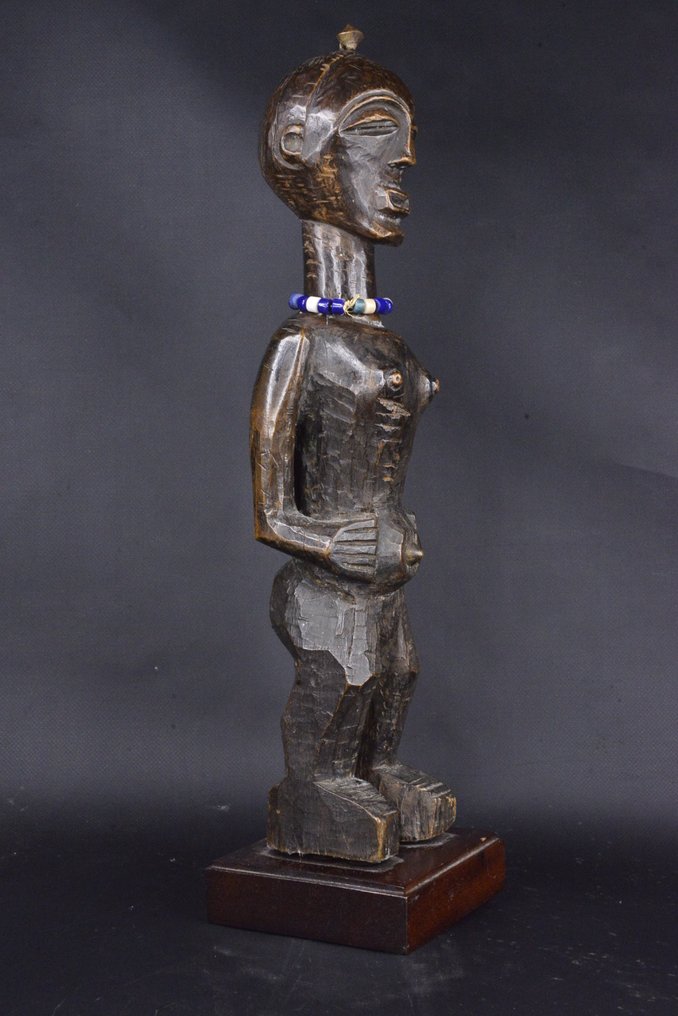
Statue of Protection - Songye - DR Congo


07
days
21
hours
21
minutes
31
seconds
Current bid
€ 1
Reserve price not met

Expert
Selected by Dimitri André
Holds a postgraduate degree in African studies and 15 years experience in African art.
Estimate € 1,600 - € 2,000
 | €1 |
|---|
Catawiki Buyer Protection
Your payment’s safe with us until you receive your object.View details
Trustpilot 4.4 | 142317 reviews
Rated Excellent on Trustpilot.
Description from the seller
Congo (ex-Zaïre)
Songyé
Wood
Height: 440mm + base 34mm
Width: 100mm
Depth: 85mm
Weight: 1520g
Provenance:
Pierre Dartevelle Brussels
Millon Sale of 07/04/2022
Private collection
This anthropomorphic statuette in carved wood comes from the Songye ethnic group, a population established in the Democratic Republic of the Congo (DRC).
1. Origin and Style
• People: Songye, Shaba/Katanga region in the southeast of the DRC.
• Features of Songye statuary present here:
o The geometric and angular posture: the arms are bent at a right angle and the hands are placed in a very characteristic way around a prominent abdomen.
o The expressive face: the eyes are carved in the shape of “coffee grains” or stretched almonds, and the mouth is often rectangular or slightly open, typical of the Songye aesthetic canon.
o The treatment of the body: vigorous shapes with massive legs, bent and semi-grounded on a wooden base.
o Ornaments: the presence of a bead necklace in blue and white glass paste and a small point or a metal horn insert at the top of the head, elements essential to load the object magickally.
2. Functional and Ritual Use
Among the Songye, this statuette is called a Nkisi (plural Mankisi), a protective fetish or a power figure.
• The receptacle of magical forces: Unlike other cultures where the statue represents an ancestor, the Nkisi is a therapeutic and protective tool. The sculptor shapes the wooden shell, but it is the diviner-healer (the Nganga) who gives it its powers by inserting magical or medicinal charges (the bishimba). These magical substances are traditionally placed in the horn at the top of the head or inside a cavity carved in the abdomen (here sealed by a central plug).
• Community or personal role: Given its medium size, it is likely a family or personal fetish. It was used to ward off bad spells, protect the home from malevolent spirits (ndoki), ensure the fertility of the women of the lineage, or ensure hunting success and ward off diseases.
Items are shipped with tracking numbers.
Delivery in France by Chronopost in 1 to 2 days. Delivery within the European Union by Chronopost International in 3 to 5 days. Delivery by Colissimo International for the rest of Europe and for the entire World.
We speak english.
Seller's Story
Passionate about World Arts and more specifically about African Art, we buy from collectors, former officials, military, health workers, public works staff who have worked in Africa and also in Côte d'Ivoire, from antique dealers and traders who roam across West Africa to find quality objects.
It is with pride that we present works that, beyond their power to beautify spaces, invite our collectors to resonate with the richness and depth of human expression through the most authentic art.
At Arts Ethniques Gallery, we have the privilege of offering our visitors an exclusive selection of artworks, all unique and original. Each piece presented is the outcome of a demanding artistic approach, driven by a singular vision and mastered craftsmanship, all elements that guarantee authenticity and value.
The works we offer are not industrial reproductions. They are individual creations, crafted with sensitivity and precision, each bearing its own story, identity and presence. Originality is the very foundation of our commitment to excellence. Thus, every mask and every statue in our collection is the subject of a rigorous selection, in order to preserve their rarity and singularity.
Acquiring a work from Arts Ethniques Gallery means owning a truly unique piece: a creation that embodies both talent, cultural memory and the expressive force of African art. It is also a lasting investment in a work whose artistic and emotional value transcends time.
We guarantee that every work leaving our gallery is an authentic piece, without replicas, bearing witness to the creativity, heritage and passion of the African artists who shaped them.
We invite you to participate in our gallery’s auctions with confidence. Each presented work is an original, unique and irreplaceable creation, selected with the greatest rigor to guarantee its authenticity and artistic value.
Whether you wish to enrich a personal collection or introduce an exceptional artwork into your space, Arts Ethniques Gallery offers a safe, transparent and professional setting to acquire remarkable pieces.
Art auctions are a privileged moment to discover rare works, capable of becoming the heart of a collection. Acquiring a work at our sales is not just buying an object: it is investing in a creation whose aesthetic value and cultural reach reinforce over time.
The pieces presented by Arts Ethniques Gallery testify not only to the talent and vision of the artists but also possess the ability to transform spaces and enrich the gaze of those who behold them.
Participating in our auctions is taking part in a singular experience, where the passion for art meets the rigors of collecting. Bidding on a work from Arts Ethniques Gallery goes beyond a simple transaction: it is a gesture of commitment and appreciation for art in its most authentic form.
We invite you to bid with passion and to join us in this adventure dedicated to discovery, transmission and celebration of art.
Perhaps your next heart piece is already waiting for you."
Translated by Google TranslateCongo (ex-Zaïre)
Songyé
Wood
Height: 440mm + base 34mm
Width: 100mm
Depth: 85mm
Weight: 1520g
Provenance:
Pierre Dartevelle Brussels
Millon Sale of 07/04/2022
Private collection
This anthropomorphic statuette in carved wood comes from the Songye ethnic group, a population established in the Democratic Republic of the Congo (DRC).
1. Origin and Style
• People: Songye, Shaba/Katanga region in the southeast of the DRC.
• Features of Songye statuary present here:
o The geometric and angular posture: the arms are bent at a right angle and the hands are placed in a very characteristic way around a prominent abdomen.
o The expressive face: the eyes are carved in the shape of “coffee grains” or stretched almonds, and the mouth is often rectangular or slightly open, typical of the Songye aesthetic canon.
o The treatment of the body: vigorous shapes with massive legs, bent and semi-grounded on a wooden base.
o Ornaments: the presence of a bead necklace in blue and white glass paste and a small point or a metal horn insert at the top of the head, elements essential to load the object magickally.
2. Functional and Ritual Use
Among the Songye, this statuette is called a Nkisi (plural Mankisi), a protective fetish or a power figure.
• The receptacle of magical forces: Unlike other cultures where the statue represents an ancestor, the Nkisi is a therapeutic and protective tool. The sculptor shapes the wooden shell, but it is the diviner-healer (the Nganga) who gives it its powers by inserting magical or medicinal charges (the bishimba). These magical substances are traditionally placed in the horn at the top of the head or inside a cavity carved in the abdomen (here sealed by a central plug).
• Community or personal role: Given its medium size, it is likely a family or personal fetish. It was used to ward off bad spells, protect the home from malevolent spirits (ndoki), ensure the fertility of the women of the lineage, or ensure hunting success and ward off diseases.
Items are shipped with tracking numbers.
Delivery in France by Chronopost in 1 to 2 days. Delivery within the European Union by Chronopost International in 3 to 5 days. Delivery by Colissimo International for the rest of Europe and for the entire World.
We speak english.
Seller's Story
Passionate about World Arts and more specifically about African Art, we buy from collectors, former officials, military, health workers, public works staff who have worked in Africa and also in Côte d'Ivoire, from antique dealers and traders who roam across West Africa to find quality objects.
It is with pride that we present works that, beyond their power to beautify spaces, invite our collectors to resonate with the richness and depth of human expression through the most authentic art.
At Arts Ethniques Gallery, we have the privilege of offering our visitors an exclusive selection of artworks, all unique and original. Each piece presented is the outcome of a demanding artistic approach, driven by a singular vision and mastered craftsmanship, all elements that guarantee authenticity and value.
The works we offer are not industrial reproductions. They are individual creations, crafted with sensitivity and precision, each bearing its own story, identity and presence. Originality is the very foundation of our commitment to excellence. Thus, every mask and every statue in our collection is the subject of a rigorous selection, in order to preserve their rarity and singularity.
Acquiring a work from Arts Ethniques Gallery means owning a truly unique piece: a creation that embodies both talent, cultural memory and the expressive force of African art. It is also a lasting investment in a work whose artistic and emotional value transcends time.
We guarantee that every work leaving our gallery is an authentic piece, without replicas, bearing witness to the creativity, heritage and passion of the African artists who shaped them.
We invite you to participate in our gallery’s auctions with confidence. Each presented work is an original, unique and irreplaceable creation, selected with the greatest rigor to guarantee its authenticity and artistic value.
Whether you wish to enrich a personal collection or introduce an exceptional artwork into your space, Arts Ethniques Gallery offers a safe, transparent and professional setting to acquire remarkable pieces.
Art auctions are a privileged moment to discover rare works, capable of becoming the heart of a collection. Acquiring a work at our sales is not just buying an object: it is investing in a creation whose aesthetic value and cultural reach reinforce over time.
The pieces presented by Arts Ethniques Gallery testify not only to the talent and vision of the artists but also possess the ability to transform spaces and enrich the gaze of those who behold them.
Participating in our auctions is taking part in a singular experience, where the passion for art meets the rigors of collecting. Bidding on a work from Arts Ethniques Gallery goes beyond a simple transaction: it is a gesture of commitment and appreciation for art in its most authentic form.
We invite you to bid with passion and to join us in this adventure dedicated to discovery, transmission and celebration of art.
Perhaps your next heart piece is already waiting for you."
Translated by Google TranslateDetails
Indigenous object name
Statue of Protection
Ethnic group/ culture
Songye
Country of Origin
DR Congo
Material
Wood / beads / metal nails
Sold with stand
Yes
Condition
Excellent condition
Authenticity
Original/official
Sold by
