Nyamwezi / Zigua - Tanzania


06
days
02
hours
21
minutes
47
seconds
Starting bid
€ 1
Reserve price not met

Expert
Selected by Dimitri André
Holds a postgraduate degree in African studies and 15 years experience in African art.
Estimate € 550 - € 650
No bids placed
Catawiki Buyer Protection
Your payment’s safe with us until you receive your object.View details
Trustpilot 4.4 | 142317 reviews
Rated Excellent on Trustpilot.
Description from the seller
Tanzania
Nyamézi / Zigua
Wood
Height: 325 mm + base 20 mm
Width: 70 mm
Depth: 65 mm
Weight: 470 g
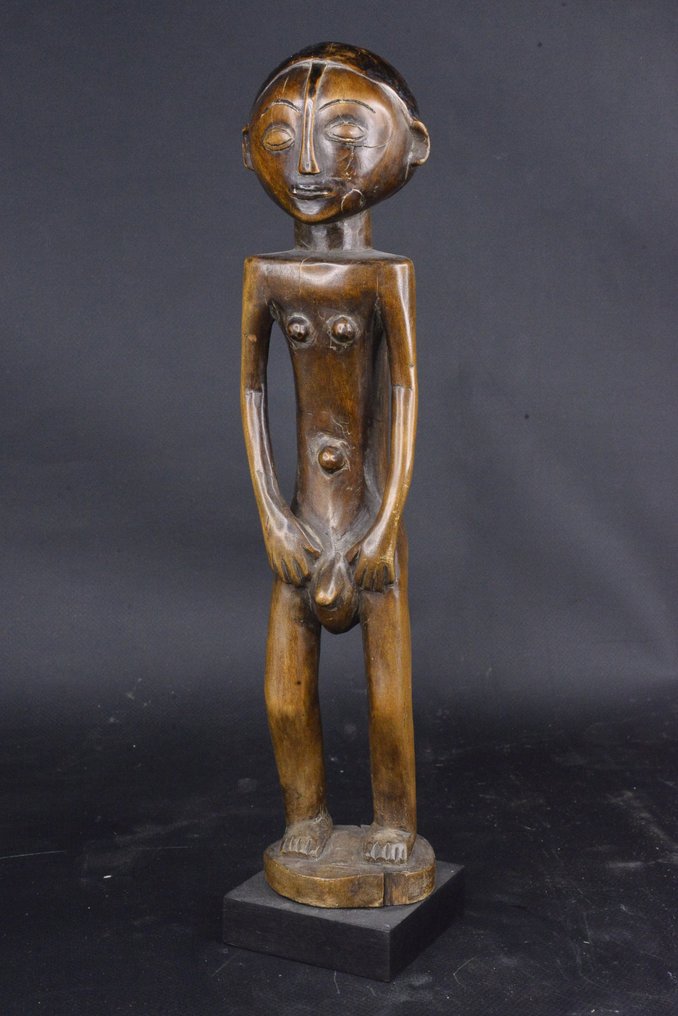
Nyamwezi — ancestral female figure on a seat
Tanzania — Nyamwezi culture
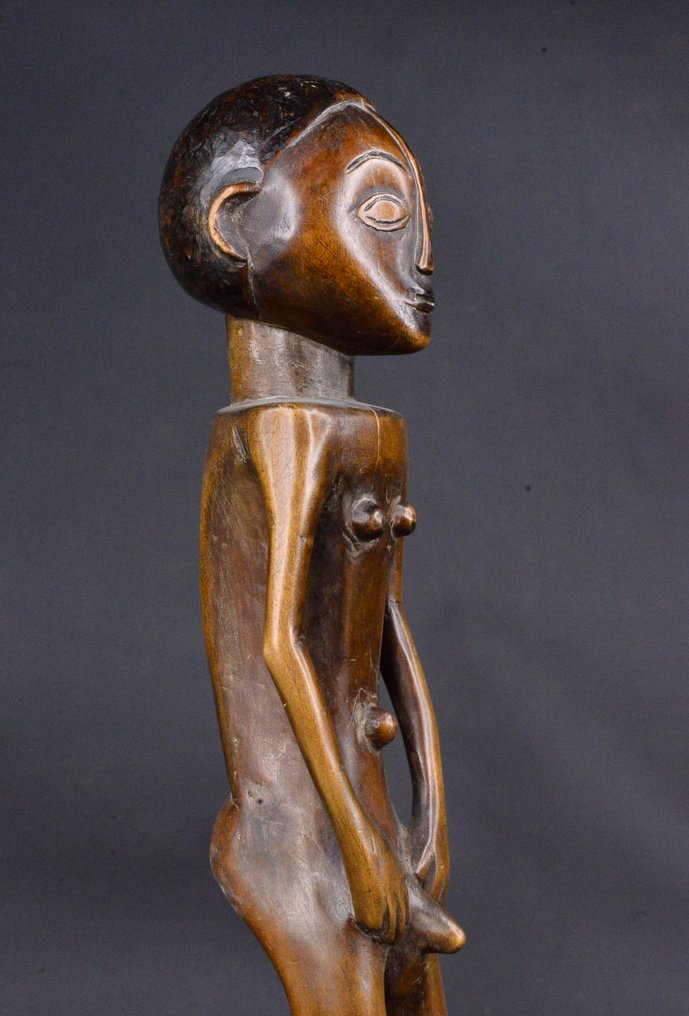
The sculpture presents a set of characteristics that are very coherent with Nyamwezi statuary: a highly elongated female silhouette, a spherical head, a long cylindrical neck, very elongated arms, a simplified treatment of the face, a body with smooth volumes, elongated legs, and a representation associated with a sculpted seat.
The Nyamwezi corpus is particularly recognizable by the elongation of proportions and the geometric reduction of the limbs. Specialized sources also describe female figures as one of the most important types of this sculpture.
Geographical origin
Central and western Tanzania — historical area of the Unyamwezi.
The traditional Nyamwezi territory is mainly in the center-west of Tanzania, around Tabora and surrounding regions. European and American collections classify sculptures of this type under the Nyamwezi cultural area.
Ethnicity / culture
Nyamwezi
The silhouette is very characteristic of the Nyamwezi plastic language: vertical and stretched body, relatively large head, elongated neck, thin limbs, and economy of anatomical details.
The collection of the Völkerkundemuseum Herrnhut / Staatliche Kunstsammlungen Dresden precisely includes a Nyamwezi female figure in wood of 40 cm, which constitutes a particularly relevant European reference for this sculpture.
Type of object
Nyamwezi ancestral female figure, associated with a seat
Nyamwezi anthropomorphic figures are linked to several contexts: ancestor worship, prestige of chiefs, divination, and, in some cases, objects worn or danced.
The presence here of a seat directly integrated into the composition is particularly interesting. Nyamwezi anthropomorphic seats constitute another well-documented domain of sculpture in this region and are associated with rank, authority, and representation of lineages. The Smithsonian holds specific documentation on female figures, chiefs’ seats, seated figures, and Nyamwezi staffs.
Artistic and stylistic description
The figure depicts a standing woman, leaning on a sculpted seat placed behind her.
The head, almost spherical, rests on a long cylindrical neck. The face is built with simple volumes: fairly broad forehead, thin eyebrow arches, almond-shaped eyes slightly raised, narrow and long nose, and small mouth.
The hairstyle is treated as a compact mass at the back and top of the skull, with black and light bands arranged in parallel lines.
The ringed neck is a very visible element of the composition. Several horizontal rings are directly carved around the neck, to which a red color element is added.
The torso is extremely elongated and almost cylindrical. The breasts are clearly individualized, while the belly is very elongated and bears a raised navel.
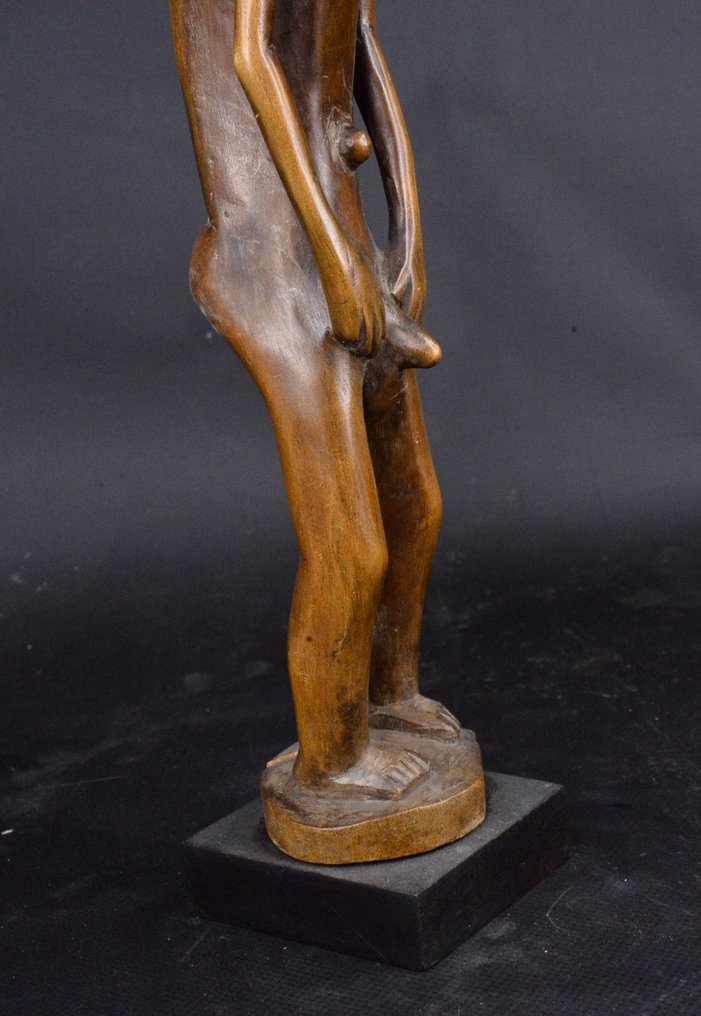
The arms, very long, descend parallel to the body and then meet in front of the pubic area. The hands are carefully indicated with long fingers. The representation of the female genitalia is deliberately explicit—a phenomenon seen in several Nyamwezi figures documented in collections and the specialized market.
The hips and buttocks are particularly developed. The legs, long and relatively simple, descend to a circular base on which the feet rest.
At the back, the seat shows a robust geometric construction, with a rectangular seat and upright. This combination of human figure and seat brings the work closer to the vocabulary of Nyamwezi prestige seats.
Materials and technique
Carved wood and pigments.
The figure was carved in wood using a very vertical construction. The body volumes are achieved by long continuous planes, while facial features, hairstyle, fingers, neck, and feet are directly carved.
The polychromy strongly influences the reading of the figure: brown for the body, black for the hairstyle, lighter touches around the eyes, neck, and feet, with red accents at the neck and wrist.
The smooth, polished character of certain surfaces is compatible with descriptions of Nyamwezi sculptors’ work, often associated with dense woods and carefully finished surfaces.
Symbolism
The female representation emphasizes several elements related to fertility, lineage continuity, and ancestral presence: developed breasts, marked belly, explicit genitalia and upright posture.
Source material on Nyamwezi sculpture stresses the importance of ancestor worship and divination in figurative production. Some interpretations also associate female figures with fertility concerns.
The seat likewise acts as a marker of rank and authority in several central Tanzanian societies, including the Nyamwezi. The QCC Art Gallery recalls that carved seats in this region could materialize a chief’s status and lineage history.
Function / ritual use
Nyamwezi figures were used in various contexts related to ancestors, divination, and political prestige.
Some figures were linked to divination practices; others represented ancestors or entered into symbolic representations of chiefs and lineages. Anthropomorphic seats in the region were notably tied to chiefs’ authority and ceremonies.
For this sculpture, it is preferable to retain the general function of an ancestral figure associated with a seat, without assigning a specific rite to this exemplar.
Cultural context
Nyamwezi sculpture presents an aesthetic very different from the great bodies of West or Central Africa: it favors extreme elongation, simplification of volumes, and a vertical monumentality.
The so-called “stick figures” or elongated figures constitute one of the best-known signatures of Nyamwezi sculpture. A male figure kept at Princeton is explicitly cataloged as Nyamwezi, Ancestor figure, wood, with strong vertical emphasis.
The same vocabulary appears in prestige seats and in some female figures, creating a continuum between anthropomorphic sculpture, prestige object, and ancestral representation.
Comparisons with museum pieces and documented collections
Staatliche Kunstsammlungen Dresden – Völkerkundemuseum Herrnhut, Germany
Nyamwezi female figure, wood, 40 cm, inv. 66 574.
This is a particularly important European reference. The object is explicitly identified as Nyamwezi female figure and documented in Dresden ethnographic collections.
Ethnologisches Museum, Staatliche Museen zu Berlin
The museum preserves a major Nyamwezi prestige seat, in wood, about 107 cm, from Tanzania. This piece is particularly useful for understanding the relationship between Nyamwezi sculpture, human representation, seat, and authority.
Publications on Nyamwezi seats emphasize their relation to chiefs and their ceremonial power symbols.
British Museum, London
The British Museum preserves a wooden female figure, catalogued under Af1909,-.40. Its current notice attributes it to the Baganda, but curator comments indicate it could have been carved by Nyamwezi sculptors accompanying commercial expeditions to Bukerebe. This piece is especially interesting for the historical significance of Nyamwezi sculptors beyond their own territory.
Metropolitan Museum / American collections
The American corpus confirms the importance of elongated Nyamwezi figures. The Princeton University Art Museum preserves a Nyamwezi Ancestor figure, wooden, 62 cm, explicitly classified as Nyamwezi sculpture linked to ancestors.
The QCC Art Gallery, City University of New York, in the Shangaa: Art of Tanzania exhibition, also documents a Nyamwezi female figure in wood of 40 cm from the Dresden Museum of Ethnology as well as several other Tanzanian female figures.
Yale University Art Gallery
The Yale University Art Gallery also preserves a small seated figure on a high-backed chair, possibly Nyamwezi, in wood, fiber, and glass beads. Its presence in an American university collection is particularly interesting for the relationship between anthropomorphic figure and seat in Central Tanzanian art.
Bibliography / sources
• Gary Van Wyk (ed.), Shangaa: Art of Tanzania, New York, 2013.
• Marc L. Felix & Maria Kecskesi, Tanzania, reference cited by Dorotheum for Nyamwezi figures.
• Nancy Ingram Nooter, documentation on Nyamwezi figures, seats, and rods, Smithsonian Libraries African Art Index Project.
• Staatliche Kunstsammlungen Dresden / Völkerkundemuseum Herrnhut, Nyamwezi female figure, inv. 66 574.
• Ethnologisches Museum, Berlin, Nyamwezi prestige seat.
• British Museum, Nyamwezi female figure, inv. Af1909,-.40, with commentary on possible Nyamwezi sculptor involvement.
• Princeton University Art Museum, Nyamwezi Ancestor figure, inv. 1998-574.
• Cleveland / Smithsonian / American collections of Tanzania, comparative documentation of the Nyamwezi corpus.
Fast and insured shipping. Parcels are sent with insurance and tracking number.
Delivery via Chronopost between 1 to 3 days in France, 2 to 5 days within the European Union. Delivery to the rest of Europe, worldwide and to islands with Colissimo International.
We speak english.
mask african art Afro‑German: African mask art arte de máscaras africanas arte delle maschere africane
statue african art African statue art arte de estatuas africanas arte delle statue africane Afro‑German mask art
Seller's Story
Passionate about World Arts and more specifically about African Art, we buy from collectors, former officials, military, health workers, public works staff who have worked in Africa and also in Côte d'Ivoire, from antique dealers and traders who roam across West Africa to find quality objects.
It is with pride that we present works that, beyond their power to beautify spaces, invite our collectors to resonate with the richness and depth of human expression through the most authentic art.
At Arts Ethniques Gallery, we have the privilege of offering our visitors an exclusive selection of artworks, all unique and original. Each piece presented is the outcome of a demanding artistic approach, driven by a singular vision and mastered craftsmanship, all elements that guarantee authenticity and value.
The works we offer are not industrial reproductions. They are individual creations, crafted with sensitivity and precision, each bearing its own story, identity and presence. Originality is the very foundation of our commitment to excellence. Thus, every mask and every statue in our collection is the subject of a rigorous selection, in order to preserve their rarity and singularity.
Acquiring a work from Arts Ethniques Gallery means owning a truly unique piece: a creation that embodies both talent, cultural memory and the expressive force of African art. It is also a lasting investment in a work whose artistic and emotional value transcends time.
We guarantee that every work leaving our gallery is an authentic piece, without replicas, bearing witness to the creativity, heritage and passion of the African artists who shaped them.
We invite you to participate in our gallery’s auctions with confidence. Each presented work is an original, unique and irreplaceable creation, selected with the greatest rigor to guarantee its authenticity and artistic value.
Whether you wish to enrich a personal collection or introduce an exceptional artwork into your space, Arts Ethniques Gallery offers a safe, transparent and professional setting to acquire remarkable pieces.
Art auctions are a privileged moment to discover rare works, capable of becoming the heart of a collection. Acquiring a work at our sales is not just buying an object: it is investing in a creation whose aesthetic value and cultural reach reinforce over time.
The pieces presented by Arts Ethniques Gallery testify not only to the talent and vision of the artists but also possess the ability to transform spaces and enrich the gaze of those who behold them.
Participating in our auctions is taking part in a singular experience, where the passion for art meets the rigors of collecting. Bidding on a work from Arts Ethniques Gallery goes beyond a simple transaction: it is a gesture of commitment and appreciation for art in its most authentic form.
We invite you to bid with passion and to join us in this adventure dedicated to discovery, transmission and celebration of art.
Perhaps your next heart piece is already waiting for you."
Translated by Google TranslateTanzania
Nyamézi / Zigua
Wood
Height: 325 mm + base 20 mm
Width: 70 mm
Depth: 65 mm
Weight: 470 g
Nyamwezi — ancestral female figure on a seat
Tanzania — Nyamwezi culture
The sculpture presents a set of characteristics that are very coherent with Nyamwezi statuary: a highly elongated female silhouette, a spherical head, a long cylindrical neck, very elongated arms, a simplified treatment of the face, a body with smooth volumes, elongated legs, and a representation associated with a sculpted seat.
The Nyamwezi corpus is particularly recognizable by the elongation of proportions and the geometric reduction of the limbs. Specialized sources also describe female figures as one of the most important types of this sculpture.
Geographical origin
Central and western Tanzania — historical area of the Unyamwezi.
The traditional Nyamwezi territory is mainly in the center-west of Tanzania, around Tabora and surrounding regions. European and American collections classify sculptures of this type under the Nyamwezi cultural area.
Ethnicity / culture
Nyamwezi
The silhouette is very characteristic of the Nyamwezi plastic language: vertical and stretched body, relatively large head, elongated neck, thin limbs, and economy of anatomical details.
The collection of the Völkerkundemuseum Herrnhut / Staatliche Kunstsammlungen Dresden precisely includes a Nyamwezi female figure in wood of 40 cm, which constitutes a particularly relevant European reference for this sculpture.
Type of object
Nyamwezi ancestral female figure, associated with a seat
Nyamwezi anthropomorphic figures are linked to several contexts: ancestor worship, prestige of chiefs, divination, and, in some cases, objects worn or danced.
The presence here of a seat directly integrated into the composition is particularly interesting. Nyamwezi anthropomorphic seats constitute another well-documented domain of sculpture in this region and are associated with rank, authority, and representation of lineages. The Smithsonian holds specific documentation on female figures, chiefs’ seats, seated figures, and Nyamwezi staffs.
Artistic and stylistic description
The figure depicts a standing woman, leaning on a sculpted seat placed behind her.
The head, almost spherical, rests on a long cylindrical neck. The face is built with simple volumes: fairly broad forehead, thin eyebrow arches, almond-shaped eyes slightly raised, narrow and long nose, and small mouth.
The hairstyle is treated as a compact mass at the back and top of the skull, with black and light bands arranged in parallel lines.
The ringed neck is a very visible element of the composition. Several horizontal rings are directly carved around the neck, to which a red color element is added.
The torso is extremely elongated and almost cylindrical. The breasts are clearly individualized, while the belly is very elongated and bears a raised navel.
The arms, very long, descend parallel to the body and then meet in front of the pubic area. The hands are carefully indicated with long fingers. The representation of the female genitalia is deliberately explicit—a phenomenon seen in several Nyamwezi figures documented in collections and the specialized market.
The hips and buttocks are particularly developed. The legs, long and relatively simple, descend to a circular base on which the feet rest.
At the back, the seat shows a robust geometric construction, with a rectangular seat and upright. This combination of human figure and seat brings the work closer to the vocabulary of Nyamwezi prestige seats.
Materials and technique
Carved wood and pigments.
The figure was carved in wood using a very vertical construction. The body volumes are achieved by long continuous planes, while facial features, hairstyle, fingers, neck, and feet are directly carved.
The polychromy strongly influences the reading of the figure: brown for the body, black for the hairstyle, lighter touches around the eyes, neck, and feet, with red accents at the neck and wrist.
The smooth, polished character of certain surfaces is compatible with descriptions of Nyamwezi sculptors’ work, often associated with dense woods and carefully finished surfaces.
Symbolism
The female representation emphasizes several elements related to fertility, lineage continuity, and ancestral presence: developed breasts, marked belly, explicit genitalia and upright posture.
Source material on Nyamwezi sculpture stresses the importance of ancestor worship and divination in figurative production. Some interpretations also associate female figures with fertility concerns.
The seat likewise acts as a marker of rank and authority in several central Tanzanian societies, including the Nyamwezi. The QCC Art Gallery recalls that carved seats in this region could materialize a chief’s status and lineage history.
Function / ritual use
Nyamwezi figures were used in various contexts related to ancestors, divination, and political prestige.
Some figures were linked to divination practices; others represented ancestors or entered into symbolic representations of chiefs and lineages. Anthropomorphic seats in the region were notably tied to chiefs’ authority and ceremonies.
For this sculpture, it is preferable to retain the general function of an ancestral figure associated with a seat, without assigning a specific rite to this exemplar.
Cultural context
Nyamwezi sculpture presents an aesthetic very different from the great bodies of West or Central Africa: it favors extreme elongation, simplification of volumes, and a vertical monumentality.
The so-called “stick figures” or elongated figures constitute one of the best-known signatures of Nyamwezi sculpture. A male figure kept at Princeton is explicitly cataloged as Nyamwezi, Ancestor figure, wood, with strong vertical emphasis.
The same vocabulary appears in prestige seats and in some female figures, creating a continuum between anthropomorphic sculpture, prestige object, and ancestral representation.
Comparisons with museum pieces and documented collections
Staatliche Kunstsammlungen Dresden – Völkerkundemuseum Herrnhut, Germany
Nyamwezi female figure, wood, 40 cm, inv. 66 574.
This is a particularly important European reference. The object is explicitly identified as Nyamwezi female figure and documented in Dresden ethnographic collections.
Ethnologisches Museum, Staatliche Museen zu Berlin
The museum preserves a major Nyamwezi prestige seat, in wood, about 107 cm, from Tanzania. This piece is particularly useful for understanding the relationship between Nyamwezi sculpture, human representation, seat, and authority.
Publications on Nyamwezi seats emphasize their relation to chiefs and their ceremonial power symbols.
British Museum, London
The British Museum preserves a wooden female figure, catalogued under Af1909,-.40. Its current notice attributes it to the Baganda, but curator comments indicate it could have been carved by Nyamwezi sculptors accompanying commercial expeditions to Bukerebe. This piece is especially interesting for the historical significance of Nyamwezi sculptors beyond their own territory.
Metropolitan Museum / American collections
The American corpus confirms the importance of elongated Nyamwezi figures. The Princeton University Art Museum preserves a Nyamwezi Ancestor figure, wooden, 62 cm, explicitly classified as Nyamwezi sculpture linked to ancestors.
The QCC Art Gallery, City University of New York, in the Shangaa: Art of Tanzania exhibition, also documents a Nyamwezi female figure in wood of 40 cm from the Dresden Museum of Ethnology as well as several other Tanzanian female figures.
Yale University Art Gallery
The Yale University Art Gallery also preserves a small seated figure on a high-backed chair, possibly Nyamwezi, in wood, fiber, and glass beads. Its presence in an American university collection is particularly interesting for the relationship between anthropomorphic figure and seat in Central Tanzanian art.
Bibliography / sources
• Gary Van Wyk (ed.), Shangaa: Art of Tanzania, New York, 2013.
• Marc L. Felix & Maria Kecskesi, Tanzania, reference cited by Dorotheum for Nyamwezi figures.
• Nancy Ingram Nooter, documentation on Nyamwezi figures, seats, and rods, Smithsonian Libraries African Art Index Project.
• Staatliche Kunstsammlungen Dresden / Völkerkundemuseum Herrnhut, Nyamwezi female figure, inv. 66 574.
• Ethnologisches Museum, Berlin, Nyamwezi prestige seat.
• British Museum, Nyamwezi female figure, inv. Af1909,-.40, with commentary on possible Nyamwezi sculptor involvement.
• Princeton University Art Museum, Nyamwezi Ancestor figure, inv. 1998-574.
• Cleveland / Smithsonian / American collections of Tanzania, comparative documentation of the Nyamwezi corpus.
Fast and insured shipping. Parcels are sent with insurance and tracking number.
Delivery via Chronopost between 1 to 3 days in France, 2 to 5 days within the European Union. Delivery to the rest of Europe, worldwide and to islands with Colissimo International.
We speak english.
mask african art Afro‑German: African mask art arte de máscaras africanas arte delle maschere africane
statue african art African statue art arte de estatuas africanas arte delle statue africane Afro‑German mask art
Seller's Story
Passionate about World Arts and more specifically about African Art, we buy from collectors, former officials, military, health workers, public works staff who have worked in Africa and also in Côte d'Ivoire, from antique dealers and traders who roam across West Africa to find quality objects.
It is with pride that we present works that, beyond their power to beautify spaces, invite our collectors to resonate with the richness and depth of human expression through the most authentic art.
At Arts Ethniques Gallery, we have the privilege of offering our visitors an exclusive selection of artworks, all unique and original. Each piece presented is the outcome of a demanding artistic approach, driven by a singular vision and mastered craftsmanship, all elements that guarantee authenticity and value.
The works we offer are not industrial reproductions. They are individual creations, crafted with sensitivity and precision, each bearing its own story, identity and presence. Originality is the very foundation of our commitment to excellence. Thus, every mask and every statue in our collection is the subject of a rigorous selection, in order to preserve their rarity and singularity.
Acquiring a work from Arts Ethniques Gallery means owning a truly unique piece: a creation that embodies both talent, cultural memory and the expressive force of African art. It is also a lasting investment in a work whose artistic and emotional value transcends time.
We guarantee that every work leaving our gallery is an authentic piece, without replicas, bearing witness to the creativity, heritage and passion of the African artists who shaped them.
We invite you to participate in our gallery’s auctions with confidence. Each presented work is an original, unique and irreplaceable creation, selected with the greatest rigor to guarantee its authenticity and artistic value.
Whether you wish to enrich a personal collection or introduce an exceptional artwork into your space, Arts Ethniques Gallery offers a safe, transparent and professional setting to acquire remarkable pieces.
Art auctions are a privileged moment to discover rare works, capable of becoming the heart of a collection. Acquiring a work at our sales is not just buying an object: it is investing in a creation whose aesthetic value and cultural reach reinforce over time.
The pieces presented by Arts Ethniques Gallery testify not only to the talent and vision of the artists but also possess the ability to transform spaces and enrich the gaze of those who behold them.
Participating in our auctions is taking part in a singular experience, where the passion for art meets the rigors of collecting. Bidding on a work from Arts Ethniques Gallery goes beyond a simple transaction: it is a gesture of commitment and appreciation for art in its most authentic form.
We invite you to bid with passion and to join us in this adventure dedicated to discovery, transmission and celebration of art.
Perhaps your next heart piece is already waiting for you."
Translated by Google TranslateDetails
Ethnic group/ culture
Nyamwezi / Zigua
Country of Origin
Tanzania
Material
Wood
Sold with stand
Yes
Condition
Good condition
Authenticity
Original/official
Sold by
