Statue - Baoulé / Attié / Attier ? - Côte d'Ivoire

07
days
21
hours
44
minutes
04
seconds
Starting bid
€ 1
Reserve price not met

Expert
Selected by Dimitri André
Holds a postgraduate degree in African studies and 15 years experience in African art.
Estimate € 1,600 - € 2,000
No bids placed
Catawiki Buyer Protection
Your payment’s safe with us until you receive your object.View details
Trustpilot 4.4 | 142317 reviews
Rated Excellent on Trustpilot.
Description from the seller
Côte d'Ivoire
Attier / Attié
Wood and beads
Height: 255mm + base 35mm
Width: 90mm
Depth: 60mm
Weight: 390g
Provenance:
Millon sale of 07/04/2022
Private collection
Attié (Akyé) — female figure of Nkpasopi type
Ivory Coast — Lagunes region
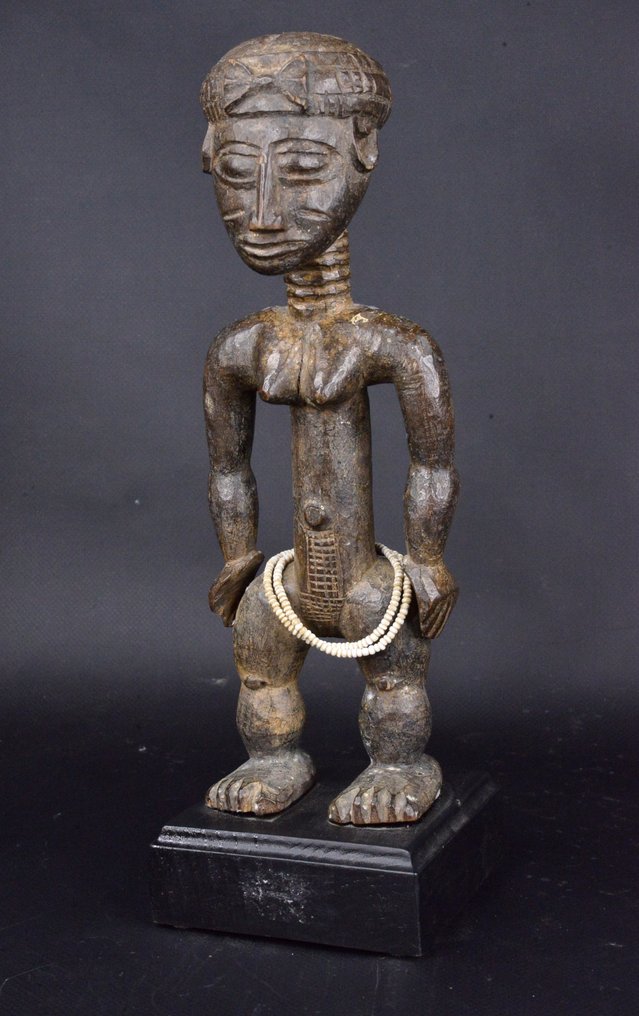
The examination of the different views allows us to assign Attié (Akyé) and identify the figure as a Nkpasopi female figure, a category well documented in the sculpture of the Lagunary populations of southeastern Ivory Coast.
The morphology is particularly coherent with this corpus: female body with rounded volumes, ringed long neck, very elongated arms descending along the torso, hands joined in front of the lower abdomen, elaborately worked coiffure, oval face and beaded adornment.
Documentation by Alain-Michel Boyer and the Galerie Flak notes that Nkpasopi, literally “women of wood,” are divination figures of the Lagunary populations and act as intermediaries between the living and supernatural entities. Attié are among the groups most directly associated with this sculptural tradition.
Geographic origin
Southeast Ivory Coast — lagoon region, Attié country.
The Attié, also called Akyé, occupy especially the region around Adzopé and Alépé, north of Abidjan.
Specialized sources emphasize that the lagoon populations of this region — Attié, Kyaman, Gwa, Abouré, Ébrié and other groups — share a related sculptural vocabulary, though each community has its own traditions and characteristics.
Ethnicity / culture
Attié (Akyé)
The Attié attribution is particularly convincing here due to the combination of several features that appear together in specialized references: ringed long neck, slender female silhouette, naturalistic treatment of the face, threadlike arms, hands drawn toward the lower abdomen, elaborate coiffure and beaded adornment.
The Metropolitan Museum also houses in its collection a Female Figure classified as the work of a Lagoon or Akye-Akan artist, from Ivory Coast and made of wood, pigments and metal. This classification confirms the importance of the Akye/Attié corpus within the sculpture of Lagoon peoples.
Type of object
Nkpasopi Female figure — divination figure
Nkpasopi are female figures carved to establish a relationship between the ritual expert and the supernatural world.
Alain-Michel Boyer describes them as “women of wood” and emphasizes their function as intermediaries between the living and supernatural entities.
The present sculpture corresponds very well to this category with its asserted femininity, its adornment and its body construction.
Artistic and stylistic description
The figure is standing, facing front, in a calm and perfectly balanced posture.
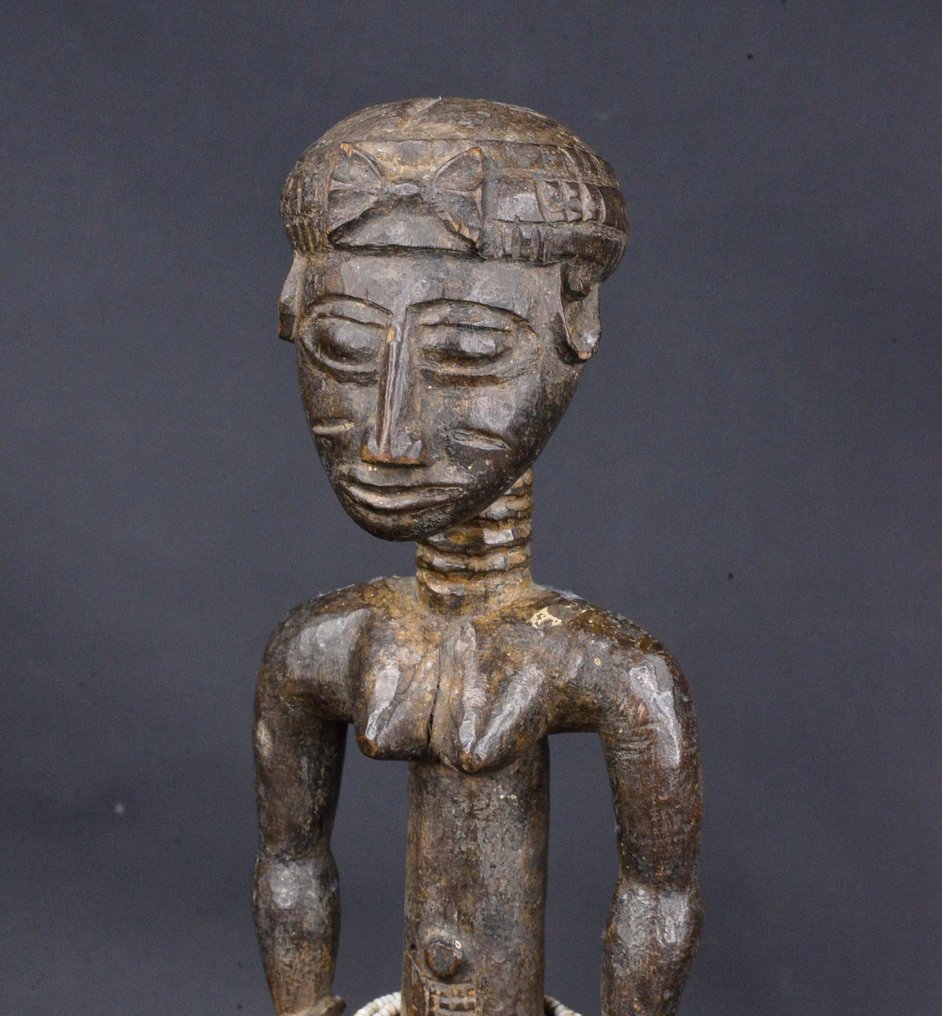
The head, relatively large in relation to the body, is oval. The forehead is high, the eyebrows finely drawn, the eyes broad and gently modeled, the nose long and straight, and the lips discreetly protruding.
The face bears a serene and inward-looking expression, characteristic of a sculpture that seeks less momentary expression than the permanent presence of the character.
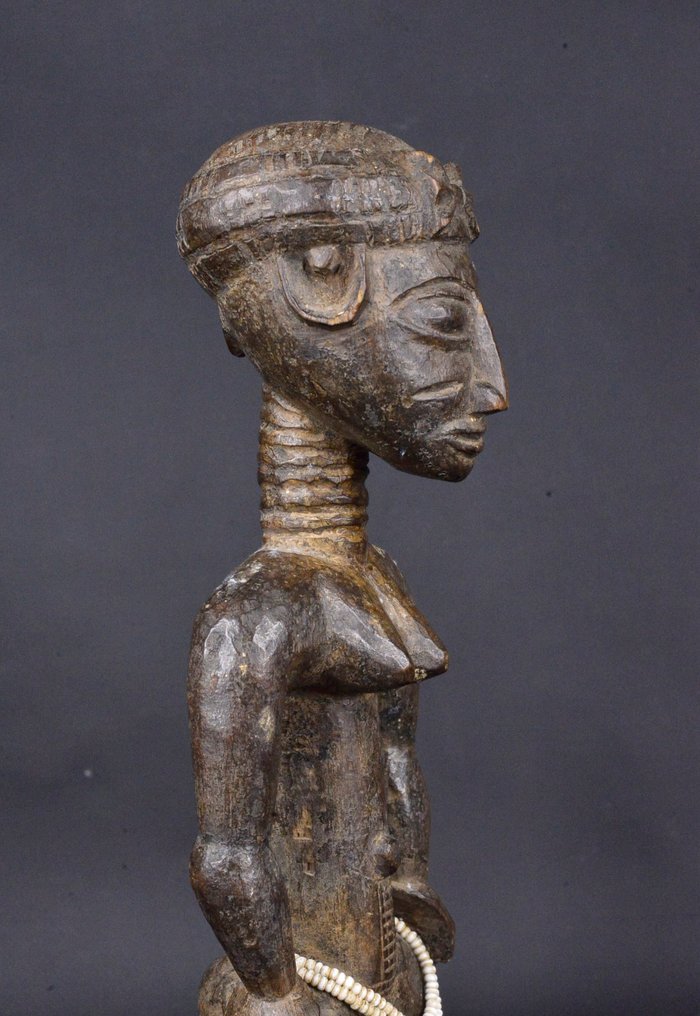
The coiffure is particularly elaborate. It forms a compact construction on the crown and the back of the skull, with several carved and painted sections. The coiffure is not a secondary detail: it contributes to the character’s identity and to the aesthetic canon sought in lagoon sculpture.
The very long neck, encircled by several carved rings, is one of the most immediately characteristic elements of the sculpture. Specialized sources precisely cite ringed necks among the distinctive traits of Attié female figures.
The torso is very elongated and carefully modeled. The breasts are strongly projecting, the belly and hips rendered according to an ideal of the female body.
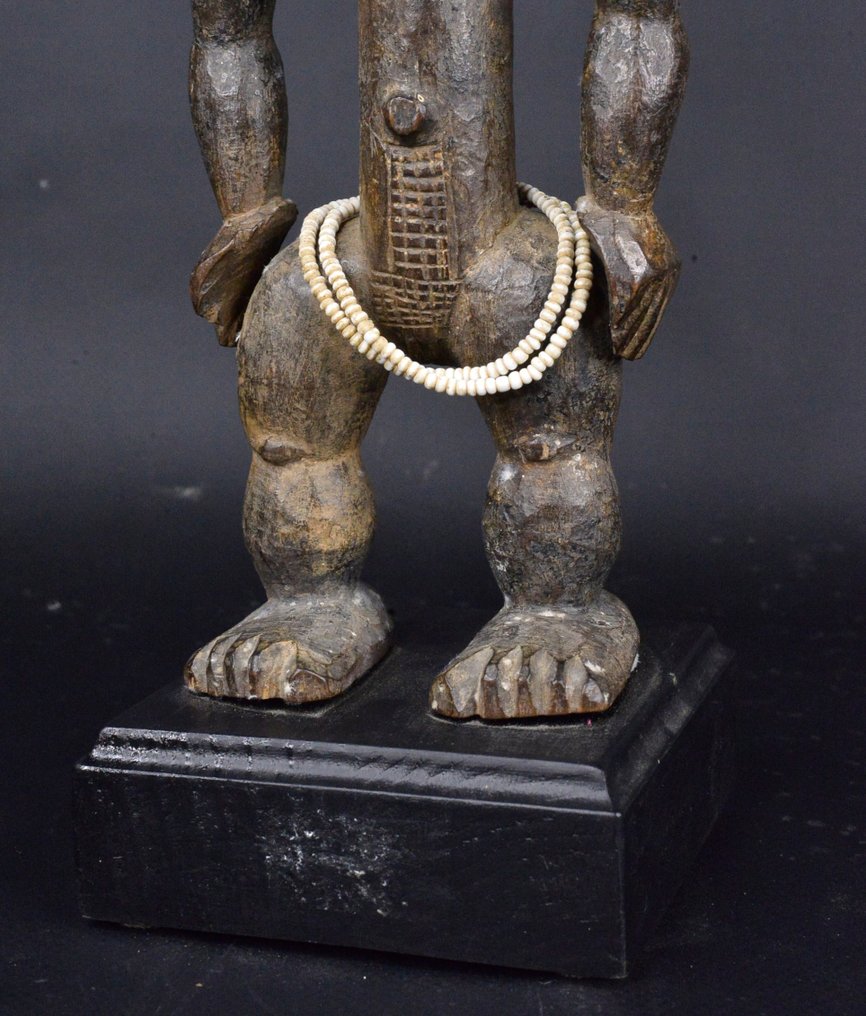
The arms, exceptionally long and slender, descend parallel to the torso. The hands join in front of the abdomen, around the pubic area.
The lower part is built on powerful, slightly bent legs. The feet rest on a circular base integrated into the sculpture.
The adornment of small white beads around the hips reinforces the representation of a woman adorned. The Seattle Art Museum notes that figures of this type could take on the clothing, beads and amulets of the woman who owned them, while materializing a particular spirit.
Materials and technique
Carved wood, pigments and beads.
The figure was carved in wood with a very vertical construction. Body volumes are achieved by long continuous surfaces carefully polished, while facial details, coiffure, fingers and neck rings are directly carved.
The sculpture retains differentiated polychromy: honey-brown skin, black in the coiffure, light elements at the level of the face and limbs, and a red touch on the neck and wrist.
This combination of carved wood and polychromy is perfectly coherent with female figures of lagoon populations documented in American collections. The Smithsonian notably houses a wooden and glass-bead Attié female figure from the Lagunes region.
Symbolism
The sculpture strongly emphasizes attributes linked to femininity, beauty and reproductive capacity.
In the context of Nkpasopi figures, this idealization is not merely aesthetic. The figure must materialize a supernatural presence in a form considered sufficiently beautiful and appropriate to establish a relationship with the spirit.
The Seattle Art Museum explains that these “people of wood” could represent a bush spirit, a supernatural partner, or the assistant of a diviner, and they constituted a point of contact in the relationship with the invisible world.
Thus the presence of beads and ornaments contributes both to the social appearance of the represented woman and to her ability to incarnate the spiritual personality associated with her.
Function / ritual use
The primary function to note is that of a divination figure.
Nkpasopi intervened in the relationship between the diviner or healer and the supernatural powers. Specialized sources indicate that they were used to transmit messages from the supernatural world to the world of the living.
The Smithsonian also notes that female figures of Lagune populations could be associated with particular spirits of a person and serve as supports for practices intended to protect or aid their owner.
Cultural context
The sculpture of the Lagune populations of Ivory Coast is particularly interesting for its stylistic proximity to Baoulé sculpture, while retaining distinctive characteristics.
Attié sculptors often favor elongated silhouettes, extended limbs, fluid modeling and refined bodily details.
Specialized documentation emphasizes especially the importance of the body built in cylindrical and bulbous segments, with constrictions and bulges that give the sculpture a very particular rhythm. This plastic language is considered particularly characteristic of the Attié area.
However there exists a vast common stock of shapes among the different lagoon populations; this is why museums sometimes use the Lagoon / Akye-Akan peoples designation rather than a narrower ethnic attribution.
Comparisons with museum pieces and documented collections
Musée du quai Branly – Jacques Chirac, Paris
The museum houses an Attié female statue, acquired in a public sale by preemption and integrated into its national collections. It is documented as an Attié work from Ivory Coast, in the corpus of lagoon female sculptures.
This reference is particularly important because the Quai Branly Museum holds a small but specifically documented Attié collection. Its acquisition of a large Attié female statue underscores the importance given to this corpus in the French national collections.
Metropolitan Museum of Art, New York
The Met preserves a Female Figure, classified as Lagoon or Akye-Akan, Ivory Coast, in wood, pigments and metal, inv. 1978.412.482.
This reference is interesting to situate the present sculpture within the vast corpus of lagoon female figures and to confirm the close proximity between Attié/Akyé productions and other regional groups.
National Museum of African Art – Smithsonian Institution, Washington
The Smithsonian preserves a Female Figure, attributed to an Attié/Kyaman artist, from the Lagunes region, in wood and glass beads, inv. 69-31-46.
Although its posture is different, this work constitutes a direct institutional reference attesting to the presence of a recognized Attié female figurative tradition in major American collections.
Seattle Art Museum
The Seattle Art Museum preserves a Female Figure explicitly attributed to the Attie, Ivory Coast, inv. 2005.146, in wood and chalk.
The museum notice is particularly useful for the present exemplar: it describes a female figure intended to materialize a spirit, with elaborate coiffure, body scarification and neck markings, and the role of intermediary with the supernatural world.
Emory University
The Emory University collection preserves a Female Figure from Ivory Coast, attributed to Lagoon populations. Its notice states that sculptures of this corpus, also called “people of wood,” could represent divining women or spirits and were produced notably by the Kyaman, Gwa, Akye, Abure, Eotile and Abe.
This notice is particularly helpful to understand why the Attié attribution must be founded on a combination of stylistic characteristics rather than a single motif.
Bibliography / sources
• Alain-Michel Boyer, Arts of Africa and Oceania. Fleurons of the Barbier-Mueller Museum, Geneva.
• Eberhard Fischer & Lorenz Homberger, The Masters of Ivory Coast Sculpture, Musée du quai Branly / Skira.
• Alain-Michel Boyer, The Lagoon Region, documentation devoted to the arts of the southeast Ivorian populations.
• Musée du quai Branly – Jacques Chirac, Attié female sculpture, Ivory Coast.
• Metropolitan Museum of Art, Female Figure, Lagoon or Akye-Akan peoples, inv. 1978.412.482.
• National Museum of African Art, Smithsonian Institution, Female Figure, Attié/Kyaman, inv. 69-31-46.
• Seattle Art Museum, Female Figure, Attie, inv. 2005.146.
• Emory University, Female Figure, Ivory Coast, inv. 1994.004.604.
Fast and protected shipping. Packages are sent with tracking numbers. Delivery 1 to 3 days in France via Chronopost, 2 to 5 days throughout the European Union via Chronopost International. International Colissimo delivery to the rest of Europe and worldwide.
We speak english.
Mask african art African mask art arte de máscaras africanas arte delle maschere africane
statue african art Arte de estatuas africanas arte delle statue africane African mask art
Máscara de estatua de galería de arte africano
Seller's Story
Passionate about World Arts and more specifically about African Art, we buy from collectors, former officials, military, health workers, public works staff who have worked in Africa and also in Côte d'Ivoire, from antique dealers and traders who roam across West Africa to find quality objects.
It is with pride that we present works that, beyond their power to beautify spaces, invite our collectors to resonate with the richness and depth of human expression through the most authentic art.
At Arts Ethniques Gallery, we have the privilege of offering our visitors an exclusive selection of artworks, all unique and original. Each piece presented is the outcome of a demanding artistic approach, driven by a singular vision and mastered craftsmanship, all elements that guarantee authenticity and value.
The works we offer are not industrial reproductions. They are individual creations, crafted with sensitivity and precision, each bearing its own story, identity and presence. Originality is the very foundation of our commitment to excellence. Thus, every mask and every statue in our collection is the subject of a rigorous selection, in order to preserve their rarity and singularity.
Acquiring a work from Arts Ethniques Gallery means owning a truly unique piece: a creation that embodies both talent, cultural memory and the expressive force of African art. It is also a lasting investment in a work whose artistic and emotional value transcends time.
We guarantee that every work leaving our gallery is an authentic piece, without replicas, bearing witness to the creativity, heritage and passion of the African artists who shaped them.
We invite you to participate in our gallery’s auctions with confidence. Each presented work is an original, unique and irreplaceable creation, selected with the greatest rigor to guarantee its authenticity and artistic value.
Whether you wish to enrich a personal collection or introduce an exceptional artwork into your space, Arts Ethniques Gallery offers a safe, transparent and professional setting to acquire remarkable pieces.
Art auctions are a privileged moment to discover rare works, capable of becoming the heart of a collection. Acquiring a work at our sales is not just buying an object: it is investing in a creation whose aesthetic value and cultural reach reinforce over time.
The pieces presented by Arts Ethniques Gallery testify not only to the talent and vision of the artists but also possess the ability to transform spaces and enrich the gaze of those who behold them.
Participating in our auctions is taking part in a singular experience, where the passion for art meets the rigors of collecting. Bidding on a work from Arts Ethniques Gallery goes beyond a simple transaction: it is a gesture of commitment and appreciation for art in its most authentic form.
We invite you to bid with passion and to join us in this adventure dedicated to discovery, transmission and celebration of art.
Perhaps your next heart piece is already waiting for you."
Translated by Google TranslateCôte d'Ivoire
Attier / Attié
Wood and beads
Height: 255mm + base 35mm
Width: 90mm
Depth: 60mm
Weight: 390g
Provenance:
Millon sale of 07/04/2022
Private collection
Attié (Akyé) — female figure of Nkpasopi type
Ivory Coast — Lagunes region
The examination of the different views allows us to assign Attié (Akyé) and identify the figure as a Nkpasopi female figure, a category well documented in the sculpture of the Lagunary populations of southeastern Ivory Coast.
The morphology is particularly coherent with this corpus: female body with rounded volumes, ringed long neck, very elongated arms descending along the torso, hands joined in front of the lower abdomen, elaborately worked coiffure, oval face and beaded adornment.
Documentation by Alain-Michel Boyer and the Galerie Flak notes that Nkpasopi, literally “women of wood,” are divination figures of the Lagunary populations and act as intermediaries between the living and supernatural entities. Attié are among the groups most directly associated with this sculptural tradition.
Geographic origin
Southeast Ivory Coast — lagoon region, Attié country.
The Attié, also called Akyé, occupy especially the region around Adzopé and Alépé, north of Abidjan.
Specialized sources emphasize that the lagoon populations of this region — Attié, Kyaman, Gwa, Abouré, Ébrié and other groups — share a related sculptural vocabulary, though each community has its own traditions and characteristics.
Ethnicity / culture
Attié (Akyé)
The Attié attribution is particularly convincing here due to the combination of several features that appear together in specialized references: ringed long neck, slender female silhouette, naturalistic treatment of the face, threadlike arms, hands drawn toward the lower abdomen, elaborate coiffure and beaded adornment.
The Metropolitan Museum also houses in its collection a Female Figure classified as the work of a Lagoon or Akye-Akan artist, from Ivory Coast and made of wood, pigments and metal. This classification confirms the importance of the Akye/Attié corpus within the sculpture of Lagoon peoples.
Type of object
Nkpasopi Female figure — divination figure
Nkpasopi are female figures carved to establish a relationship between the ritual expert and the supernatural world.
Alain-Michel Boyer describes them as “women of wood” and emphasizes their function as intermediaries between the living and supernatural entities.
The present sculpture corresponds very well to this category with its asserted femininity, its adornment and its body construction.
Artistic and stylistic description
The figure is standing, facing front, in a calm and perfectly balanced posture.
The head, relatively large in relation to the body, is oval. The forehead is high, the eyebrows finely drawn, the eyes broad and gently modeled, the nose long and straight, and the lips discreetly protruding.
The face bears a serene and inward-looking expression, characteristic of a sculpture that seeks less momentary expression than the permanent presence of the character.
The coiffure is particularly elaborate. It forms a compact construction on the crown and the back of the skull, with several carved and painted sections. The coiffure is not a secondary detail: it contributes to the character’s identity and to the aesthetic canon sought in lagoon sculpture.
The very long neck, encircled by several carved rings, is one of the most immediately characteristic elements of the sculpture. Specialized sources precisely cite ringed necks among the distinctive traits of Attié female figures.
The torso is very elongated and carefully modeled. The breasts are strongly projecting, the belly and hips rendered according to an ideal of the female body.
The arms, exceptionally long and slender, descend parallel to the torso. The hands join in front of the abdomen, around the pubic area.
The lower part is built on powerful, slightly bent legs. The feet rest on a circular base integrated into the sculpture.
The adornment of small white beads around the hips reinforces the representation of a woman adorned. The Seattle Art Museum notes that figures of this type could take on the clothing, beads and amulets of the woman who owned them, while materializing a particular spirit.
Materials and technique
Carved wood, pigments and beads.
The figure was carved in wood with a very vertical construction. Body volumes are achieved by long continuous surfaces carefully polished, while facial details, coiffure, fingers and neck rings are directly carved.
The sculpture retains differentiated polychromy: honey-brown skin, black in the coiffure, light elements at the level of the face and limbs, and a red touch on the neck and wrist.
This combination of carved wood and polychromy is perfectly coherent with female figures of lagoon populations documented in American collections. The Smithsonian notably houses a wooden and glass-bead Attié female figure from the Lagunes region.
Symbolism
The sculpture strongly emphasizes attributes linked to femininity, beauty and reproductive capacity.
In the context of Nkpasopi figures, this idealization is not merely aesthetic. The figure must materialize a supernatural presence in a form considered sufficiently beautiful and appropriate to establish a relationship with the spirit.
The Seattle Art Museum explains that these “people of wood” could represent a bush spirit, a supernatural partner, or the assistant of a diviner, and they constituted a point of contact in the relationship with the invisible world.
Thus the presence of beads and ornaments contributes both to the social appearance of the represented woman and to her ability to incarnate the spiritual personality associated with her.
Function / ritual use
The primary function to note is that of a divination figure.
Nkpasopi intervened in the relationship between the diviner or healer and the supernatural powers. Specialized sources indicate that they were used to transmit messages from the supernatural world to the world of the living.
The Smithsonian also notes that female figures of Lagune populations could be associated with particular spirits of a person and serve as supports for practices intended to protect or aid their owner.
Cultural context
The sculpture of the Lagune populations of Ivory Coast is particularly interesting for its stylistic proximity to Baoulé sculpture, while retaining distinctive characteristics.
Attié sculptors often favor elongated silhouettes, extended limbs, fluid modeling and refined bodily details.
Specialized documentation emphasizes especially the importance of the body built in cylindrical and bulbous segments, with constrictions and bulges that give the sculpture a very particular rhythm. This plastic language is considered particularly characteristic of the Attié area.
However there exists a vast common stock of shapes among the different lagoon populations; this is why museums sometimes use the Lagoon / Akye-Akan peoples designation rather than a narrower ethnic attribution.
Comparisons with museum pieces and documented collections
Musée du quai Branly – Jacques Chirac, Paris
The museum houses an Attié female statue, acquired in a public sale by preemption and integrated into its national collections. It is documented as an Attié work from Ivory Coast, in the corpus of lagoon female sculptures.
This reference is particularly important because the Quai Branly Museum holds a small but specifically documented Attié collection. Its acquisition of a large Attié female statue underscores the importance given to this corpus in the French national collections.
Metropolitan Museum of Art, New York
The Met preserves a Female Figure, classified as Lagoon or Akye-Akan, Ivory Coast, in wood, pigments and metal, inv. 1978.412.482.
This reference is interesting to situate the present sculpture within the vast corpus of lagoon female figures and to confirm the close proximity between Attié/Akyé productions and other regional groups.
National Museum of African Art – Smithsonian Institution, Washington
The Smithsonian preserves a Female Figure, attributed to an Attié/Kyaman artist, from the Lagunes region, in wood and glass beads, inv. 69-31-46.
Although its posture is different, this work constitutes a direct institutional reference attesting to the presence of a recognized Attié female figurative tradition in major American collections.
Seattle Art Museum
The Seattle Art Museum preserves a Female Figure explicitly attributed to the Attie, Ivory Coast, inv. 2005.146, in wood and chalk.
The museum notice is particularly useful for the present exemplar: it describes a female figure intended to materialize a spirit, with elaborate coiffure, body scarification and neck markings, and the role of intermediary with the supernatural world.
Emory University
The Emory University collection preserves a Female Figure from Ivory Coast, attributed to Lagoon populations. Its notice states that sculptures of this corpus, also called “people of wood,” could represent divining women or spirits and were produced notably by the Kyaman, Gwa, Akye, Abure, Eotile and Abe.
This notice is particularly helpful to understand why the Attié attribution must be founded on a combination of stylistic characteristics rather than a single motif.
Bibliography / sources
• Alain-Michel Boyer, Arts of Africa and Oceania. Fleurons of the Barbier-Mueller Museum, Geneva.
• Eberhard Fischer & Lorenz Homberger, The Masters of Ivory Coast Sculpture, Musée du quai Branly / Skira.
• Alain-Michel Boyer, The Lagoon Region, documentation devoted to the arts of the southeast Ivorian populations.
• Musée du quai Branly – Jacques Chirac, Attié female sculpture, Ivory Coast.
• Metropolitan Museum of Art, Female Figure, Lagoon or Akye-Akan peoples, inv. 1978.412.482.
• National Museum of African Art, Smithsonian Institution, Female Figure, Attié/Kyaman, inv. 69-31-46.
• Seattle Art Museum, Female Figure, Attie, inv. 2005.146.
• Emory University, Female Figure, Ivory Coast, inv. 1994.004.604.
Fast and protected shipping. Packages are sent with tracking numbers. Delivery 1 to 3 days in France via Chronopost, 2 to 5 days throughout the European Union via Chronopost International. International Colissimo delivery to the rest of Europe and worldwide.
We speak english.
Mask african art African mask art arte de máscaras africanas arte delle maschere africane
statue african art Arte de estatuas africanas arte delle statue africane African mask art
Máscara de estatua de galería de arte africano
Seller's Story
Passionate about World Arts and more specifically about African Art, we buy from collectors, former officials, military, health workers, public works staff who have worked in Africa and also in Côte d'Ivoire, from antique dealers and traders who roam across West Africa to find quality objects.
It is with pride that we present works that, beyond their power to beautify spaces, invite our collectors to resonate with the richness and depth of human expression through the most authentic art.
At Arts Ethniques Gallery, we have the privilege of offering our visitors an exclusive selection of artworks, all unique and original. Each piece presented is the outcome of a demanding artistic approach, driven by a singular vision and mastered craftsmanship, all elements that guarantee authenticity and value.
The works we offer are not industrial reproductions. They are individual creations, crafted with sensitivity and precision, each bearing its own story, identity and presence. Originality is the very foundation of our commitment to excellence. Thus, every mask and every statue in our collection is the subject of a rigorous selection, in order to preserve their rarity and singularity.
Acquiring a work from Arts Ethniques Gallery means owning a truly unique piece: a creation that embodies both talent, cultural memory and the expressive force of African art. It is also a lasting investment in a work whose artistic and emotional value transcends time.
We guarantee that every work leaving our gallery is an authentic piece, without replicas, bearing witness to the creativity, heritage and passion of the African artists who shaped them.
We invite you to participate in our gallery’s auctions with confidence. Each presented work is an original, unique and irreplaceable creation, selected with the greatest rigor to guarantee its authenticity and artistic value.
Whether you wish to enrich a personal collection or introduce an exceptional artwork into your space, Arts Ethniques Gallery offers a safe, transparent and professional setting to acquire remarkable pieces.
Art auctions are a privileged moment to discover rare works, capable of becoming the heart of a collection. Acquiring a work at our sales is not just buying an object: it is investing in a creation whose aesthetic value and cultural reach reinforce over time.
The pieces presented by Arts Ethniques Gallery testify not only to the talent and vision of the artists but also possess the ability to transform spaces and enrich the gaze of those who behold them.
Participating in our auctions is taking part in a singular experience, where the passion for art meets the rigors of collecting. Bidding on a work from Arts Ethniques Gallery goes beyond a simple transaction: it is a gesture of commitment and appreciation for art in its most authentic form.
We invite you to bid with passion and to join us in this adventure dedicated to discovery, transmission and celebration of art.
Perhaps your next heart piece is already waiting for you."
Translated by Google TranslateDetails
Indigenous object name
Statue
Ethnic group/ culture
Baoulé / Attié / Attier ?
Country of Origin
Côte d'Ivoire
Material
Wood
Sold with stand
Yes
Condition
Excellent condition
Authenticity
Original/official
Sold by
