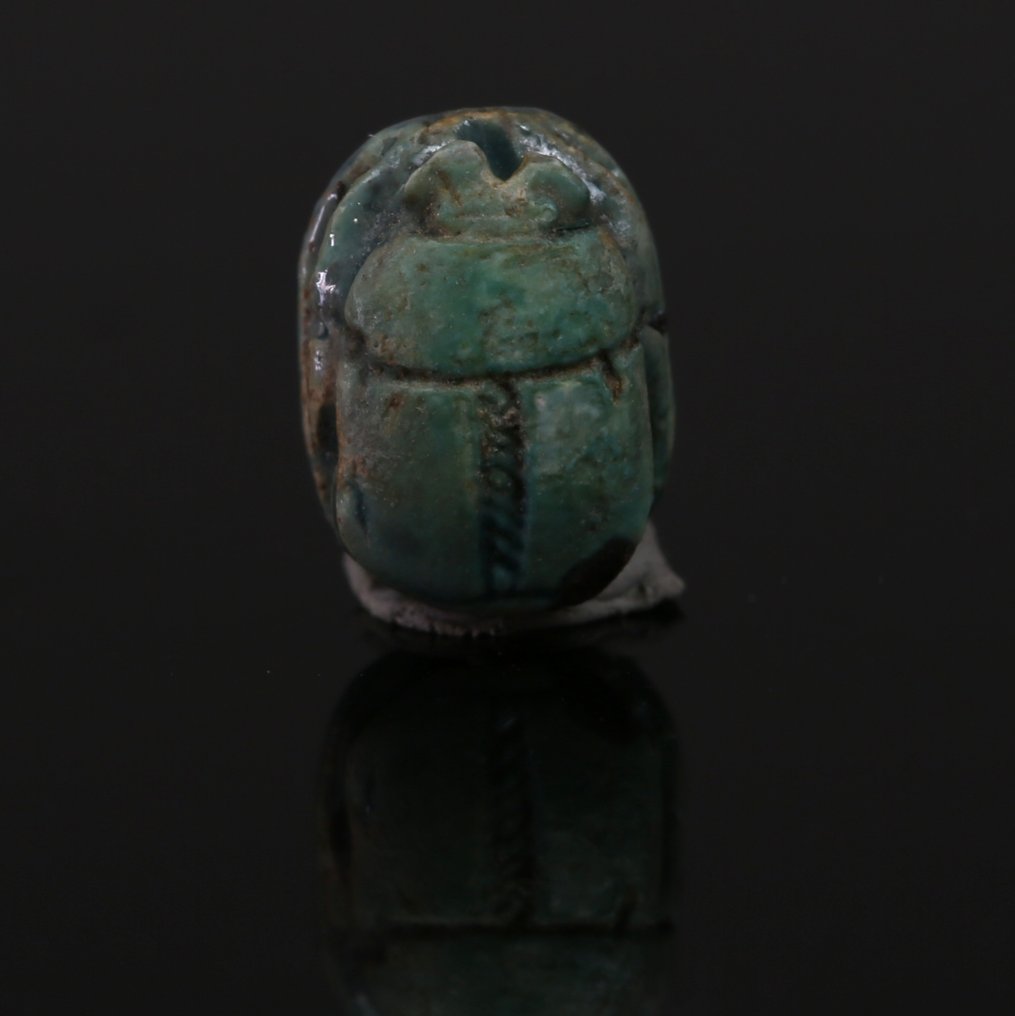
Ancient Egypt, Amarna period Faience Scarab, reign of Amenhotep III, Ex MUSEUM


01
day
23
hours
35
minutes
31
seconds
Current bid
€ 250
Reserve price not met

Expert
Selected by Ruth Garrido Vila
Directed the Ifergan Collection Museum, specialising in Phoenician and Mediterranean archaeology.
Estimate € 850 - € 1,000
 | €250 | |
|---|---|---|
 | €3 | |
| €2 | |
Catawiki Buyer Protection
Your payment’s safe with us until you receive your object.View details
Trustpilot 4.4 | 142645 reviews
Rated Excellent on Trustpilot.
Egyptian faience scarab amulet from the Amarna period (reign of Amenhotep III), 6 x 10 mm, in good condition; provenance Ex Museum Exhibition, Arbeitsgruppe für Biblische Archäologie, Germany (deaccessioned), acquired in 2024, with a Certificate of Authenticity and export licence.
AI-assisted summary
Description from the seller
ITEM: Scarab, reign of Amenhotep III
MATERIAL: Faience
CULTURE: Egyptian
PERIOD: Amarna period, 1391 – 1353 B.C
DIMENSIONS: 6 mm x 10 mm
CONDITION: Good condition
PROVENANCE: Ex Museum Exhibiton of the Arbeitsgruppe für Biblische Archäologie, Germany (Deaccession)
Comes with Certificate of Authenticity and Export license
If you bid outside the european union and win the item, we will have to apply for an export licence for your country and shipping will take 3 to 5 weeks.
Scarab amulets from the Amarna Period, particularly during the reign of Amenhotep III (circa 1391–1353 BCE), represent both continuity and innovation in Egyptian religious and artistic practices. Scarabs had long been used in ancient Egypt as protective amulets, symbols of rebirth, and tokens of personal identity. During Amenhotep III’s reign—an era of immense wealth, artistic refinement, and growing religious experimentation—scarabs continued to hold deep symbolic importance while often serving as diplomatic gifts or royal propaganda tools.
Scarabs from this period were typically made of glazed steatite or faience and bore inscriptions on their flat undersides. These could include the names and titles of the king, deities, or references to specific events. Under Amenhotep III, a distinctive group of large “commemorative scarabs” was produced, bearing long inscriptions detailing royal achievements such as lion hunts, building projects, or diplomatic marriages. These were widely distributed throughout the Near East, emphasizing the pharaoh’s power and divine favor.
Artistically, Amarna Period scarabs often reflect the increasing stylization and realism that characterized the broader visual culture of the time. While most still maintained the traditional beetle form associated with the god Khepri, some scarabs began to show more fluid and dynamic shapes, influenced by the artistic reforms that would fully blossom under Amenhotep IV (Akhenaten). The craftsmanship of these amulets was high, with finely carved hieroglyphs and smooth, glossy glazes in shades of blue and green—colors linked to life, regeneration, and the Nile.
In both funerary and diplomatic contexts, these scarabs served to reinforce the divine nature of the king and the protective power of Egyptian symbolism. Their widespread discovery—from Egyptian tombs to Levantine palaces—attests to Egypt’s far-reaching influence during Amenhotep III’s reign.
Seller's Story
Your Antiquarian offers ancient art and ancient coins. Our main objective is to offer the highest quality at the best price respecting and strictly complying with the laws of heritage protection and UNESCO heritage norms. Therefore, all the pieces that are published come from private collections in which the provenance can be checked or international auctions. All our antiquities and coins are accompanied by their Certificate of Authenticity. We have a no quibble 90 day return policy. At Your Antiquarian we are committed to helping disadvantaged groups and for this reason a portion of each purchase is donated to charities to help people in need.
Translated by Google TranslateITEM: Scarab, reign of Amenhotep III
MATERIAL: Faience
CULTURE: Egyptian
PERIOD: Amarna period, 1391 – 1353 B.C
DIMENSIONS: 6 mm x 10 mm
CONDITION: Good condition
PROVENANCE: Ex Museum Exhibiton of the Arbeitsgruppe für Biblische Archäologie, Germany (Deaccession)
Comes with Certificate of Authenticity and Export license
If you bid outside the european union and win the item, we will have to apply for an export licence for your country and shipping will take 3 to 5 weeks.
Scarab amulets from the Amarna Period, particularly during the reign of Amenhotep III (circa 1391–1353 BCE), represent both continuity and innovation in Egyptian religious and artistic practices. Scarabs had long been used in ancient Egypt as protective amulets, symbols of rebirth, and tokens of personal identity. During Amenhotep III’s reign—an era of immense wealth, artistic refinement, and growing religious experimentation—scarabs continued to hold deep symbolic importance while often serving as diplomatic gifts or royal propaganda tools.
Scarabs from this period were typically made of glazed steatite or faience and bore inscriptions on their flat undersides. These could include the names and titles of the king, deities, or references to specific events. Under Amenhotep III, a distinctive group of large “commemorative scarabs” was produced, bearing long inscriptions detailing royal achievements such as lion hunts, building projects, or diplomatic marriages. These were widely distributed throughout the Near East, emphasizing the pharaoh’s power and divine favor.
Artistically, Amarna Period scarabs often reflect the increasing stylization and realism that characterized the broader visual culture of the time. While most still maintained the traditional beetle form associated with the god Khepri, some scarabs began to show more fluid and dynamic shapes, influenced by the artistic reforms that would fully blossom under Amenhotep IV (Akhenaten). The craftsmanship of these amulets was high, with finely carved hieroglyphs and smooth, glossy glazes in shades of blue and green—colors linked to life, regeneration, and the Nile.
In both funerary and diplomatic contexts, these scarabs served to reinforce the divine nature of the king and the protective power of Egyptian symbolism. Their widespread discovery—from Egyptian tombs to Levantine palaces—attests to Egypt’s far-reaching influence during Amenhotep III’s reign.
Seller's Story
Your Antiquarian offers ancient art and ancient coins. Our main objective is to offer the highest quality at the best price respecting and strictly complying with the laws of heritage protection and UNESCO heritage norms. Therefore, all the pieces that are published come from private collections in which the provenance can be checked or international auctions. All our antiquities and coins are accompanied by their Certificate of Authenticity. We have a no quibble 90 day return policy. At Your Antiquarian we are committed to helping disadvantaged groups and for this reason a portion of each purchase is donated to charities to help people in need.
Translated by Google TranslateDetails
Culture
Ancient Egypt, Amarna period
Century/timeframe
Amarna period, 1391 - 1353 B.C
Name of object
Scarab, reign of Amenhotep III, Ex MUSEUM
Acquired from
Private collection
Year acquired
2024
Material
Faience
Country acquired from
Germany
Condition
Good
Previous owner acquired from
Antique market
Previous owner - year acquired
1970
Previous owner - country acquired from
Germany
I verify that I have obtained this object legally and that I am allowed to sell it
Yes
Authenticity
Original/official
Sold by
Disclaimer
The seller was informed by Catawiki about documentation requirements and guarantees the following: - the object was legally obtained, - the seller has the right to sell and/or export the object, as relevant, - the seller will provide the necessary provenance information and arrange required documentation and permits/licenses, as applicable and as per local laws, - the seller will notify the buyer of any delays in obtaining permits/licenses. By bidding, you acknowledge that import documentation may be required depending on your country of residence and that obtaining permits/licenses may cause delays in the delivery of your object.
The seller was informed by Catawiki about documentation requirements and guarantees the following: - the object was legally obtained, - the seller has the right to sell and/or export the object, as relevant, - the seller will provide the necessary provenance information and arrange required documentation and permits/licenses, as applicable and as per local laws, - the seller will notify the buyer of any delays in obtaining permits/licenses. By bidding, you acknowledge that import documentation may be required depending on your country of residence and that obtaining permits/licenses may cause delays in the delivery of your object.
