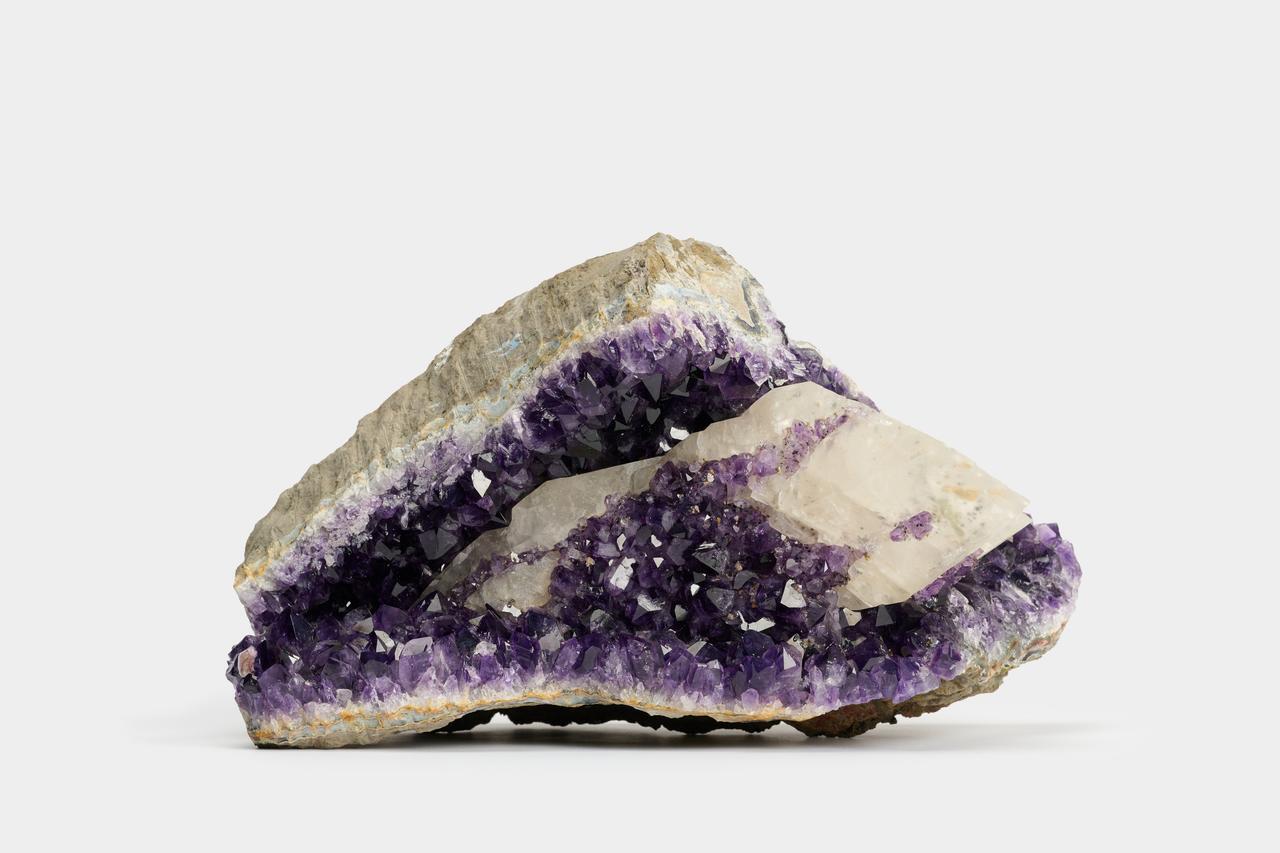
95g Ruby Zoisite Skull – Whorl Pattern, Night Jaw – Collector's Piece - 4.8 x 3.5 x 3.2 cm Skull- 95 g


02
days
03
hours
05
minutes
59
seconds

No bids placed
Catawiki Buyer Protection
Your payment’s safe with us until you receive your object.View details
Trustpilot 4.4 | 142645 reviews
Rated Excellent on Trustpilot.
Rubin-zoisite skull specimen (Schädel) with zoisite matrix containing ruby and hornblende inclusions, weighing 95 g and measuring 4.8 × 3.5 × 3.2 cm, originating from the Mundarara Mine, Longido District, Arusha Region, Tanzania.
AI-assisted summary
Description from the seller
What at first glance appears to be deliberately applied painting is, in fact, the record of colossal tectonic forces. During the metamorphism when zoisite, ruby, and hornblende came together to form this rock, the material was subjected not only to immense heat but also to directed pressure—a shear that forced all elongated minerals to align along specific flow lines. The dark hornblende, naturally stalk-like and flexible, followed this pressure most readily: it did not align straight, but in undulating, sometimes whirling bands, just as driftwood yields to the course of a river.
This swirling motion is exhibited by this skull in unmistakable clarity: in the lower jaw, the hornblende coalesces into a closed, almost mask-like black area, while it dissolves over the rest of the skull into lively, dynamic lines — not a random pattern, but frozen movement from a time when the rock itself was still shapeable.
Mineralogically, ruby-zoisite remains a metamorphic rock: zoisite — named after the Austrian collector Baron Sigmund Zois — forms the green matrix, pierced by opaque, chromium-tinted ruby (corundum) and that same black hornblende. The only known deposit lies in the Mundarara mine in the Longido District, Arusha Region, Tanzania.
Material: ruby-zoisite (anyolite) – zoisite with ruby (corundum) and hornblende inclusions
Origin: Mundarara Mine, Longido District, Arusha Region, Tanzania
Dimensions: 4.8 x 3.5 x 3.2 cm
Weight: 95 g
Special features: pronounced, swirl-like hornblende pattern; closed, mask-like darkening on the lower jaw
Seller's Story
Ich lasse mich immer wieder von der Schönheit der Natur überraschen und berühren. Mineralien und Edelsteine empfinde ich als Verkörperung jener Perfektion und Harmonie, die allem Sein zugrunde liegt. In ihnen verdichtet sich die Essenz der Erde – kristallisiert für die Ewigkeit und doch in jedem Stück einzigartig.
Jedes Mineral, das ich anbiete, ist von mir persönlich ausgewählt. Nicht nach bloßem Glanz, sondern nach dem Gefühl von Wahrhaftigkeit, das es in mir hervorruft. So findet nur das seinen Weg in meine Hände – und weiter in Ihre –, was ich selbst als würdig empfinde, in seiner Schönheit weitergereicht zu werden.
In meinem Handeln leiten mich Ehrlichkeit, Sorgfalt und die Freude am Teilen dieser Schätze. Ich verstehe mich dabei weniger als Händler, sondern vielmehr als Vermittler zwischen der Natur und den Menschen, die bereit sind, ihre Geschenke mit Achtsamkeit anzunehmen.
What at first glance appears to be deliberately applied painting is, in fact, the record of colossal tectonic forces. During the metamorphism when zoisite, ruby, and hornblende came together to form this rock, the material was subjected not only to immense heat but also to directed pressure—a shear that forced all elongated minerals to align along specific flow lines. The dark hornblende, naturally stalk-like and flexible, followed this pressure most readily: it did not align straight, but in undulating, sometimes whirling bands, just as driftwood yields to the course of a river.
This swirling motion is exhibited by this skull in unmistakable clarity: in the lower jaw, the hornblende coalesces into a closed, almost mask-like black area, while it dissolves over the rest of the skull into lively, dynamic lines — not a random pattern, but frozen movement from a time when the rock itself was still shapeable.
Mineralogically, ruby-zoisite remains a metamorphic rock: zoisite — named after the Austrian collector Baron Sigmund Zois — forms the green matrix, pierced by opaque, chromium-tinted ruby (corundum) and that same black hornblende. The only known deposit lies in the Mundarara mine in the Longido District, Arusha Region, Tanzania.
Material: ruby-zoisite (anyolite) – zoisite with ruby (corundum) and hornblende inclusions
Origin: Mundarara Mine, Longido District, Arusha Region, Tanzania
Dimensions: 4.8 x 3.5 x 3.2 cm
Weight: 95 g
Special features: pronounced, swirl-like hornblende pattern; closed, mask-like darkening on the lower jaw
Seller's Story
Ich lasse mich immer wieder von der Schönheit der Natur überraschen und berühren. Mineralien und Edelsteine empfinde ich als Verkörperung jener Perfektion und Harmonie, die allem Sein zugrunde liegt. In ihnen verdichtet sich die Essenz der Erde – kristallisiert für die Ewigkeit und doch in jedem Stück einzigartig.
Jedes Mineral, das ich anbiete, ist von mir persönlich ausgewählt. Nicht nach bloßem Glanz, sondern nach dem Gefühl von Wahrhaftigkeit, das es in mir hervorruft. So findet nur das seinen Weg in meine Hände – und weiter in Ihre –, was ich selbst als würdig empfinde, in seiner Schönheit weitergereicht zu werden.
In meinem Handeln leiten mich Ehrlichkeit, Sorgfalt und die Freude am Teilen dieser Schätze. Ich verstehe mich dabei weniger als Händler, sondern vielmehr als Vermittler zwischen der Natur und den Menschen, die bereit sind, ihre Geschenke mit Achtsamkeit anzunehmen.
Details
Sold by