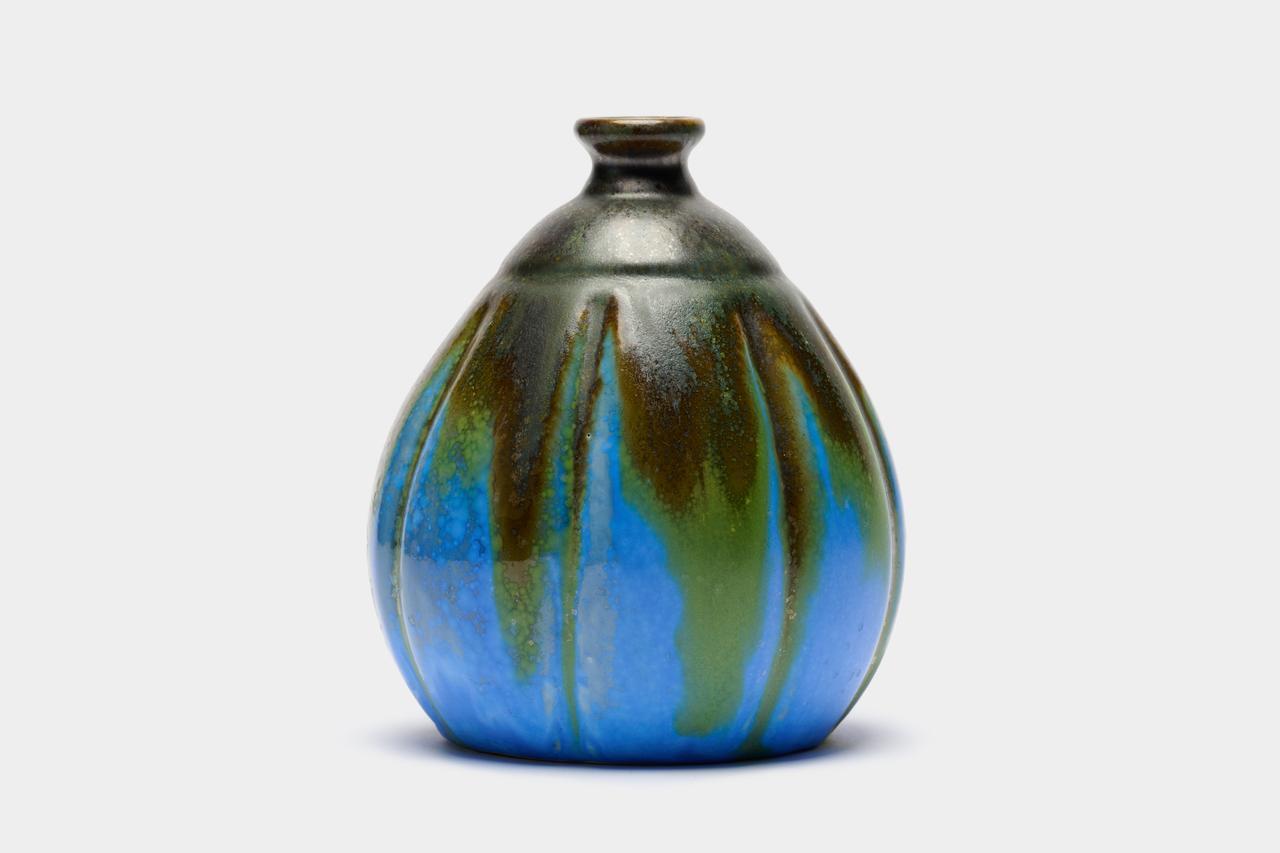
Fives Lille - Gustave De Bruyn - Vase - Ceramic


08
days
02
hours
11
minutes
50
seconds
Starting bid
€ 1
Reserve price not met

Expert
Selected by Michel Karis
Art historian with extensive experience working at various auction houses in antiques.
Estimate € 200 - € 220
No bids placed
Catawiki Buyer Protection
Your payment’s safe with us until you receive your object.View details
Trustpilot 4.4 | 142947 reviews
Rated Excellent on Trustpilot.
Lot of two vases by Gustave De Bruyn for Fives Lille, model 4340 with lily of the valley and edelweiss decoration; Vase 1: height 32.5 cm, diameter 15.5 cm, signature on base; Vase 2: height 29 cm, width 12 cm, floral relief with multicoloured glaze, base marked 4414 and atelier mark.
AI-assisted summary
Description from the seller
Gustave De Bruyn (Leuven 1838- Lille 1916) vase from Fives Lille. Model 4340 with lily of the valley and edelweiss-deco. The vase bears the signature of De Bruyn on the bottom. Gustave De Bruyn patented in 1885 lead-oxide-free enameling with superior quality, awarded the silver medal at the Paris World Exhibition in 1889
Vase 1 :
Height 32.5 cm, Width 19.5 cm, Diameter 15.5 cm. Excellent condition, no chips, cracks or real scratches.
The faïencerie De Bruyn
An iconic earthenware factory from Fives-Lille
The De Bruyn earthenware factory, located in Fives-Lille in the north of France, is one of the leading manufacturers of French pottery production at the end of the 19th century. Founded by Antoine Gustave De Bruyn, a ceramicist of Belgian origin born in Leuven, it settled in Lille in 1864 and quickly developed significantly.
At that time, Fives was an industrial center in full expansion, offering a favorable environment for large-scale production. The De Bruyn earthenware factory employed several hundred workers and specialized in the production of decorative and tableware.
A characteristic line of production: barbotine and natural decorations
The reputation of De Bruyn rests largely on its production of barbotine, a technique using liquid clay paste to create relief decorations.
From the 1880s, the factory developed a wide range of products:
* zoomorphic or anthropomorphic jugs
* vases and plant pots with floral décor
* garden flower boxes and decorative objects
These pieces, often colorful and expressive, fit squarely within the Art Nouveau movement, with motifs inspired by nature and organic forms.
An industrial history marked by market developments
After strong growth at the end of the 19th century, the De Bruyn earthenware factory experienced the economic developments of the 20th century.
The company remained active until mid-century, before being taken over in 1950 and then definitively ceased its activities in 1962.
This disappearance today explains why these pieces are found exclusively on the antique market and among collectors.
Signatures and identification of De Bruyn ceramics
The De Bruyn pieces are usually marked under the base, with several variations per period:
* the inscription "Fives-Lille"
* the signature "De Bruyn" or "G. De Bruyn"
* relief stamp with initials or symbol (The De Bruyn logo is a D woven into a B, in the middle of an anchor)
* accompanying model number
Some signatures can appear in relief within the material, especially on the barbotine pieces, and are sometimes accompanied by the remark MADE IN FRANCE.
Vase 2 :
Beautiful antique vase by Belgian ceramicist Gustave De Bruyn (1881–1947), active in Fives-Lille (France). This vase was produced in the period 1920–1935 and is a fine example of his work during the transition from Art Nouveau to Art Deco.
Height: 29 cm Width: 12 cm Decor: floral motifs in relief, with glossy multicolored glaze
Marks on the underside: casting number 4414 and workshop marking
Excellent condition, without cracks, chips or any other possible blemishes.
Gustave De Bruyn (Leuven 1838- Lille 1916) vase from Fives Lille. Model 4340 with lily of the valley and edelweiss-deco. The vase bears the signature of De Bruyn on the bottom. Gustave De Bruyn patented in 1885 lead-oxide-free enameling with superior quality, awarded the silver medal at the Paris World Exhibition in 1889
Vase 1 :
Height 32.5 cm, Width 19.5 cm, Diameter 15.5 cm. Excellent condition, no chips, cracks or real scratches.
The faïencerie De Bruyn
An iconic earthenware factory from Fives-Lille
The De Bruyn earthenware factory, located in Fives-Lille in the north of France, is one of the leading manufacturers of French pottery production at the end of the 19th century. Founded by Antoine Gustave De Bruyn, a ceramicist of Belgian origin born in Leuven, it settled in Lille in 1864 and quickly developed significantly.
At that time, Fives was an industrial center in full expansion, offering a favorable environment for large-scale production. The De Bruyn earthenware factory employed several hundred workers and specialized in the production of decorative and tableware.
A characteristic line of production: barbotine and natural decorations
The reputation of De Bruyn rests largely on its production of barbotine, a technique using liquid clay paste to create relief decorations.
From the 1880s, the factory developed a wide range of products:
* zoomorphic or anthropomorphic jugs
* vases and plant pots with floral décor
* garden flower boxes and decorative objects
These pieces, often colorful and expressive, fit squarely within the Art Nouveau movement, with motifs inspired by nature and organic forms.
An industrial history marked by market developments
After strong growth at the end of the 19th century, the De Bruyn earthenware factory experienced the economic developments of the 20th century.
The company remained active until mid-century, before being taken over in 1950 and then definitively ceased its activities in 1962.
This disappearance today explains why these pieces are found exclusively on the antique market and among collectors.
Signatures and identification of De Bruyn ceramics
The De Bruyn pieces are usually marked under the base, with several variations per period:
* the inscription "Fives-Lille"
* the signature "De Bruyn" or "G. De Bruyn"
* relief stamp with initials or symbol (The De Bruyn logo is a D woven into a B, in the middle of an anchor)
* accompanying model number
Some signatures can appear in relief within the material, especially on the barbotine pieces, and are sometimes accompanied by the remark MADE IN FRANCE.
Vase 2 :
Beautiful antique vase by Belgian ceramicist Gustave De Bruyn (1881–1947), active in Fives-Lille (France). This vase was produced in the period 1920–1935 and is a fine example of his work during the transition from Art Nouveau to Art Deco.
Height: 29 cm Width: 12 cm Decor: floral motifs in relief, with glossy multicolored glaze
Marks on the underside: casting number 4414 and workshop marking
Excellent condition, without cracks, chips or any other possible blemishes.
Details
Era
1900-2000
Weight
2800 g
Country of origin
France
Designer/artist/maker
Gustave De Bruyn
Material
Ceramic
Manufacturer/brand
Fives Lille
Condition
Excellent condition: barely used with minimal signs of wear
Height
32 cm
Width
20 cm
Depth
20 cm
Diameter
15 cm
Estimated period
1910-1920
Sold by