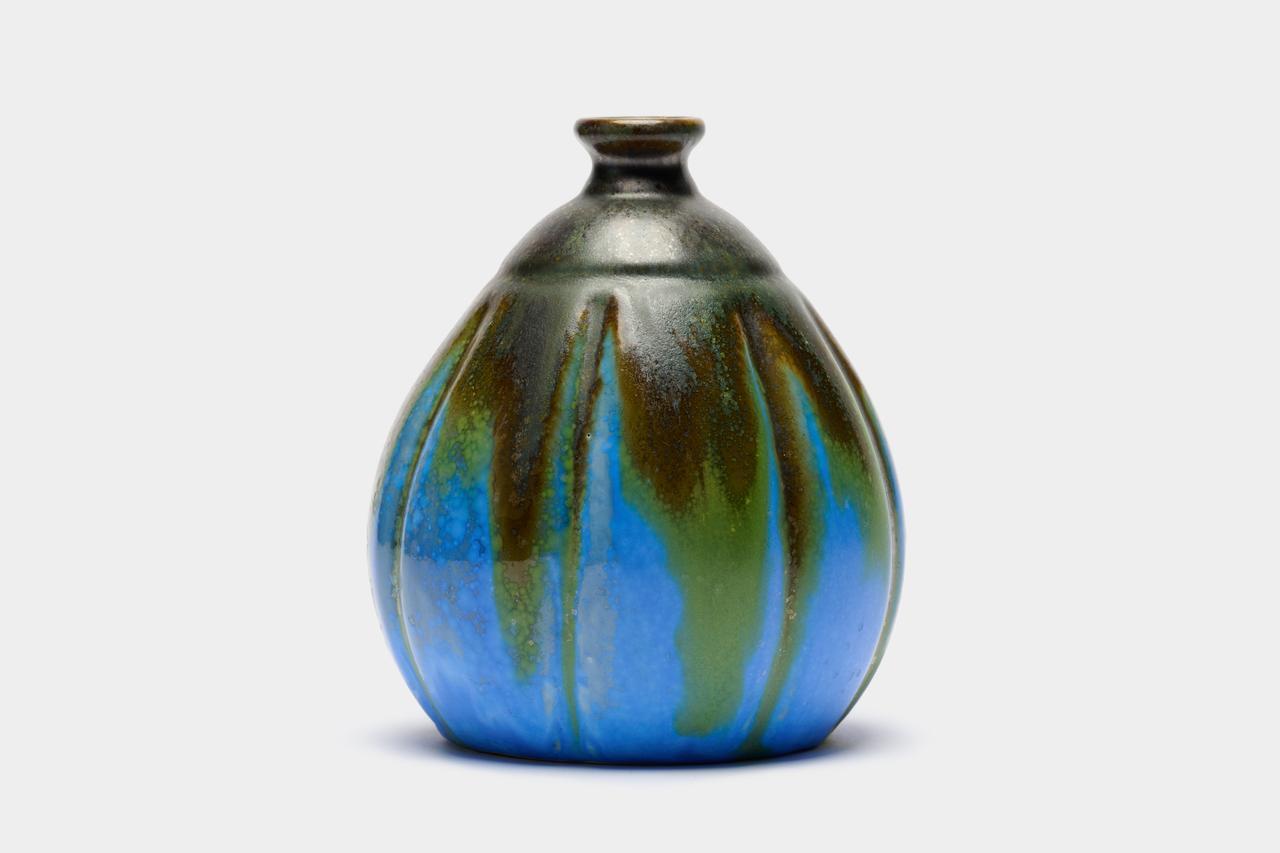
Lötz Witwe, Loetz - Vase - 'Crete Vesuvian' - Iridescent glass


04
days
16
hours
34
minutes
36
seconds
Current bid
€ 61
Reserve price not met

Expert
Selected by Michel Karis
Art historian with extensive experience working at various auction houses in antiques.
Estimate € 550 - € 650
 | €61 | |
|---|---|---|
 | €58 | |
 | €55 |
Catawiki Buyer Protection
Your payment’s safe with us until you receive your object.View details
Trustpilot 4.4 | 142857 reviews
Rated Excellent on Trustpilot.
Loetz-Witwe iridescent glass vase, model 'Crete Vesuvian', Art Nouveau, circa 1901, 15.5 cm high and about 13 cm in diameter, in excellent condition.
AI-assisted summary
Description from the seller
Johann Loetz Witwe, Klostermühle, Austria – Art Nouveau vase with decor ‘Vesuvian’ – 1901.
‘Vesuvian’ has a matte iridescent bright-green surface based on a Crete backing, with Crete applications in the form of large drops (dikkopjes) [note: likely ‘drops’].
This information can be found in the Loetz catalog by Jan Mergl from 2003 and on the Loetz glass website.
The vase is in excellent condition with only minor signs of aging. Nicely polished pontil. The vase is 15.5 cm high and the widest diameter is about 13 cm.
Photos are part of the description. It is carefully packed, insured, and shipped to your home with a tracking code. We do not ship outside the EU and to (non-EU) countries with a special customs status.
Lötz/Loetz was founded in 1840 by Johann Lötz and was a Bohemian company that belonged to the Austro-Hungarian Empire. In 1879 a grandson of Lötz, Max Ritter-Von Spaun, took over the business from his grandmother and kept the name Joh. Lötz Witwe.
From that moment Johann Lötz Witwe really began to make a name for itself; they developed new innovative glass techniques, but also their design and vivid colors were completely revolutionary. They designed exceptional shapes and vases, luxurious items, which they sold in luxury shops in Vienna, Berlin, Hamburg, Paris, London, Milan, Brussels, and Madrid. It quickly made them very well known and famous.
It was the period when Art Nouveau flourished. They used organic forms; nature was their model, often the shapes were formed organically by bending the hot glass with pliers to create uneven forms.
Loetz took part in various world exhibitions, including the famous 1900 World’s Fair in Paris. They were awarded numerous prizes for participation in world exhibitions. Their designs were popular, also in the United States. They were able to make iridescent glass. In short, Loetz had become a byword. And that is still the case.
Loetz also worked closely with other glass manufacturers and with various artists, such as Josef Hoffmann, Koloman Moser, and other artists of the Wiener Werkstätte. In the twenties, neater vases were produced more in line with the Art Deco style of that era.
Loetz existed until 1940; after a bombing the factory burned down completely.
Loetz glass remains very popular and is collected worldwide; in addition, their oeuvre can be found in many museum collections.
Johann Loetz Witwe, Klostermühle, Austria – Art Nouveau vase with decor ‘Vesuvian’ – 1901.
‘Vesuvian’ has a matte iridescent bright-green surface based on a Crete backing, with Crete applications in the form of large drops (dikkopjes) [note: likely ‘drops’].
This information can be found in the Loetz catalog by Jan Mergl from 2003 and on the Loetz glass website.
The vase is in excellent condition with only minor signs of aging. Nicely polished pontil. The vase is 15.5 cm high and the widest diameter is about 13 cm.
Photos are part of the description. It is carefully packed, insured, and shipped to your home with a tracking code. We do not ship outside the EU and to (non-EU) countries with a special customs status.
Lötz/Loetz was founded in 1840 by Johann Lötz and was a Bohemian company that belonged to the Austro-Hungarian Empire. In 1879 a grandson of Lötz, Max Ritter-Von Spaun, took over the business from his grandmother and kept the name Joh. Lötz Witwe.
From that moment Johann Lötz Witwe really began to make a name for itself; they developed new innovative glass techniques, but also their design and vivid colors were completely revolutionary. They designed exceptional shapes and vases, luxurious items, which they sold in luxury shops in Vienna, Berlin, Hamburg, Paris, London, Milan, Brussels, and Madrid. It quickly made them very well known and famous.
It was the period when Art Nouveau flourished. They used organic forms; nature was their model, often the shapes were formed organically by bending the hot glass with pliers to create uneven forms.
Loetz took part in various world exhibitions, including the famous 1900 World’s Fair in Paris. They were awarded numerous prizes for participation in world exhibitions. Their designs were popular, also in the United States. They were able to make iridescent glass. In short, Loetz had become a byword. And that is still the case.
Loetz also worked closely with other glass manufacturers and with various artists, such as Josef Hoffmann, Koloman Moser, and other artists of the Wiener Werkstätte. In the twenties, neater vases were produced more in line with the Art Deco style of that era.
Loetz existed until 1940; after a bombing the factory burned down completely.
Loetz glass remains very popular and is collected worldwide; in addition, their oeuvre can be found in many museum collections.
Details
Era
1900-2000
Glass type
Iridescent glass
Country of origin
Austria
Model
'Crete Vesuvian'
Material
Glass
Style
Art Nouveau
Manufacturer/brand
Loetz, Lötz Witwe
Condition
Excellent condition: barely used with minimal signs of wear
Height
15.5 cm
Width
13 cm
Depth
13 cm
Estimated period
1900-1910
Sold by