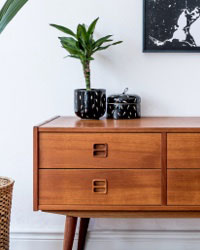
Writing desk - Wood


03
days
17
hours
49
minutes
53
seconds
Starting bid
€ 1
Reserve price not met

Expert
Selected by Elena Napoleone
Holds a bachelor's degree in history of art and architecture, with 12 years of experience in decorative arts.
Estimate € 550 - € 700
No bids placed
Catawiki Buyer Protection
Your payment’s safe with us until you receive your object.View details
Trustpilot 4.4 | 142376 reviews
Rated Excellent on Trustpilot.
Description from the seller
Secretary / bureau with a bowed-front in mahogany and burr walnut root — Georgian style / Queen Anne Revival, England, c. 1925–1940.
Object: tilting-top desk / bureau
International designation: slant-front bureau or fall-front writing bureau
Origin: England
Era: first half of the 20th century
Dating: c. 1925–1940
Style: Georgian Revival / Queen Anne Revival
Materials: wooden frame in mahogany tone; fronts and top panel veneered with burr walnut root, with light inlaid fillets; brass hardware
Dimensions: 102 × 100 × 43 cm
Important English tilting-top desk with serpentine front, made in mahogany and partially veneered in burr walnut root, with fine light fillets and brass hardware.
The lower part features three full-width drawers with slightly bowing or serpentine fronts. Above these, two smaller side-by-side drawers emerge, totaling five drawers externally.
The fronts display rectangular burr walnut root accents with strong natural figure, bordered by ultra-fine light fillets. The same decoration is repeated on the vertical stiles of the case and, especially, on the large panel of the tilting-top.
Each drawer retains two articulated brass pulls of traditional design, accompanied by lock-plate mirrors.
The base ends in a molded, undulating profile skirting, supported by bracket-foot-type feet, another feature directly derived from early 18th-century English furniture.
Top and writing surface:
The large slanting top presents a broad central burr walnut root field, framed by a light fillet and a more homogeneous-toned moulding.
When opened, the top becomes a generous horizontal writing surface, supported by the structure itself.
It is interesting to note that the interior of the top appears to have been left without the usual leather or baeta covering. There may have originally been a writing skiver or similar surface, though this cannot be stated for certain.
Interior:
The interior is quite complete and constitutes one of the most interesting aspects of the piece.
It presents a symmetric arrangement of:
- five small open compartments for correspondence;
- vertical dividers with cut profiles;
- five small internal drawers;
- a small central cabinet with arched door and lock;
- ample writing surface.
This arrangement deliberately reproduces the so-called fitted interior of English Georigian bureaux.
Style:
There is a deliberate blend of references.
The extensive use of burr walnut, the tilting bureau, and the carved feet point chiefly to Queen Anne / George I, while the serpentine front and certain proportions evolved later within the Georgian tradition.
Condition:
The piece shows signs of use compatible with roughly 90–100 years.
Notes show scratches and abrasions, small knocks, wear on moldings, occasional losses of finish, marks on the writing plane, and small losses especially at the base and feet.
The burr walnut root is overall well preserved and continues to provide excellent decorative impact.
The brass pulls show good uniformity.
Secretary / bureau with a bowed-front in mahogany and burr walnut root — Georgian style / Queen Anne Revival, England, c. 1925–1940.
Object: tilting-top desk / bureau
International designation: slant-front bureau or fall-front writing bureau
Origin: England
Era: first half of the 20th century
Dating: c. 1925–1940
Style: Georgian Revival / Queen Anne Revival
Materials: wooden frame in mahogany tone; fronts and top panel veneered with burr walnut root, with light inlaid fillets; brass hardware
Dimensions: 102 × 100 × 43 cm
Important English tilting-top desk with serpentine front, made in mahogany and partially veneered in burr walnut root, with fine light fillets and brass hardware.
The lower part features three full-width drawers with slightly bowing or serpentine fronts. Above these, two smaller side-by-side drawers emerge, totaling five drawers externally.
The fronts display rectangular burr walnut root accents with strong natural figure, bordered by ultra-fine light fillets. The same decoration is repeated on the vertical stiles of the case and, especially, on the large panel of the tilting-top.
Each drawer retains two articulated brass pulls of traditional design, accompanied by lock-plate mirrors.
The base ends in a molded, undulating profile skirting, supported by bracket-foot-type feet, another feature directly derived from early 18th-century English furniture.
Top and writing surface:
The large slanting top presents a broad central burr walnut root field, framed by a light fillet and a more homogeneous-toned moulding.
When opened, the top becomes a generous horizontal writing surface, supported by the structure itself.
It is interesting to note that the interior of the top appears to have been left without the usual leather or baeta covering. There may have originally been a writing skiver or similar surface, though this cannot be stated for certain.
Interior:
The interior is quite complete and constitutes one of the most interesting aspects of the piece.
It presents a symmetric arrangement of:
- five small open compartments for correspondence;
- vertical dividers with cut profiles;
- five small internal drawers;
- a small central cabinet with arched door and lock;
- ample writing surface.
This arrangement deliberately reproduces the so-called fitted interior of English Georigian bureaux.
Style:
There is a deliberate blend of references.
The extensive use of burr walnut, the tilting bureau, and the carved feet point chiefly to Queen Anne / George I, while the serpentine front and certain proportions evolved later within the Georgian tradition.
Condition:
The piece shows signs of use compatible with roughly 90–100 years.
Notes show scratches and abrasions, small knocks, wear on moldings, occasional losses of finish, marks on the writing plane, and small losses especially at the base and feet.
The burr walnut root is overall well preserved and continues to provide excellent decorative impact.
The brass pulls show good uniformity.
Details
Era
1900-2000
Style subtype
Georgian Style
Country of origin
United Kingdom
Material
Wood
Style
Antique
Condition
Good condition - used with small signs of aging & blemishes
Height
102 cm
Width
100 cm
Depth
43 cm
Estimated period
1920-1930
Sold by