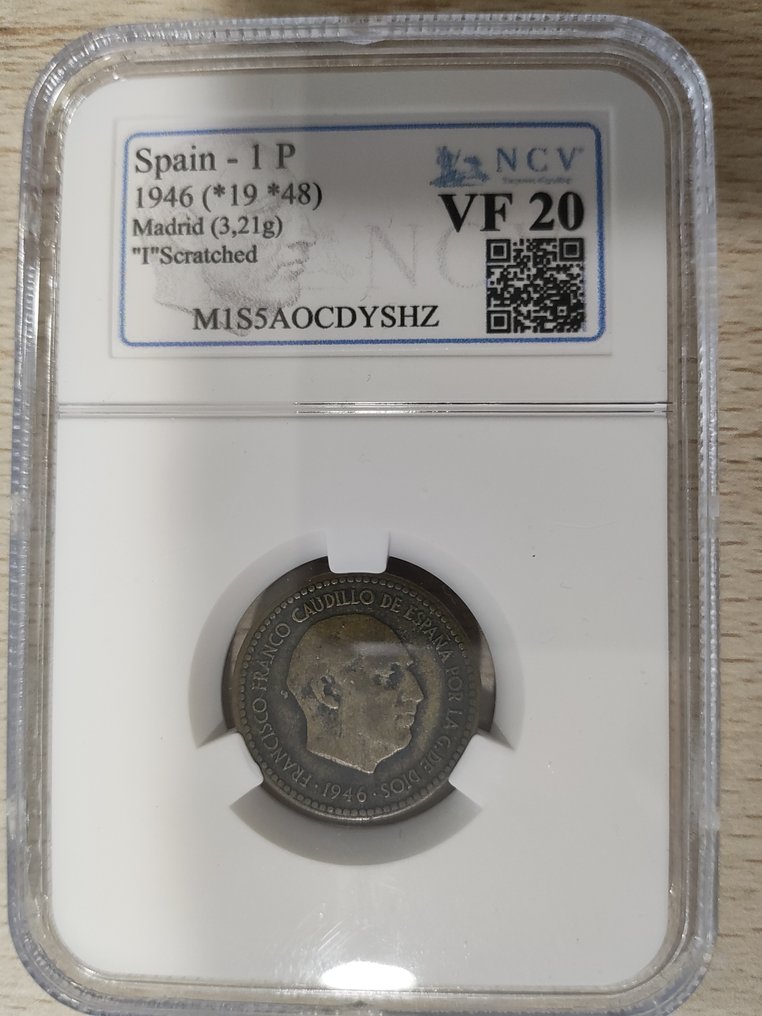
Spain. Francisco Franco. 1 Peseta 1946 estrella 48 (Rarísima)


03
days
02
hours
40
minutes
20
seconds
Current bid
€ 3,050
Reserve price not met

Expert
Selected by Carmen Vera Gutiérrez
Experienced antique appraiser specialising in Spanish coins with deep knowledge of ancient currency.
Estimate € 3,700 - € 4,100
 | €3,050 | |
|---|---|---|
| €2,850 | |
| €2,650 | |
Catawiki Buyer Protection
Your payment’s safe with us until you receive your object.View details
Trustpilot 4.4 | 144154 reviews
Rated Excellent on Trustpilot.
Spanish 1946 estrella 48 (Rarísima) historical coin from Spain, in NCV condition, part of the World Coins series (pre-2000, no euro), with one item.
AI-assisted summary
Description from the seller
After two years of testing, a law dated December 18, 1946 established the foundations of a new and ambitious monetary system, which relied on silver and nickel as base metals. But deficiencies in the supply of metal and machinery, due to the European postwar period, caused the government’s plans to fail, and these coins never came to light. From then on, successive laws put coins of other metals into circulation, which gradually formed the system that would be definitive.
Thus, on December 27, 1947, a new law extended the validity of the peseta coin created in 1944, but with a new design: the effigy of the Head of State on the obverse. This had already been foreseen in the mentioned 1946 law, and for that purpose the well-known sculptor Mariano Benlliure had been commissioned to create a engraving with the bust of Francisco Franco.
The work that Benlliure carried out in low relief, suitable for medal-making, was not suitable for coins, since coins require a lower relief (that does not protrude above the edge). Nevertheless, from Benlliure’s engraving dies were manufactured, with which some coins were minted in early 1948. And these turned out to be defective, because when reducing the engraving to the size of the dies, almost all the relief of the original design was lost; as a result, production had to be interrupted.
Details
Era
1900-2000
Country/province
Spain
Year/period and variation
1946 estrella 48 (Rarísima)
Ruler
Francisco Franco
Denomination
1 Peseta
Condition
NCV
Number of objects
1
Theme
History
Coin type
World Coins (non Euro coins pre-2000)
Sold by