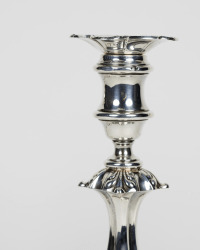
Salt cellar (2) - .925 silver


05
days
10
hours
38
minutes
05
seconds
Starting bid
€ 1
No reserve price

Expert
Selected by Inés Fernández
Specialised in Spanish and Portuguese silver with over 10 years in galleries and auctions.
Estimate € 170 - € 200
No bids placed
Catawiki Buyer Protection
Your payment’s safe with us until you receive your object.View details
Trustpilot 4.4 | 142553 reviews
Rated Excellent on Trustpilot.
Description from the seller
Elegant English silver salt cellar made in Sterling 925, hallmarked in Birmingham in 1906, during the Edwardian period.
The piece presents an attractive four-lobed shape with a wavy outline and a gently domed body, supported on four small decorative feet with botanical motifs.
The interior is gilded, creating an elegant contrast with the exterior silver. The gilded interior, in addition to its decorative function, was traditionally used in silver salt cellars to protect the metal from direct contact with salt.
The piece retains its official English hallmarks, including the passant lion for Sterling 925 silver, the Birmingham Assay Office anchor, and the date letter “g,” corresponding to 1906.
The salt cellar is accompanied by a small spoon of Russian manufacture, circa 1940–1950, made of plated metal, of a period later than the salt cellar.
Material: Sterling Silver 925
Origin: Birmingham, England
Date: 1906
Period: Edwardian Era
Interior: Gilded
Weight of the salt cellar: 29 g
Dimensions:
Length: 6 cm
Width: 5 cm
Height: 3 cm
Spoon: Russia, circa 1940–1950, plated metal.
Good overall condition consistent with its age, with patina and minor signs of use typical of the passage of time.
The photographs are part of the description.
Elegant English silver salt cellar made in Sterling 925, hallmarked in Birmingham in 1906, during the Edwardian period.
The piece presents an attractive four-lobed shape with a wavy outline and a gently domed body, supported on four small decorative feet with botanical motifs.
The interior is gilded, creating an elegant contrast with the exterior silver. The gilded interior, in addition to its decorative function, was traditionally used in silver salt cellars to protect the metal from direct contact with salt.
The piece retains its official English hallmarks, including the passant lion for Sterling 925 silver, the Birmingham Assay Office anchor, and the date letter “g,” corresponding to 1906.
The salt cellar is accompanied by a small spoon of Russian manufacture, circa 1940–1950, made of plated metal, of a period later than the salt cellar.
Material: Sterling Silver 925
Origin: Birmingham, England
Date: 1906
Period: Edwardian Era
Interior: Gilded
Weight of the salt cellar: 29 g
Dimensions:
Length: 6 cm
Width: 5 cm
Height: 3 cm
Spoon: Russia, circa 1940–1950, plated metal.
Good overall condition consistent with its age, with patina and minor signs of use typical of the passage of time.
The photographs are part of the description.
Details
Era
1900-2000
Gross weight
29 g
Silver type
.925 silver
Number of objects
2
Country of origin
United Kingdom
Material
Silver-plated alpaca, Silver
Style
Antique
Condition
Good condition - used with small signs of ageing
Height
3 cm
Width
5 cm
Depth
6 cm
Estimated period
1900-1910
Sold by