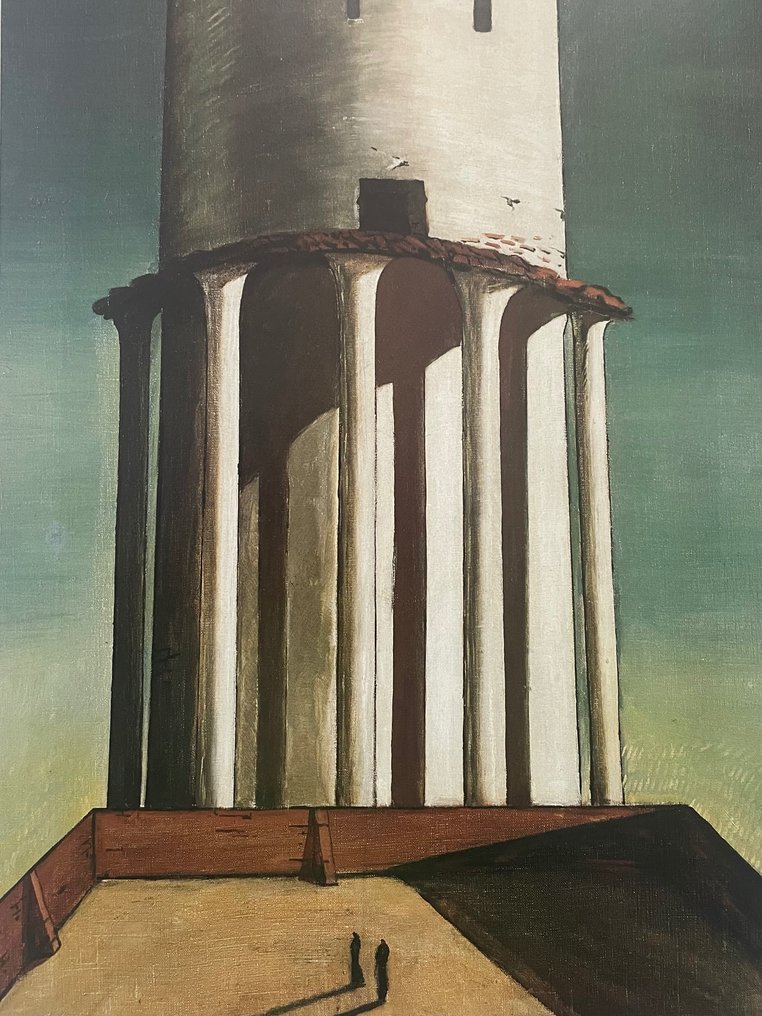
Giorgio de Chirico (after) - La Grande Torre - Achenbach Licensed Print



06
days
06
hours
14
minutes
14
seconds
Current bid
€ 25
Reserve price not met

Expert
Selected by Annick van Itallie
Graduated in art history with over 25 years' experience in antiques and applied arts appraisal.
Estimate € 150 - € 200
 | €25 | |
|---|---|---|
| €2 | |
| €1 |
Catawiki Buyer Protection
Your payment’s safe with us until you receive your object.View details
Trustpilot 4.4 | 143856 reviews
Rated Excellent on Trustpilot.
Luxury edition lithograph after Giorgio de Chirico, La Grande Torre, licensed by Achenbach Art Edition, Düsseldorf, in excellent condition, 60 x 90 cm, printed on 250 g Fine Art satin paper, Germany, 1986.
AI-assisted summary
Description from the seller
Offset Lithography after Giorgio de Chirico.
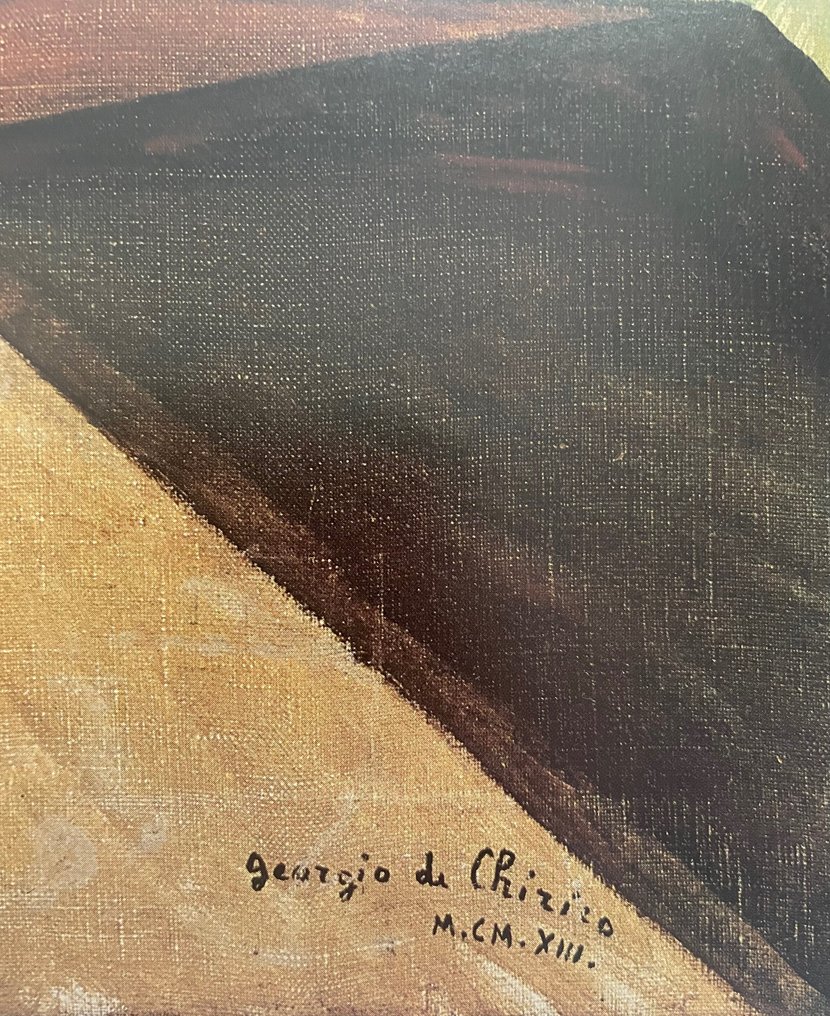
Reproduction of the work “La Grande Torre” by De Chirico in 1913.
Luxury edition on thick satin Fine Art paper (250g).
Published by Achenbach Art Edition, Düsseldorf.
Authorized print with copyright and legally registered serial number.
Large format.
- Sheet dimensions: 60 x 90 cm
- Year: 1986
- Condition: Excellent (this work has never been framed or exhibited, always kept in a professional art folder, and therefore remains in perfect condition).
- Provenance: Private collection.
The work will be carefully handled and packaged in a reinforced cardboard box. The shipment will be traceable with a tracking number.
The shipment will also include transportation insurance for the final value of the work, with full reimbursement in case of loss or damage, at no cost to the buyer.
(*) Sonia Delaunay was born on November 14, 1885, in Gradizhsk, Ukraine.
Her birth name was Sarah Ilínichna Stern. She was born into a very modest family, who, unable to take care of her, sent her to live with her uncle and aunt Anna and Heinrich Terk in Saint Petersburg, who legally adopted her.
She traveled across Europe with her adoptive parents and learned several languages.
She studied art at the Academy of Fine Arts in Karlsruhe, Germany.
In 1904, she moved to Paris, where her artistic talent was influenced by the Post-Impressionists and Fauves.
She married Wilhelm Uhde in 1909. A year later she divorced and married the painter Robert Delaunay. They were the parents of a son, Charles Delaunay.
From 1910, she drew inspiration from the forms of Cubism and the colors of Gauguin, van Gogh, among others, developing a style based on the juxtaposition of pure colors split into prisms.
With this technique she produced paintings, fabrics, and designed costumes for the theater.
During 1911 she created her first “simultaneous dress,” combining different very colorful fabrics. A few years later she applied this technique to upholstery as well, which was used by other designers in later decades.
In 1917 and 1918 she contributed to set and costume design for Sergei Diaghilev’s Ballets Russes.
In the following years she mainly dedicated herself to fashion design and hand-printed fabrics with bright colors that revolutionized textile design.
In 1925 she participated in the International Exhibition of Decorative Arts in Paris, where she presented her ‘simultaneous boutique,’ which brought her great popularity.
From 1940 her pictorial style became softer and simpler, especially in gouaches, where her chromatic experiments reached new heights of refinement.
In 1964, the National Museum of Modern Art in Paris received a donation of 58 of her works, which were exhibited in the Louvre, making her the first woman to have her paintings exhibited in this museum during her lifetime.
The French state named her Officer of the Legion of Honor in 1975.
She published the book Nouvelles Irons jusqu’au soleil (1978), reflections on her work and that of her husband Robert.
Sonia Delaunay died on December 5, 1979, at the age of 94, in Paris, France.
Seller's Story
EsKobARTE carefully selects artworks from renowned and emerging artists worldwide, offering them here at affordable prices. *** HIGH-QUALITY LICENSED PRINTS *** We only sell authentic artworks and high-quality licensed prints. *** WE ARE PROFESSIONALS *** You can bid on our items with complete confidence. Over 1000 positive reviews on Catawiki attest to our professionalism. *** SECURE, CERTIFIED, AND INSURED SHIPPING *** All our items are carefully packaged in eco-friendly cardboard boxes. We work with the best courier services (UPS, DPD, DHL, FedEx) to guarantee the best service and tracking. Our shipments also include insurance against damage or loss, at no extra cost to the buyer *** COMBINED SHIPPING *** If you purchase multiple items -even from different auctions- you will only pay for shipping once *** ANY QUESTIONS? *** Feel free to contact us via chat, we will gladly assist you as soon as possible *** THANK YOU AND GOOD LUCK WITH YOUR BIDS! ***
Translated by Google TranslateOffset Lithography after Giorgio de Chirico.
Reproduction of the work “La Grande Torre” by De Chirico in 1913.
Luxury edition on thick satin Fine Art paper (250g).
Published by Achenbach Art Edition, Düsseldorf.
Authorized print with copyright and legally registered serial number.
Large format.
- Sheet dimensions: 60 x 90 cm
- Year: 1986
- Condition: Excellent (this work has never been framed or exhibited, always kept in a professional art folder, and therefore remains in perfect condition).
- Provenance: Private collection.
The work will be carefully handled and packaged in a reinforced cardboard box. The shipment will be traceable with a tracking number.
The shipment will also include transportation insurance for the final value of the work, with full reimbursement in case of loss or damage, at no cost to the buyer.
(*) Sonia Delaunay was born on November 14, 1885, in Gradizhsk, Ukraine.
Her birth name was Sarah Ilínichna Stern. She was born into a very modest family, who, unable to take care of her, sent her to live with her uncle and aunt Anna and Heinrich Terk in Saint Petersburg, who legally adopted her.
She traveled across Europe with her adoptive parents and learned several languages.
She studied art at the Academy of Fine Arts in Karlsruhe, Germany.
In 1904, she moved to Paris, where her artistic talent was influenced by the Post-Impressionists and Fauves.
She married Wilhelm Uhde in 1909. A year later she divorced and married the painter Robert Delaunay. They were the parents of a son, Charles Delaunay.
From 1910, she drew inspiration from the forms of Cubism and the colors of Gauguin, van Gogh, among others, developing a style based on the juxtaposition of pure colors split into prisms.
With this technique she produced paintings, fabrics, and designed costumes for the theater.
During 1911 she created her first “simultaneous dress,” combining different very colorful fabrics. A few years later she applied this technique to upholstery as well, which was used by other designers in later decades.
In 1917 and 1918 she contributed to set and costume design for Sergei Diaghilev’s Ballets Russes.
In the following years she mainly dedicated herself to fashion design and hand-printed fabrics with bright colors that revolutionized textile design.
In 1925 she participated in the International Exhibition of Decorative Arts in Paris, where she presented her ‘simultaneous boutique,’ which brought her great popularity.
From 1940 her pictorial style became softer and simpler, especially in gouaches, where her chromatic experiments reached new heights of refinement.
In 1964, the National Museum of Modern Art in Paris received a donation of 58 of her works, which were exhibited in the Louvre, making her the first woman to have her paintings exhibited in this museum during her lifetime.
The French state named her Officer of the Legion of Honor in 1975.
She published the book Nouvelles Irons jusqu’au soleil (1978), reflections on her work and that of her husband Robert.
Sonia Delaunay died on December 5, 1979, at the age of 94, in Paris, France.
Seller's Story
EsKobARTE carefully selects artworks from renowned and emerging artists worldwide, offering them here at affordable prices. *** HIGH-QUALITY LICENSED PRINTS *** We only sell authentic artworks and high-quality licensed prints. *** WE ARE PROFESSIONALS *** You can bid on our items with complete confidence. Over 1000 positive reviews on Catawiki attest to our professionalism. *** SECURE, CERTIFIED, AND INSURED SHIPPING *** All our items are carefully packaged in eco-friendly cardboard boxes. We work with the best courier services (UPS, DPD, DHL, FedEx) to guarantee the best service and tracking. Our shipments also include insurance against damage or loss, at no extra cost to the buyer *** COMBINED SHIPPING *** If you purchase multiple items -even from different auctions- you will only pay for shipping once *** ANY QUESTIONS? *** Feel free to contact us via chat, we will gladly assist you as soon as possible *** THANK YOU AND GOOD LUCK WITH YOUR BIDS! ***
Translated by Google TranslateDetails
Era
1900-2000
Designer/artist
Giorgio de Chirico (after)
Poster title
La Grande Torre - Achenbach Licensed Print
Subject
Art
Country of origin
Germany
Condition
A (excellent - mint condition)
Height
90 cm
Width
60 cm