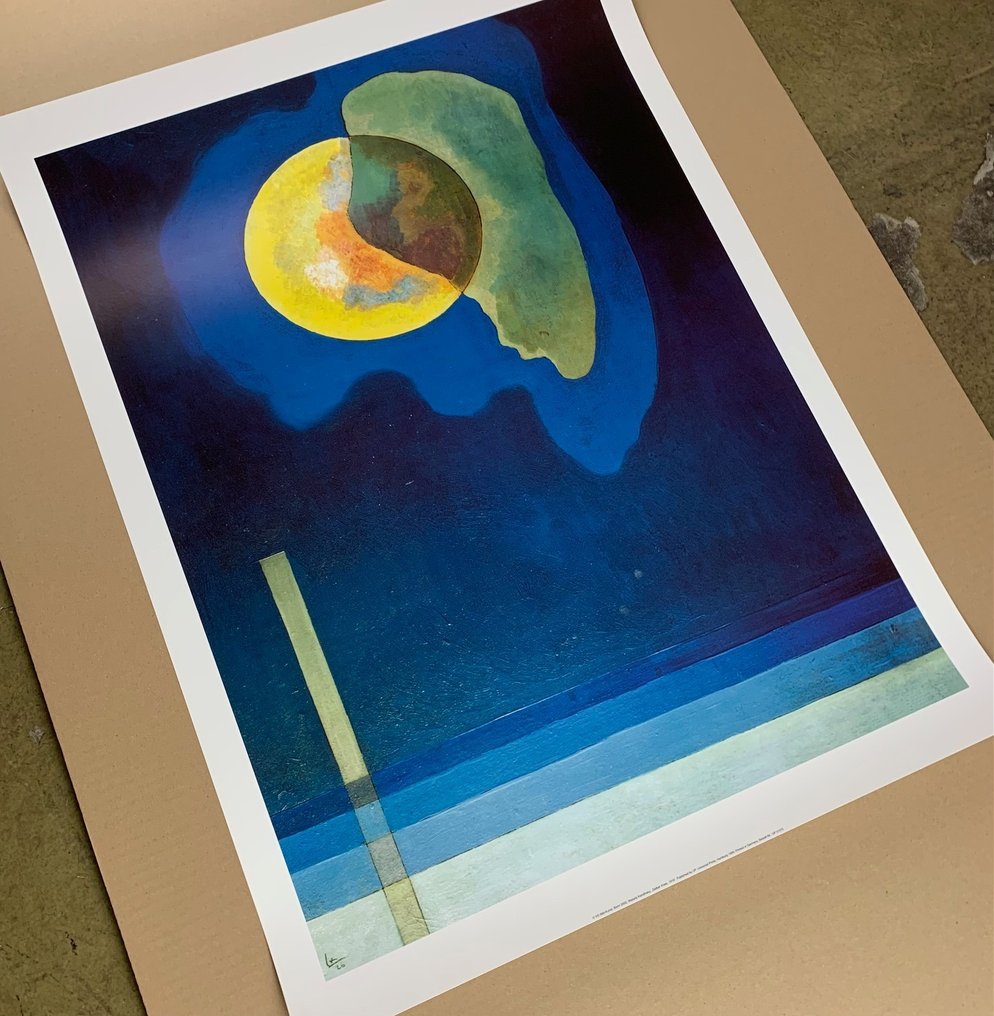
Wassily Kandinsky (1866-1944) - Yellow Circle 1926 - Artprint - 80 x 60 cm



03
days
00
hours
52
minutes
32
seconds
Current bid
€ 1
No reserve price

Expert
Selected by Alexander Fahl
Art historian with over 10 years' experience and expertise in Italian design.
Estimate € 150 - € 200
 | €1 |
|---|
Catawiki Buyer Protection
Your payment’s safe with us until you receive your object.View details
Trustpilot 4.4 | 143216 reviews
Rated Excellent on Trustpilot.
Wassily Kandinsky, Yellow Circle 1926, an artprint in 80 × 60 cm, offset print on stiff paper, in excellent condition, made in Germany in the Moderne style.
AI-assisted summary
Description from the seller
Beautiful, expressive fine art print by Wassily Kandinsky in the 78 x 59 cm format with the title Yellow Circle. The work is a high-quality print on sturdy paper and in very good condition.
Artist: Wassily Kandinsky
Title: Gelber Kreis
Type: Fine art print
Technique: Offset printing on sturdy paper
Originality: Reproduction
Sheet size: 78 x 59 cm
Condition: New
Origin: Art publishing house
Era: Abstract art
Nationality: Russian art
Wassily Kandinsky:
Wassily Kandinsky, born December 16, 1866 in Moscow, Russia, and died December 13, 1944 in Neuilly-sur-Seine, France, was a pioneer of abstract art and one of the most influential artists of the 20th century. As a co-founder of the artist group “Der Blaue Reiter” and a significant theorist of abstract painting, Kandinsky revolutionized the art world with his radical approaches to color and form.
Kandinsky began his artistic career relatively late, having studied law and economics in Moscow first. He moved to Munich, where he continued his artistic training at the Academy of Fine Arts. In Munich, Kandinsky came into contact with various artists and art movements that influenced his early works. The decorative quality of Art Nouveau and the experimental color of Fauvism, represented by artists such as Henri Matisse and André Derain, left clear traces in Kandinsky’s work. Matisse’s “Dance” and Derain’s “Charing Cross Bridge” show how color and form can become dynamic and emotional compositions, a technique Kandinsky further developed.
A decisive turning point in Kandinsky’s career was his encounter with Post-Impressionism and the works of artists such as Paul Cézanne and Vincent van Gogh. Cézanne’s structured approach to composition and Van Gogh’s intensive color palette and emotional expressiveness influenced Kandinsky’s move toward abstraction. Works like “Impression III (Concert)” (1911) show the gradual dissolution of representational forms in favor of pure expressive painting. Cézanne’s “Mont Sainte-Victoire” and Van Gogh’s “Starry Night” provide examples of the experimental handling of form and color, which can also be found in Kandinsky’s works.
Kandinsky was also heavily inspired by music, particularly the compositions of Richard Wagner and Arnold Schoenberg. These musical influences led him to believe that painting, like music, could dispense with objects and subjects and still convey emotional and spiritual experiences. Following this idea, Kandinsky developed his theory of the “inner necessity,” which he formulated in his groundbreaking book “Concerning the Spiritual in Art” (1911). These theories influenced not only his own works but also a whole generation of artists, including Paul Klee and Franz Marc, his colleagues in the group “Der Blaue Reiter.” Klee’s playful and often symbolic compositions, as well as Marc’s colorful and spiritual animal representations, show close kinship with Kandinsky’s ideas.
Kandinsky’s paintings such as “Composition VII” (1913) and “Improvisation 28” (1912) are outstanding examples of his abstract phase, in which he sought to express pure feelings and mental states through color and form. These works significantly influenced the development of Abstract Art, particularly artists such as Piet Mondrian and Kasimir Malewich (Kandinsky used “Kaszimir Malewicz” in German spellings). Mondrian’s “Composition with Red, Blue, and Yellow” and Malewich’s “Black Square” are direct successors of Kandinsky’s idea of reducing art to its most fundamental elements. Both artists adopted Kandinsky’s approach of using color and form as a means to create harmony and spiritual order.
Related artists to Kandinsky:
Paul Klee, Franz Marc, August Macke, Gabriele Münter, Alexej von Jawlensky, Lyonel Feininger, Arnold Schoenberg, Johannes Itten, Oskar Schlemmer, László Moholy-Nagy, Piet Mondrian, Kasimir Malewich, El Lissitzky, Jean Arp, Sophie Taeuber-Arp, Robert Delaunay, Sonia Delaunay, Fernand Léger, Marcel Duchamp, Georges Braque, Pablo Picasso, Henri Matisse, Paul Cézanne, Marc Chagall, Egon Schiele, Oskar Kokoschka, Hans Richter, Max Ernst, Hans Hofmann, Vladimir Tatlin
Shipping information:
We roll prints onto rigid cardboard cores, wrap them with corrugated cardboard, and ship them in sturdy boxes. Shipping is with a tracking number for shipment tracking.
About us:
We have been active in the art trade for over 20 years and have extensive experience in the professional handling and shipping of artworks.
- No shipping Canary Islands, Taiwan -
Seller's Story
We have been operating several online shops in the art trade for over 20 years. On the one hand, we specialize in rare art prints, exhibition posters and collectible reproductions, and on the other hand, we trade in art editions and originals by well-known contemporary artists.
The works we offer all come from the respective publishers, art galleries and institutions such as museums that published them in close cooperation with the artists. The works you find with us are often several decades old, in perfect or good condition and without a previous private owner.
We place particular emphasis on professional packaging. Nothing is more annoying than purchasing a rare print that arrives damaged due to poor or inadequate packaging.
If you have any questions about the works on offer, we are always happy to help you!
Translated by Google TranslateBeautiful, expressive fine art print by Wassily Kandinsky in the 78 x 59 cm format with the title Yellow Circle. The work is a high-quality print on sturdy paper and in very good condition.
Artist: Wassily Kandinsky
Title: Gelber Kreis
Type: Fine art print
Technique: Offset printing on sturdy paper
Originality: Reproduction
Sheet size: 78 x 59 cm
Condition: New
Origin: Art publishing house
Era: Abstract art
Nationality: Russian art
Wassily Kandinsky:
Wassily Kandinsky, born December 16, 1866 in Moscow, Russia, and died December 13, 1944 in Neuilly-sur-Seine, France, was a pioneer of abstract art and one of the most influential artists of the 20th century. As a co-founder of the artist group “Der Blaue Reiter” and a significant theorist of abstract painting, Kandinsky revolutionized the art world with his radical approaches to color and form.
Kandinsky began his artistic career relatively late, having studied law and economics in Moscow first. He moved to Munich, where he continued his artistic training at the Academy of Fine Arts. In Munich, Kandinsky came into contact with various artists and art movements that influenced his early works. The decorative quality of Art Nouveau and the experimental color of Fauvism, represented by artists such as Henri Matisse and André Derain, left clear traces in Kandinsky’s work. Matisse’s “Dance” and Derain’s “Charing Cross Bridge” show how color and form can become dynamic and emotional compositions, a technique Kandinsky further developed.
A decisive turning point in Kandinsky’s career was his encounter with Post-Impressionism and the works of artists such as Paul Cézanne and Vincent van Gogh. Cézanne’s structured approach to composition and Van Gogh’s intensive color palette and emotional expressiveness influenced Kandinsky’s move toward abstraction. Works like “Impression III (Concert)” (1911) show the gradual dissolution of representational forms in favor of pure expressive painting. Cézanne’s “Mont Sainte-Victoire” and Van Gogh’s “Starry Night” provide examples of the experimental handling of form and color, which can also be found in Kandinsky’s works.
Kandinsky was also heavily inspired by music, particularly the compositions of Richard Wagner and Arnold Schoenberg. These musical influences led him to believe that painting, like music, could dispense with objects and subjects and still convey emotional and spiritual experiences. Following this idea, Kandinsky developed his theory of the “inner necessity,” which he formulated in his groundbreaking book “Concerning the Spiritual in Art” (1911). These theories influenced not only his own works but also a whole generation of artists, including Paul Klee and Franz Marc, his colleagues in the group “Der Blaue Reiter.” Klee’s playful and often symbolic compositions, as well as Marc’s colorful and spiritual animal representations, show close kinship with Kandinsky’s ideas.
Kandinsky’s paintings such as “Composition VII” (1913) and “Improvisation 28” (1912) are outstanding examples of his abstract phase, in which he sought to express pure feelings and mental states through color and form. These works significantly influenced the development of Abstract Art, particularly artists such as Piet Mondrian and Kasimir Malewich (Kandinsky used “Kaszimir Malewicz” in German spellings). Mondrian’s “Composition with Red, Blue, and Yellow” and Malewich’s “Black Square” are direct successors of Kandinsky’s idea of reducing art to its most fundamental elements. Both artists adopted Kandinsky’s approach of using color and form as a means to create harmony and spiritual order.
Related artists to Kandinsky:
Paul Klee, Franz Marc, August Macke, Gabriele Münter, Alexej von Jawlensky, Lyonel Feininger, Arnold Schoenberg, Johannes Itten, Oskar Schlemmer, László Moholy-Nagy, Piet Mondrian, Kasimir Malewich, El Lissitzky, Jean Arp, Sophie Taeuber-Arp, Robert Delaunay, Sonia Delaunay, Fernand Léger, Marcel Duchamp, Georges Braque, Pablo Picasso, Henri Matisse, Paul Cézanne, Marc Chagall, Egon Schiele, Oskar Kokoschka, Hans Richter, Max Ernst, Hans Hofmann, Vladimir Tatlin
Shipping information:
We roll prints onto rigid cardboard cores, wrap them with corrugated cardboard, and ship them in sturdy boxes. Shipping is with a tracking number for shipment tracking.
About us:
We have been active in the art trade for over 20 years and have extensive experience in the professional handling and shipping of artworks.
- No shipping Canary Islands, Taiwan -
Seller's Story
We have been operating several online shops in the art trade for over 20 years. On the one hand, we specialize in rare art prints, exhibition posters and collectible reproductions, and on the other hand, we trade in art editions and originals by well-known contemporary artists.
The works we offer all come from the respective publishers, art galleries and institutions such as museums that published them in close cooperation with the artists. The works you find with us are often several decades old, in perfect or good condition and without a previous private owner.
We place particular emphasis on professional packaging. Nothing is more annoying than purchasing a rare print that arrives damaged due to poor or inadequate packaging.
If you have any questions about the works on offer, we are always happy to help you!
Translated by Google TranslateDetails
Artist
Wassily Kandinsky (1866-1944)
Title of artwork
Yellow Circle 1926 - Artprint - 80 x 60 cm
Technique
Offset print
Signature
Plate signed
Country of origin
Germany
Year
1926
Condition
Excellent condition
Height
80 cm
Width
60 cm
Style
Modern
Sold with frame
No
Period
19th century