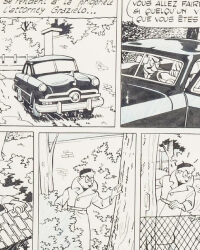
Louis Haché - Études de femmes


Starting bid
€ 1
Add to your favourites to get an alert when the auction starts.

Catawiki Buyer Protection
Your payment’s safe with us until you receive your object.View details
Trustpilot 4.4 | 143139 reviews
Rated Excellent on Trustpilot.
Description from the seller
These four pencil drawings by Louis Haché (1922-2013) present different studies of female figures in varied poses: these attitudes allow the artist to explore both facial expression and the proportions, volumes, and movement of the body.
Trained through extensive experience in illustration and comic art, Haché develops a strong mastery of figure drawing. His work as a realistic and didactic comic artist, notably for publications such as Tintin, is reflected in the precision of the line, the construction of silhouettes, and the attention paid to the characters’ postures. The fine hatching, shading effects, and contours that are more or less defined enable shaping the bodies and giving them relief.
The almost entirely blank backgrounds draw attention to the models and reinforce their presence. Some parts, deliberately more sketch-like, retain the spontaneity inherent in study drawings, while anatomical accuracy testifies to the know-how the artist acquired during his career as an illustrator and draftsman.
Thus the collection testifies to Haché’s interest in portraiture, the nude, and the observation of the model, at the boundary between artistic study and illustration. These sheets reveal a realistic and elegant style, nourished by his comic book experience, while hinting at a search for movement, softness, and expression.
Seller's Story
We are a law firm representing the artist's estate in the context of the sale of their works.
Translated by Google TranslateThese four pencil drawings by Louis Haché (1922-2013) present different studies of female figures in varied poses: these attitudes allow the artist to explore both facial expression and the proportions, volumes, and movement of the body.
Trained through extensive experience in illustration and comic art, Haché develops a strong mastery of figure drawing. His work as a realistic and didactic comic artist, notably for publications such as Tintin, is reflected in the precision of the line, the construction of silhouettes, and the attention paid to the characters’ postures. The fine hatching, shading effects, and contours that are more or less defined enable shaping the bodies and giving them relief.
The almost entirely blank backgrounds draw attention to the models and reinforce their presence. Some parts, deliberately more sketch-like, retain the spontaneity inherent in study drawings, while anatomical accuracy testifies to the know-how the artist acquired during his career as an illustrator and draftsman.
Thus the collection testifies to Haché’s interest in portraiture, the nude, and the observation of the model, at the boundary between artistic study and illustration. These sheets reveal a realistic and elegant style, nourished by his comic book experience, while hinting at a search for movement, softness, and expression.
Seller's Story
We are a law firm representing the artist's estate in the context of the sale of their works.
Translated by Google TranslateDetails
Sold by
Owner or reseller
Edition
Original
Artist
Louis Haché
Title of artwork
Études de femmes
Technique
Crayon, Pencil drawing
Signature
Hand signed, Signed
Country of origin
Belgium
Condition
Good condition
Height
59.5 cm
Width
42 cm
Weight
500 g
Depiction/theme
Portrait
Style
Realism
Period
1990-2000
Sold by