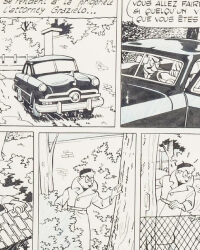
Berck (Berckmans, Arthur) - 1 Original page - Lombok - 1960


03
days
07
hours
48
minutes
51
seconds

 | €110 | |
|---|---|---|
 | €2 | |
| €1 |
Catawiki Buyer Protection
Your payment’s safe with us until you receive your object.View details
Trustpilot 4.4 | 142857 reviews
Rated Excellent on Trustpilot.
Original page from the Lombok series by Berck (Berckmans, Arthur), created in 1960, measuring 36.5 cm by 24.5 cm, in good condition.
AI-assisted summary
Description from the seller
About the draftsman;
Berck’s drawing style was influenced by Raymond Macherot (Chlorophyl) and André Franquin (Guust), “the best comic artist in the world,” according to Berck. Berck drew for a young audience with a wink of attention for adults. He believed that the drawing itself should be able to tell the story, but that the accompanying text provides the refinement that suits the work. He educated himself by watching old films and consulting books. As a child, Berck already loved drawing. He studied at the Sint-Lucas Institute in Brussels and studied anatomical drawing in Leuven. When he turned 18, he got a job with the Jesuits in Leuven where he did part-time administrative work and part-time illustrated contributions for the religious magazine Pro Apostolis. There he mainly adapted biographies of saints into comic stories. Eight years later he began working for the comic publisher Le Lombard, where he supplied illustrations for the magazine Chez Nous. He also designed advertising drawings for the ad agency Publiart. In 1958 he published in the weekly Spirou the strip Pechvogel (French: Strapontin), written by René Goscinny. This strip series revolved around a Paris taxi driver. In 1965, when Goscinny was too busy with the successful series Asterix, Pechvogel got a new writer, Acar. With him Berck continued the series for two more years. Berck’s humor is often a bit biting, especially in the stories he conceived himself. Afterwards he created the James Bond pastiche “Ken Krom,” but had to drop this series after protests from his publisher. With Yves Duval as writer, he drew the comic series Hansje, about a young drummer during Napoleon’s time. The comic is called in French Rataplan, a name that has nothing to do with the dog from the Lucky Luke series.
Together with Leo Loedts, Berck under the pseudonym “Studio Arle” created the comic series Wim and Eric: The Vanished Boat (1965) and the adventure series The Black Pinions (1965-1972) on scripts by Maurice Renders in the magazine Zonneland. In 1967 Berck left Tintin. He then went to work for Robbedoes, where he drew the series Captain Mulligan under the script of Yvan Delporte and Raymond Macherot. Mulligan was the captain of a tugboat in 1920s America during Prohibition. Two years later Berck proposed to Raoul Cauvin to make a detective comic. Cauvin had plenty of inspiration and used the same historical backdrop. Inspiration came from the television series The Untouchables. Cauvin created two main characters: Sammy Day (the small dark-haired one) and Jack Attaway (the tall blond and leader of the duo). In March 1970 the first Sammy adventure appeared in Robbedoes. At first the stories took place mainly in Chicago, later also in other parts of the world. Besides his strip series for Dupuis, he also published for the Dutch comic market the series De Donderpadjes, about a gang of scouts, and Lowietje, a series about an orphan who is also a wealthy heir. This series was later published in the French edition of Robbedoes as Lou. In Flanders he published together with Daniël Jansens the daily strip “Lombok” in Gazet van Antwerpen. From 1972 to 1974 he conceived the humorous science fiction series “Mischa” for the German Rolf Kauka studios in the magazine Primo, often together with Francis Bergèse, Raoul Cauvin, Guy Bollen or Lucien De Gieter. Berck retired in 1994. The artist Jean-Pol took over the series “Sammy.” During his career Berck would have liked to draw a humorous cowboy strip, but he never found the time. In 1973 Berck was a laureate of the Prix Saint-Michel for “Best humorous illustrator,” and again in 1975 together with Cauvin for the best humorous comic story Les gorilles font les fous (The bodyguards go nuts). In 1979 he also received a Bronze Adhemar for his entire body of work. Berck passed away in December 2020 at the age of 91.
This lot concerns an old page of LOMBOK. It is a page on which one has “worked” because it was used for several publications. A wonderful page of a comic from a period of which almost nothing is in circulation and almost never offered before.
See also the photos which form part of the description. The masterpiece will be well packed and sent by registered mail.
About the draftsman;
Berck’s drawing style was influenced by Raymond Macherot (Chlorophyl) and André Franquin (Guust), “the best comic artist in the world,” according to Berck. Berck drew for a young audience with a wink of attention for adults. He believed that the drawing itself should be able to tell the story, but that the accompanying text provides the refinement that suits the work. He educated himself by watching old films and consulting books. As a child, Berck already loved drawing. He studied at the Sint-Lucas Institute in Brussels and studied anatomical drawing in Leuven. When he turned 18, he got a job with the Jesuits in Leuven where he did part-time administrative work and part-time illustrated contributions for the religious magazine Pro Apostolis. There he mainly adapted biographies of saints into comic stories. Eight years later he began working for the comic publisher Le Lombard, where he supplied illustrations for the magazine Chez Nous. He also designed advertising drawings for the ad agency Publiart. In 1958 he published in the weekly Spirou the strip Pechvogel (French: Strapontin), written by René Goscinny. This strip series revolved around a Paris taxi driver. In 1965, when Goscinny was too busy with the successful series Asterix, Pechvogel got a new writer, Acar. With him Berck continued the series for two more years. Berck’s humor is often a bit biting, especially in the stories he conceived himself. Afterwards he created the James Bond pastiche “Ken Krom,” but had to drop this series after protests from his publisher. With Yves Duval as writer, he drew the comic series Hansje, about a young drummer during Napoleon’s time. The comic is called in French Rataplan, a name that has nothing to do with the dog from the Lucky Luke series.
Together with Leo Loedts, Berck under the pseudonym “Studio Arle” created the comic series Wim and Eric: The Vanished Boat (1965) and the adventure series The Black Pinions (1965-1972) on scripts by Maurice Renders in the magazine Zonneland. In 1967 Berck left Tintin. He then went to work for Robbedoes, where he drew the series Captain Mulligan under the script of Yvan Delporte and Raymond Macherot. Mulligan was the captain of a tugboat in 1920s America during Prohibition. Two years later Berck proposed to Raoul Cauvin to make a detective comic. Cauvin had plenty of inspiration and used the same historical backdrop. Inspiration came from the television series The Untouchables. Cauvin created two main characters: Sammy Day (the small dark-haired one) and Jack Attaway (the tall blond and leader of the duo). In March 1970 the first Sammy adventure appeared in Robbedoes. At first the stories took place mainly in Chicago, later also in other parts of the world. Besides his strip series for Dupuis, he also published for the Dutch comic market the series De Donderpadjes, about a gang of scouts, and Lowietje, a series about an orphan who is also a wealthy heir. This series was later published in the French edition of Robbedoes as Lou. In Flanders he published together with Daniël Jansens the daily strip “Lombok” in Gazet van Antwerpen. From 1972 to 1974 he conceived the humorous science fiction series “Mischa” for the German Rolf Kauka studios in the magazine Primo, often together with Francis Bergèse, Raoul Cauvin, Guy Bollen or Lucien De Gieter. Berck retired in 1994. The artist Jean-Pol took over the series “Sammy.” During his career Berck would have liked to draw a humorous cowboy strip, but he never found the time. In 1973 Berck was a laureate of the Prix Saint-Michel for “Best humorous illustrator,” and again in 1975 together with Cauvin for the best humorous comic story Les gorilles font les fous (The bodyguards go nuts). In 1979 he also received a Bronze Adhemar for his entire body of work. Berck passed away in December 2020 at the age of 91.
This lot concerns an old page of LOMBOK. It is a page on which one has “worked” because it was used for several publications. A wonderful page of a comic from a period of which almost nothing is in circulation and almost never offered before.
See also the photos which form part of the description. The masterpiece will be well packed and sent by registered mail.
Details
Item
Original page
Number of objects
1
Series
Lombok
Condition
Good condition
Artist
Berck (Berckmans, Arthur)
Year
1960
Width
36.5 cm
Height
24.5 cm