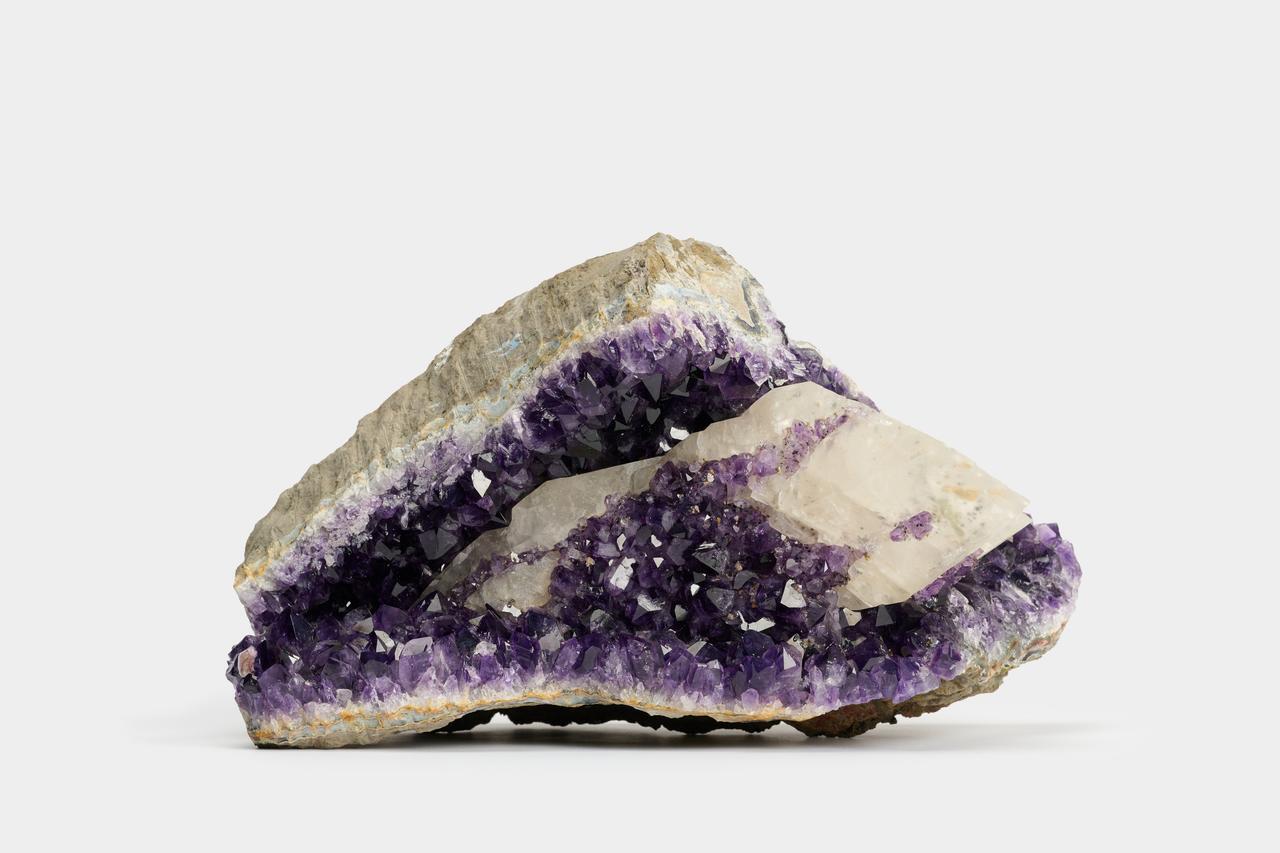
89g Hand-Carved Fluorite Skull – Thousand Peaks, Color Flow, Radiance – 4.8 x 3.4 x 3.1 cm Skull- 89 g


05
days
17
hours
03
minutes
09
seconds

 | €3 | |
|---|---|---|
 | €2 | |
| €1 |
Catawiki Buyer Protection
Your payment’s safe with us until you receive your object.View details
Trustpilot 4.4 | 143313 reviews
Rated Excellent on Trustpilot.
Fluorite skull sculpture from Brazil, weighing 89 g and measuring 4.8 x 3.4 x 3.1 cm, with a grey crystalline zone on the right half forming a mountainous relief and color transitions from pink to deep violet, and fluorite may fluoresce under UV light.
AI-assisted summary
Description from the seller
In the year 1113, an eighteen-year-old painter named Wang Ximeng completed at the court of Song Emperor Huizong a horizontal scroll nearly twelve meters long: “Thousand Li Rivers and Mountains.” The emperor is said to have personally tutored him. Peak after peak is lined up, countless blue and green tones composed from ground azurite and malachite. So painted with stone. It remained his only surviving work, for Wang Ximeng is said to have died only a few years later. The scroll today ranks among the greatest treasures of the Palace Museum in Beijing.
On the right half of this skull, the stone itself has painted its own mountains. A gray, finely crystalline zone rises there like a mountain range of thousands of tiny peaks, as if one looked from a great height over an entire land. The rest of the skull belongs to color: from delicate pink to garnet red it flows into deep violet, pierced by varying semi-transparency and soft transitions.
Fluorite owes its range of colors to so-called color centers. These are tiny defects in the crystal lattice that arise through natural radiation and, depending on the type, absorb different fractions of light. At the same time, fluorite gave a whole phenomenon its name: when physicist George Gabriel Stokes described the luminescence of certain substances under ultraviolet light in 1852, he named it “fluorescence” after this mineral.
Material: Fluorite (calcium fluoride, CaF₂)
Origin: Brazil
Dimensions: 4.8 x 3.4 x 3.1 cm
Weight: 89 g
Special features: Gray, finely crystalline zone on the right half of the skull with a mountainous relief; intense color transitions from pink to garnet red to deep violet with varying semi-transparency; fluorite can fluoresce under UV light (depends on the piece)
Seller's Story
Ich lasse mich immer wieder von der Schönheit der Natur überraschen und berühren. Mineralien und Edelsteine empfinde ich als Verkörperung jener Perfektion und Harmonie, die allem Sein zugrunde liegt. In ihnen verdichtet sich die Essenz der Erde – kristallisiert für die Ewigkeit und doch in jedem Stück einzigartig.
Jedes Mineral, das ich anbiete, ist von mir persönlich ausgewählt. Nicht nach bloßem Glanz, sondern nach dem Gefühl von Wahrhaftigkeit, das es in mir hervorruft. So findet nur das seinen Weg in meine Hände – und weiter in Ihre –, was ich selbst als würdig empfinde, in seiner Schönheit weitergereicht zu werden.
In meinem Handeln leiten mich Ehrlichkeit, Sorgfalt und die Freude am Teilen dieser Schätze. Ich verstehe mich dabei weniger als Händler, sondern vielmehr als Vermittler zwischen der Natur und den Menschen, die bereit sind, ihre Geschenke mit Achtsamkeit anzunehmen.
In the year 1113, an eighteen-year-old painter named Wang Ximeng completed at the court of Song Emperor Huizong a horizontal scroll nearly twelve meters long: “Thousand Li Rivers and Mountains.” The emperor is said to have personally tutored him. Peak after peak is lined up, countless blue and green tones composed from ground azurite and malachite. So painted with stone. It remained his only surviving work, for Wang Ximeng is said to have died only a few years later. The scroll today ranks among the greatest treasures of the Palace Museum in Beijing.
On the right half of this skull, the stone itself has painted its own mountains. A gray, finely crystalline zone rises there like a mountain range of thousands of tiny peaks, as if one looked from a great height over an entire land. The rest of the skull belongs to color: from delicate pink to garnet red it flows into deep violet, pierced by varying semi-transparency and soft transitions.
Fluorite owes its range of colors to so-called color centers. These are tiny defects in the crystal lattice that arise through natural radiation and, depending on the type, absorb different fractions of light. At the same time, fluorite gave a whole phenomenon its name: when physicist George Gabriel Stokes described the luminescence of certain substances under ultraviolet light in 1852, he named it “fluorescence” after this mineral.
Material: Fluorite (calcium fluoride, CaF₂)
Origin: Brazil
Dimensions: 4.8 x 3.4 x 3.1 cm
Weight: 89 g
Special features: Gray, finely crystalline zone on the right half of the skull with a mountainous relief; intense color transitions from pink to garnet red to deep violet with varying semi-transparency; fluorite can fluoresce under UV light (depends on the piece)
Seller's Story
Ich lasse mich immer wieder von der Schönheit der Natur überraschen und berühren. Mineralien und Edelsteine empfinde ich als Verkörperung jener Perfektion und Harmonie, die allem Sein zugrunde liegt. In ihnen verdichtet sich die Essenz der Erde – kristallisiert für die Ewigkeit und doch in jedem Stück einzigartig.
Jedes Mineral, das ich anbiete, ist von mir persönlich ausgewählt. Nicht nach bloßem Glanz, sondern nach dem Gefühl von Wahrhaftigkeit, das es in mir hervorruft. So findet nur das seinen Weg in meine Hände – und weiter in Ihre –, was ich selbst als würdig empfinde, in seiner Schönheit weitergereicht zu werden.
In meinem Handeln leiten mich Ehrlichkeit, Sorgfalt und die Freude am Teilen dieser Schätze. Ich verstehe mich dabei weniger als Händler, sondern vielmehr als Vermittler zwischen der Natur und den Menschen, die bereit sind, ihre Geschenke mit Achtsamkeit anzunehmen.
Details
Main mineral
89g Hand-Carved Fluorite Skull – Thousand Peaks, Color Flow, Radiance – 4.8 x 3.4 x 3.1 cm
Mineral form
Skull
Weight
89 g
Country of origin
Brazil
Sold by