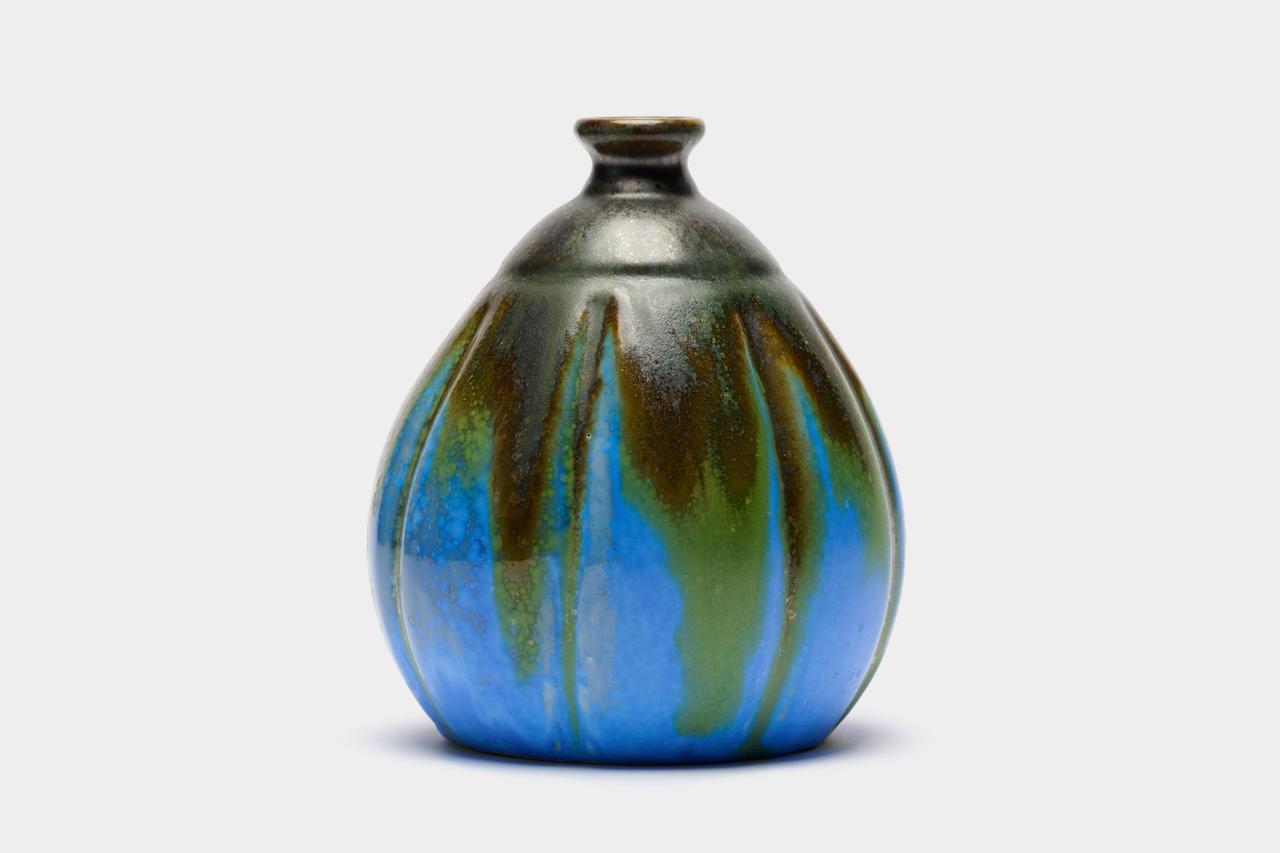
Loetz - PN I-3650 - Vase - Delphi - iridescent glass - Art Nouveau glass vase 1899


04
days
14
hours
44
minutes
14
seconds
Current bid
€ 99
Reserve price not met

Expert
Selected by Michel Karis
Art historian with extensive experience working at various auction houses in antiques.
Estimate € 550 - € 650
 | €99 |
|---|
Catawiki Buyer Protection
Your payment’s safe with us until you receive your object.View details
Trustpilot 4.4 | 143362 reviews
Rated Excellent on Trustpilot.
Art Nouveau glass vase, Delphi model, by Joh. Loetz Witwe in Klostermühle, Austria, height 20 cm, diameter 7 cm, iridescent silver glass dating from ca. 1900–1910, in excellent condition with minor signs of wear.
AI-assisted summary
Description from the seller
Highly decorative, Art Nouveau ancient glass art of beautiful form
Iridescent blue-green glass vase
from Johann Loetz Witwe
Klostermühle Austria Glass Factory, 1899
Finest workmanship and high-quality refinement
Personification of the Art Nouveau era and style from the year 1900!
Series: Delphi PN I-3650
The fairy-tale magic of iridescent and lustring glass is evident in the works of the world-famous firm Joh. Loetz Witwe, especially in the achievement of artistic design fused with craftsmanship and technical perfection. Initially inspired by Tiffany glass, the creative forces of the Bohemian glass factory soon found their own independence, which owes much to Viennese design.
Joh. Loetz Witwe
(also Johan Lötz Witwe) was a significant art glass manufactory in Klostermühle, Bohemia. Loetz works are among the outstanding examples of Jugendstil. In the Wottawattal of the Bohemian Forest lay one of the oldest glassworks, which was purchased in 1850 by Johann Lötz, the founder of the company, formerly owner of the glass factories Deffernik, Hurkental, Annatal and Vogelsang. In 1879 Max Ritter von Spaun, a grandson of Joh. Lötz, took over the factory from his grandmother and continued it under the old name “Joh. Lötz Witwe.” Similar to Louis Comfort Tiffany’s glass, Loetz glass could be produced in the Phänomen-decor with metallic iridescent color glass at a very high level. The company had contacts with other manufacturers such as J. & L. Lobmeyr and E. Bakalowits Söhne in Vienna as well as the Argentor-Werke. Notable artists worked with them, including Josef Hoffmann, Koloman Moser and the Wiener Werkstätte. The peak of collaboration occurred after 1900. The firm was awarded at the Paris World’s Fair and received honors in Chicago and St. Louis. Jugendstil works by Joh. Loetz Witwe can be found in several museums and fetch high prices at auctions.
An antique, splendid Loetz glass vase from the Jugendstil founding period of 1900! Beautiful slender form at the bottom, widening at the top with 3 rims. Light green base, decorated with a thin application of blue-violet-gold powder, often with “dabbing,” a dab of additional blue spots, glossy glass fragments that shimmer dreamily. On the base is a round fine typical Loetz break edge.
Under different lighting, its color and irresistible shine change! The Delphi pattern is the same as Candia Papillon, only the flakes are smaller. Papillon — one of the most common Loetz décors! It is a marvelous technique that Loetz developed and properly called either “Candia Papillon” or “Amber Spotted Butterfly Wings,” and by some collectors as “Oil Spot” decoration.
The quality of this glass is comparable to L.C.T. Tiffany Favrile and Steuben Glass from New York. These three were in intense competition around the turn of the century for the Jugendstil glass market in the USA.
The Papillon décor was then a major discovery and sensation in the glass world.
A remarkably beautiful design and a fantastic eye-catcher for any collection or a modern ambiance!
Large: Height 20 cm, diameter at base 7 cm
Condition: used, good condition, undamaged with small aging traces. Base scratched.
Shipping DHL insured.
Details
Specific region of origin
Klostermühle
Glass type
iridescent glass
Weight
300 g
Era
1900-2000
Title additional information
Art Nouveau glass vase 1899
Number of objects
1
Country of origin
Austria
Model
Delphi
Designer/artist/maker
PN I-3650
Material
Glass
Style
Art Nouveau
Manufacturer/brand
Loetz
Colour
Silver
Condition
Excellent condition: barely used with minimal signs of wear
Height
20 cm
Width
7 cm
Depth
7 cm
Diameter
7 cm
Estimated period
1900-1910
Sold by