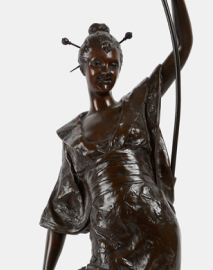
Statue, Giuliano de Medici - 28 cm - Bronze, Marble


05
days
16
hours
21
minutes
30
seconds
Starting bid
€ 1
Reserve price not met

No bids placed
Catawiki Buyer Protection
Your payment’s safe with us until you receive your object.View details
Trustpilot 4.4 | 142857 reviews
Rated Excellent on Trustpilot.
Bronze and marble statuette depicting Giuliano de' Medici in Roman armour, unsigned, in a classical style, likely a Grand Tour or 19th‑century European bronze casting inspired by Michelangelo's marble original, made in Italy and in good condition, 28 cm high, 10 cm wide, 10 cm deep, 4 kg weight.
AI-assisted summary
Description from the seller
The figurine depicts Giuliano de' Medici (duke of Nemours) in Roman armor, a famous sculptural model inspired by the original marble sculpture created by Michelangelo Buonarroti for the Sagrestia Nuova in the Medici Chapels of the Basilica of San Lorenzo in Florence.
Main features:
• Subject: Giuliano de' Medici (1453–1478), shown seated in military attire with a baton of command in hand.
• Type: This is presumably a Grand Tour-style model or a 19th-century fusion (in bronze or patinated metal) produced by European foundries (such as French or Italian ones of the era) that reproduced on a small scale the great Italian artworks destined for collectors.
• The original work: The monumental marble sculpture was carved by Michelangelo between 1520 and 1534.
The figurine depicts Giuliano de' Medici (duke of Nemours) in Roman armor, a famous sculptural model inspired by the original marble sculpture created by Michelangelo Buonarroti for the Sagrestia Nuova in the Medici Chapels of the Basilica of San Lorenzo in Florence.
Main features:
• Subject: Giuliano de' Medici (1453–1478), shown seated in military attire with a baton of command in hand.
• Type: This is presumably a Grand Tour-style model or a 19th-century fusion (in bronze or patinated metal) produced by European foundries (such as French or Italian ones of the era) that reproduced on a small scale the great Italian artworks destined for collectors.
• The original work: The monumental marble sculpture was carved by Michelangelo between 1520 and 1534.
Details
Era
1900-2000
Country of origin
Italy
Style
Antique inspired
Material
Bronze, Marble
Title of artwork
Giuliano de Medici
Signature
Not signed
Colour
Black, Bronze
Condition
Good condition
Height
28 cm
Width
10 cm
Depth
10 cm
Weight
4 kg
Sold by