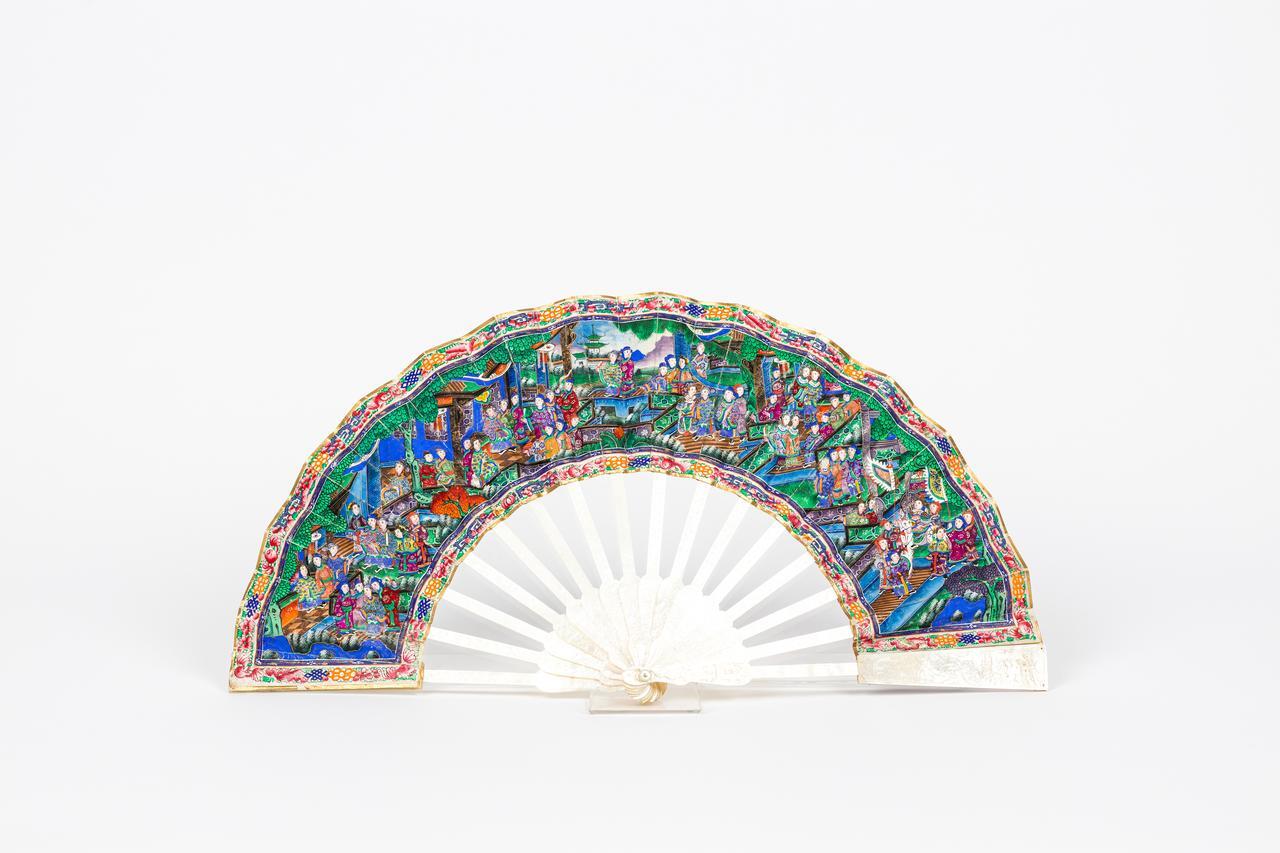
Paire de portraits de dames chinoises — Dynastie Qing - École chinoise - China - Qianlong (1736-1795)


07
days
07
hours
17
minutes
03
seconds
Current bid
€ 23
Reserve price not met

Expert
Selected by Sarah Le Helley
Studied Asian art and art market management; researched art in Taipei; worked in auctions.
Estimate € 3,000 - € 3,700
 | €23 | |
|---|---|---|
 | €20 | |
| €1 |
Catawiki Buyer Protection
Your payment’s safe with us until you receive your object.View details
Trustpilot 4.4 | 143362 reviews
Rated Excellent on Trustpilot.
Pair of Chinese female portraits under glass from the Qing dynasty, Qianlong period (1736–1795), each measuring 57.5 × 41.5 cm, origin Canton, China, with carved and pierced wooden frames, reverse-painted technique, signed and not signed, condition good, provenance The Hague, Netherlands, sold with frame.
AI-assisted summary
Description from the seller
CHINA / QING DYNASTY / QIANLONG PERIOD (1736–1795) — IMPORTANT PAIR OF FEMALE PORTRAITS UNDER GLASS
Origin artistic: Canton (Guangzhou), China.
Declared provenance: The Hague (Den Haag), Netherlands.
Very rare and expert, important pair of Chinese female portraits under glass, dating to the Qianlong period (1736–1795), Qing Dynasty.
In 2018, Qing female portraits pair, 18th–19th century: £7,500 hammer.
These two compositions depict elegant Chinese ladies in traditional costumes, richly adorned, wearing refined hair ornaments and each holding a fan.
The delicate treatment of the faces, the richness of the clothing details and the harmony of colors attest to particularly careful decorative work.
The works belong to the tradition of reverse painting on glass, an art particularly developed in Canton in the 18th century, especially for Chinese collections and trade with Europe.
Presented in their carved and pierced wooden frames, they form a harmonious ensemble with remarkable decorative presence.
Characteristics:
• Origin: China
• Center of production: Canton (Guangzhou)
• Period: Qianlong (1736–1795), Qing Dynasty
• Technique: Reverse glass paintings
• Dimensions: 57.5 × 41.5 cm each
• Frames: Carved and pierced wood
• Declared provenance: The Hague, Netherlands
• History: Acquired at a previous auction
• Condition: Alterations and paint losses visible in photographs
• Total estimated weight: About 7 kg
An collectible pair combining two complementary portraits, the elegance of Chinese artistic tradition and the refinement of Qing dynasty decorative arts.
Sale of the complete and inseparable pair.
Careful shipping with reinforced packaging, adapted to the fragility of the paintings under glass.
CHINA / QING DYNASTY / QIANLONG PERIOD (1736–1795) — IMPORTANT PAIR OF FEMALE PORTRAITS UNDER GLASS
Origin artistic: Canton (Guangzhou), China.
Declared provenance: The Hague (Den Haag), Netherlands.
Very rare and expert, important pair of Chinese female portraits under glass, dating to the Qianlong period (1736–1795), Qing Dynasty.
In 2018, Qing female portraits pair, 18th–19th century: £7,500 hammer.
These two compositions depict elegant Chinese ladies in traditional costumes, richly adorned, wearing refined hair ornaments and each holding a fan.
The delicate treatment of the faces, the richness of the clothing details and the harmony of colors attest to particularly careful decorative work.
The works belong to the tradition of reverse painting on glass, an art particularly developed in Canton in the 18th century, especially for Chinese collections and trade with Europe.
Presented in their carved and pierced wooden frames, they form a harmonious ensemble with remarkable decorative presence.
Characteristics:
• Origin: China
• Center of production: Canton (Guangzhou)
• Period: Qianlong (1736–1795), Qing Dynasty
• Technique: Reverse glass paintings
• Dimensions: 57.5 × 41.5 cm each
• Frames: Carved and pierced wood
• Declared provenance: The Hague, Netherlands
• History: Acquired at a previous auction
• Condition: Alterations and paint losses visible in photographs
• Total estimated weight: About 7 kg
An collectible pair combining two complementary portraits, the elegance of Chinese artistic tradition and the refinement of Qing dynasty decorative arts.
Sale of the complete and inseparable pair.
Careful shipping with reinforced packaging, adapted to the fragility of the paintings under glass.
Details
Sold with frame
Yes
Sold by
Owner or reseller
Artist
École chinoise
Title of artwork
Paire de portraits de dames chinoises — Dynastie Qing
Technique
Mixed technique
Signature
Not signed
Country of origin
China
Condition
Good condition
Height
57.5 cm
Width
41.5 cm
Weight
7 g
Style
Classical
Period
18th century
Dynastic style/period
Qianlong (1736-1795)
Provenance
Private collection
Sold by