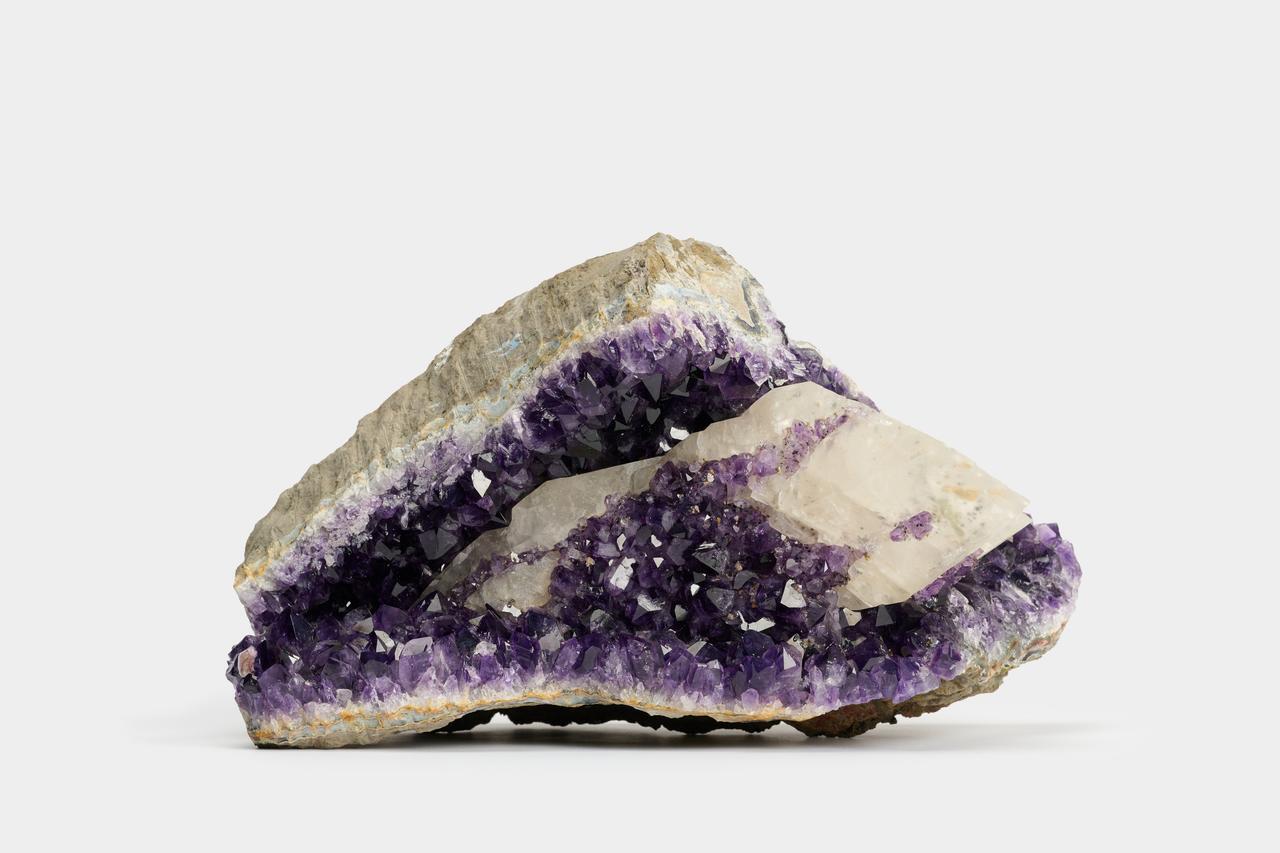
445g Fluorite & Calcite specimen – biting tips, gray-blue, force of nature – 10.5 × 6.9 × 5.6 cm Crystal cluster- 445 g


04
days
20
hours
09
minutes
56
seconds

No bids placed
Catawiki Buyer Protection
Your payment’s safe with us until you receive your object.View details
Trustpilot 4.4 | 143313 reviews
Rated Excellent on Trustpilot.
445 g fluorite and calcite stage in a crystal cluster form, with stair-stepped intergrown fluorite cubes in grey-blue tones and a large matte cream calcite crystal, originating from Skardu, Gilgit-Baltistan, Pakistan; dimensions 10.5 x 6.9 x 5.6 cm.
AI-assisted summary
Description from the seller
This mineral specimen comes from Skardu, the main town of Baltistan in northern Pakistan and the starting point of the great expeditions to K2. Its character is defined by knife-sharp serrations and tips. Here two minerals with fundamentally different crystal languages meet: the strict order of cubic fluorite and the pointed forms of trigonal calcite.
On one side, stair-stepped, intergrown fluorite cubes build up. They are glassy, gray to light blue depending on the light, and sometimes faintly lilac-tinged. Next to them rises a large, cream-colored calcite crystal, whose matte, rough surface bears growth and etching marks. From the front it looks like a fang of archaic power, from the back like a far-projecting, mountain-shaped tip. On the backside there is also a dense carpet of tiny calcite crystals over the fluorite, white to pale pink and sharp as knife blades.
These crystals show the growth form known as dogtooth calcite, the scalenohedron. Its twelve faces are scalene triangles, hence the name, from the Greek skalēnos, “unequal.” That the fine teeth sit on the fluorite reveals the sequence of their formation: they crystallized first from later solutions, when the cubes had already formed. Across the specimen runs also a fine, rust-orange line of iron oxide. Both minerals are also reference minerals of the hardness scale that Friedrich Mohs established in 1812: calcite marks hardness 3, fluorite hardness 4.
Stair-stepped cubes, a large calcite tooth, and the fine blade-like rug of the back: The specimen shows a different face from every direction and combines crystalline order with biting sharpness. A striking display specimen weighing 445 grams.
Material: Fluorite (calcium fluoride, CaF₂) with calcite (calcium carbonate, CaCO₃) in dogtooth formation (scalenohedron)
Origin: Skardu, Gilgit-Baltistan, Pakistan
Dimensions: 10.5 x 6.9 x 5.6 cm
Weight: 445 g
Special features: Stair-stepped, intergrown fluorite cubes in gray to light blue, with occasional lilac undertone; large matte-cream calcite crystal with natural growth and etching marks; back with a dense carpet of fine, sharp-edged calcite scalenohedra on fluorite; fine iron oxide line across the specimen
Seller's Story
Ich lasse mich immer wieder von der Schönheit der Natur überraschen und berühren. Mineralien und Edelsteine empfinde ich als Verkörperung jener Perfektion und Harmonie, die allem Sein zugrunde liegt. In ihnen verdichtet sich die Essenz der Erde – kristallisiert für die Ewigkeit und doch in jedem Stück einzigartig.
Jedes Mineral, das ich anbiete, ist von mir persönlich ausgewählt. Nicht nach bloßem Glanz, sondern nach dem Gefühl von Wahrhaftigkeit, das es in mir hervorruft. So findet nur das seinen Weg in meine Hände – und weiter in Ihre –, was ich selbst als würdig empfinde, in seiner Schönheit weitergereicht zu werden.
In meinem Handeln leiten mich Ehrlichkeit, Sorgfalt und die Freude am Teilen dieser Schätze. Ich verstehe mich dabei weniger als Händler, sondern vielmehr als Vermittler zwischen der Natur und den Menschen, die bereit sind, ihre Geschenke mit Achtsamkeit anzunehmen.
This mineral specimen comes from Skardu, the main town of Baltistan in northern Pakistan and the starting point of the great expeditions to K2. Its character is defined by knife-sharp serrations and tips. Here two minerals with fundamentally different crystal languages meet: the strict order of cubic fluorite and the pointed forms of trigonal calcite.
On one side, stair-stepped, intergrown fluorite cubes build up. They are glassy, gray to light blue depending on the light, and sometimes faintly lilac-tinged. Next to them rises a large, cream-colored calcite crystal, whose matte, rough surface bears growth and etching marks. From the front it looks like a fang of archaic power, from the back like a far-projecting, mountain-shaped tip. On the backside there is also a dense carpet of tiny calcite crystals over the fluorite, white to pale pink and sharp as knife blades.
These crystals show the growth form known as dogtooth calcite, the scalenohedron. Its twelve faces are scalene triangles, hence the name, from the Greek skalēnos, “unequal.” That the fine teeth sit on the fluorite reveals the sequence of their formation: they crystallized first from later solutions, when the cubes had already formed. Across the specimen runs also a fine, rust-orange line of iron oxide. Both minerals are also reference minerals of the hardness scale that Friedrich Mohs established in 1812: calcite marks hardness 3, fluorite hardness 4.
Stair-stepped cubes, a large calcite tooth, and the fine blade-like rug of the back: The specimen shows a different face from every direction and combines crystalline order with biting sharpness. A striking display specimen weighing 445 grams.
Material: Fluorite (calcium fluoride, CaF₂) with calcite (calcium carbonate, CaCO₃) in dogtooth formation (scalenohedron)
Origin: Skardu, Gilgit-Baltistan, Pakistan
Dimensions: 10.5 x 6.9 x 5.6 cm
Weight: 445 g
Special features: Stair-stepped, intergrown fluorite cubes in gray to light blue, with occasional lilac undertone; large matte-cream calcite crystal with natural growth and etching marks; back with a dense carpet of fine, sharp-edged calcite scalenohedra on fluorite; fine iron oxide line across the specimen
Seller's Story
Ich lasse mich immer wieder von der Schönheit der Natur überraschen und berühren. Mineralien und Edelsteine empfinde ich als Verkörperung jener Perfektion und Harmonie, die allem Sein zugrunde liegt. In ihnen verdichtet sich die Essenz der Erde – kristallisiert für die Ewigkeit und doch in jedem Stück einzigartig.
Jedes Mineral, das ich anbiete, ist von mir persönlich ausgewählt. Nicht nach bloßem Glanz, sondern nach dem Gefühl von Wahrhaftigkeit, das es in mir hervorruft. So findet nur das seinen Weg in meine Hände – und weiter in Ihre –, was ich selbst als würdig empfinde, in seiner Schönheit weitergereicht zu werden.
In meinem Handeln leiten mich Ehrlichkeit, Sorgfalt und die Freude am Teilen dieser Schätze. Ich verstehe mich dabei weniger als Händler, sondern vielmehr als Vermittler zwischen der Natur und den Menschen, die bereit sind, ihre Geschenke mit Achtsamkeit anzunehmen.
Details
Main mineral
445g Fluorite & Calcite specimen – biting tips, gray-blue, force of nature – 10.5 × 6.9 × 5.6 cm
Mineral form
Crystal cluster
Weight
445 g
Origin (region/city)
Skardu, Gilgit-Baltistan
Country of origin
Pakistan
Sold by