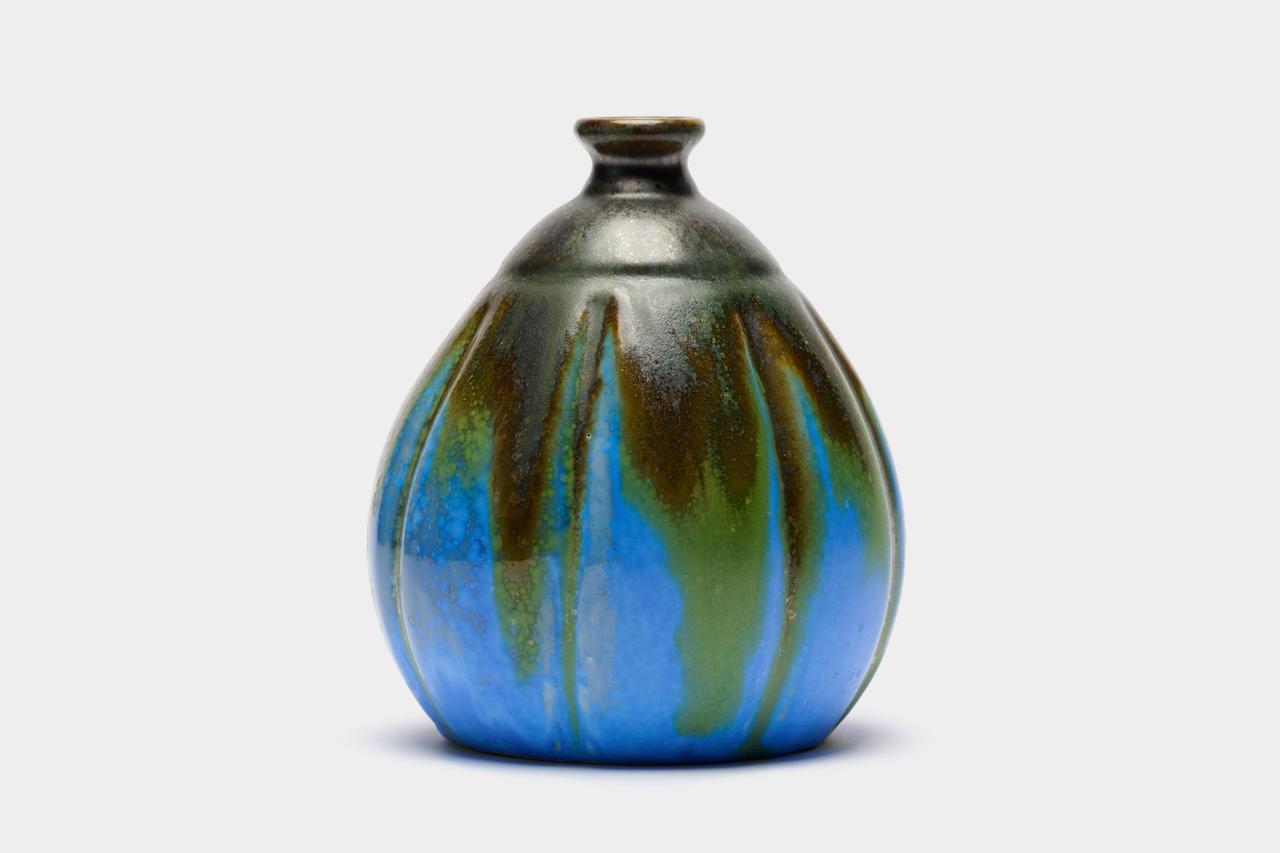
Art Nouveau Vessel - Glass - 1910-1920 - Legras / Saint-Denis


06
days
05
hours
13
minutes
08
seconds
Starting bid
€ 1
No reserve price

Expert
Selected by Michel Karis
Art historian with extensive experience working at various auction houses in antiques.
Estimate € 150 - € 200
No bids placed
Catawiki Buyer Protection
Your payment’s safe with us until you receive your object.View details
Trustpilot 4.4 | 143539 reviews
Rated Excellent on Trustpilot.
French Art Nouveau decorative glass coupe on a footed base, circa 1910–1925, made of satin‑finished glass with polychrome enamel floral decor and a Saint-Denis monogram SD, attributed to Legras, model 'Coupe Fécamp' (no. 3699), diameter 20 cm (col 17.7 cm), height 9 cm, weight 500 g, origin Saint‑Denis, France, in good condition with three noted manufacturing defects.
AI-assisted summary
Description from the seller
Circular flared coupe on a pedestal of satin-tinted glass, with polychrome enameled decoration.
This bowl is a fine illustration of French decorative glassware from the early 20th century. Its enameled floral decoration, its slightly opalescent glass, and above all its monogram « SD » (Saint-Denis) associated with François-Théodore Legras (1839–1916),
The form is particularly harmonious: the black footring echoes the upper collar and lends the whole piece a certain elegance.
The decoration consists of sinuous branches bearing turquoise-blue leaves and pendant flowers with orange-red petals, with touches of yellow and white.
Circa: 1910–1925
Style: Late Art Nouveau
Model: “Fécamp Cup” listed as model 3699 and referenced in the book “Legras” on page 306 (visible in the last three photos)
Diameter at the neck: 17.7 cm
Overall diameter: 20 cm
Height: 9 cm
Weight: 500 g
The coupe is generally in good condition but presents 3 defects:
- A small inclusion in the glass (the small dark spot visible under the reverse of the bowl)
This is surely a small impurity trapped in the glass during manufacture. In antique glass-making, this is commonly referred to as a manufacturing inclusion, or, when it is a solid particle, an foreign body included in the glass mass. It is a manufacturing defect of origin, with no particular impact on the bowl’s solidity.
- Small chips of black enamel (chipping) on the upper rim of the bowl
- The polychrome enamel of the floral decoration shows slight irregularities and firing pinholes, characteristic of an antique creation.
Despite these flaws, the bowl remains a definite decorative item from one of France’s greatest glassworks, associated with master glassmaker “Legras,” and directly testifies to the transitional period between Art Nouveau (the Belle Époque) and Art Deco.
Carefully protected shipment!
Details
Era
1900-2000
Weight
500 g
Specific region of origin
Saint-Denis
Title additional information
Legras / Saint-Denis
Number of objects
1
Material
Glass
Country of origin
France
Designer/artist/maker
François-Théodore Legras
Height
9 cm
Width
20 cm
Depth
20 cm
Condition
Good condition - used with small signs of aging & blemishes
Style
Art Nouveau
Estimated period
1910-1920