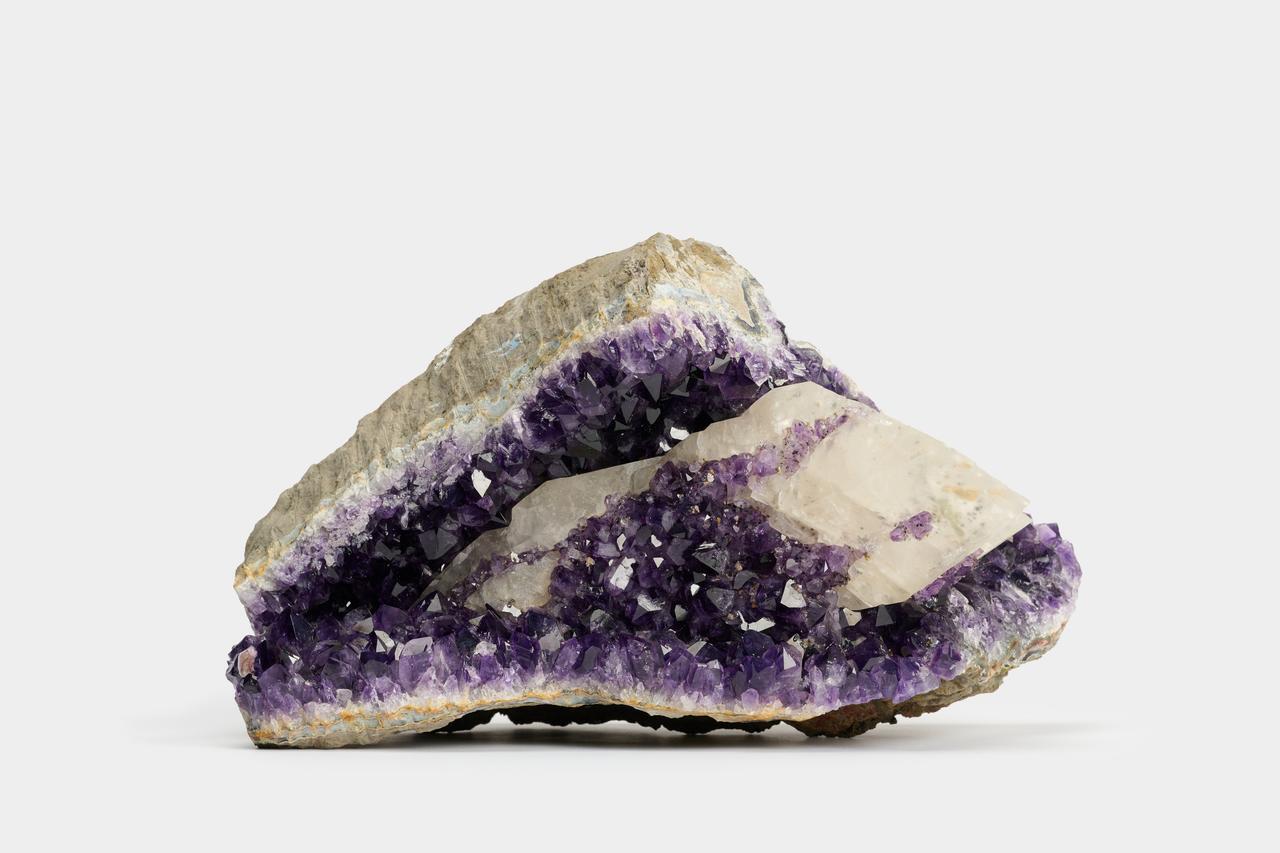
HQ Grape Agate Lavender Crystal Cluster Crystal cluster - Height: 13 cm - Width: 6.5 cm- 375 g


04
days
02
hours
42
minutes
21
seconds

 | €28 | |
|---|---|---|
 | €25 | |
| €24 | |
Catawiki Buyer Protection
Your payment’s safe with us until you receive your object.View details
Trustpilot 4.4 | 143313 reviews
Rated Excellent on Trustpilot.
HQ Druivenagaat Lavendel Kristalcluster, a grape agate lavender crystal cluster from Indonesia, Island of Sulawesi.
AI-assisted summary
Description from the seller
Grape agate is the commercial trade name for a rare, unique form of botryoidal (grape-like) purple chalcedony, a microcrystalline variant of quartz.
The most sought-after variants range from soft lilac and lavender to deep dark purple. The color arises from traces of iron and manganese within the crystal structure. Sometimes the spheres have a microscopically thin layer of sparkling crystal points, which creates a beautiful 'druzy' glitter effect.
Unique locality: The vast majority of high-quality grape agate was discovered only around 2014 and is mined exclusively in the Mamuju region on the island of Sulawesi in Indonesia.
The mineral forms deep in the voids of volcanic rock (andesite). Over millions of years, silica-rich fluids have layered themselves in perfect spheres around a central point. Hardness: It has a score of 6.5 to 7 on the Mohs hardness scale. The loose spheres, however, can be delicate and break with rough handling.
Grape agate is the commercial trade name for a rare, unique form of botryoidal (grape-like) purple chalcedony, a microcrystalline variant of quartz.
The most sought-after variants range from soft lilac and lavender to deep dark purple. The color arises from traces of iron and manganese within the crystal structure. Sometimes the spheres have a microscopically thin layer of sparkling crystal points, which creates a beautiful 'druzy' glitter effect.
Unique locality: The vast majority of high-quality grape agate was discovered only around 2014 and is mined exclusively in the Mamuju region on the island of Sulawesi in Indonesia.
The mineral forms deep in the voids of volcanic rock (andesite). Over millions of years, silica-rich fluids have layered themselves in perfect spheres around a central point. Hardness: It has a score of 6.5 to 7 on the Mohs hardness scale. The loose spheres, however, can be delicate and break with rough handling.
Details
Main mineral
HQ Grape Agate Lavender Crystal Cluster
Mineral form
Crystal cluster
Weight
375 g
Origin (region/city)
Island of Sulawesi
Country of origin
Indonesia
Height
13 cm
Width
6.5 cm
Sold by