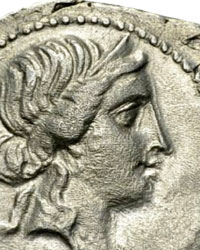
Roman Empire. Caracalla (AD 198-217). Denarius - Serapis (No reserve price)


05
days
03
hours
09
minutes
25
seconds

 | €59 | |
|---|---|---|
 | €50 | |
Catawiki Buyer Protection
Your payment’s safe with us until you receive your object.View details
Trustpilot 4.4 | 143313 reviews
Rated Excellent on Trustpilot.
Silver denarius of Caracalla depicting Serapis, minted in Rome in 213 AD; weight 2.71 g; obverse with laureate head of Caracalla right, reverse showing Serapis standing left, draped, with modius, raising the right hand and holding a sceptre in the left; very good relief with a legible legend and a natural edge crack visible at the bottom.
AI-assisted summary
Description from the seller
Silver denarius of Caracalla – Representation of Serapis (213 AD)
This magnificent silver denarius stands out for the quality of its details and its fascinating symbolism. On one side, you have the expressive portrait of Emperor Caracalla; on the other, the Greco-Egyptian god Serapis, symbol of power and divine protection.
Characteristics:
Obverse: ANTONINVS PIVS AVG BRIT – Laureate head of Caracalla to the right.
Reverse: P M TR P XVI COS IIII P P – Serapis standing to the left, draped, wearing the modius, raising his right hand and holding a sceptre in his left.
Mint: Rome (213 AD).
Metal: Silver.
Weight: 2.71 g.
Condition: Very good relief, with a perfectly legible inscription and a well-detailed portrait. (Note: a fine natural flan crack from the period visible at the bottom of the coin, evidence of its antique artisanal manufacture).
Silver denarius of Caracalla – Representation of Serapis (213 AD)
This magnificent silver denarius stands out for the quality of its details and its fascinating symbolism. On one side, you have the expressive portrait of Emperor Caracalla; on the other, the Greco-Egyptian god Serapis, symbol of power and divine protection.
Characteristics:
Obverse: ANTONINVS PIVS AVG BRIT – Laureate head of Caracalla to the right.
Reverse: P M TR P XVI COS IIII P P – Serapis standing to the left, draped, wearing the modius, raising his right hand and holding a sceptre in his left.
Mint: Rome (213 AD).
Metal: Silver.
Weight: 2.71 g.
Condition: Very good relief, with a perfectly legible inscription and a well-detailed portrait. (Note: a fine natural flan crack from the period visible at the bottom of the coin, evidence of its antique artisanal manufacture).
Details
Era
Before 1400
Culture/region
Roman Empire
Year/period and variation
- Serapis
Ruler
Caracalla (AD 198-217)
Denomination
Denarius
Metal
AR
Condition
Ungraded