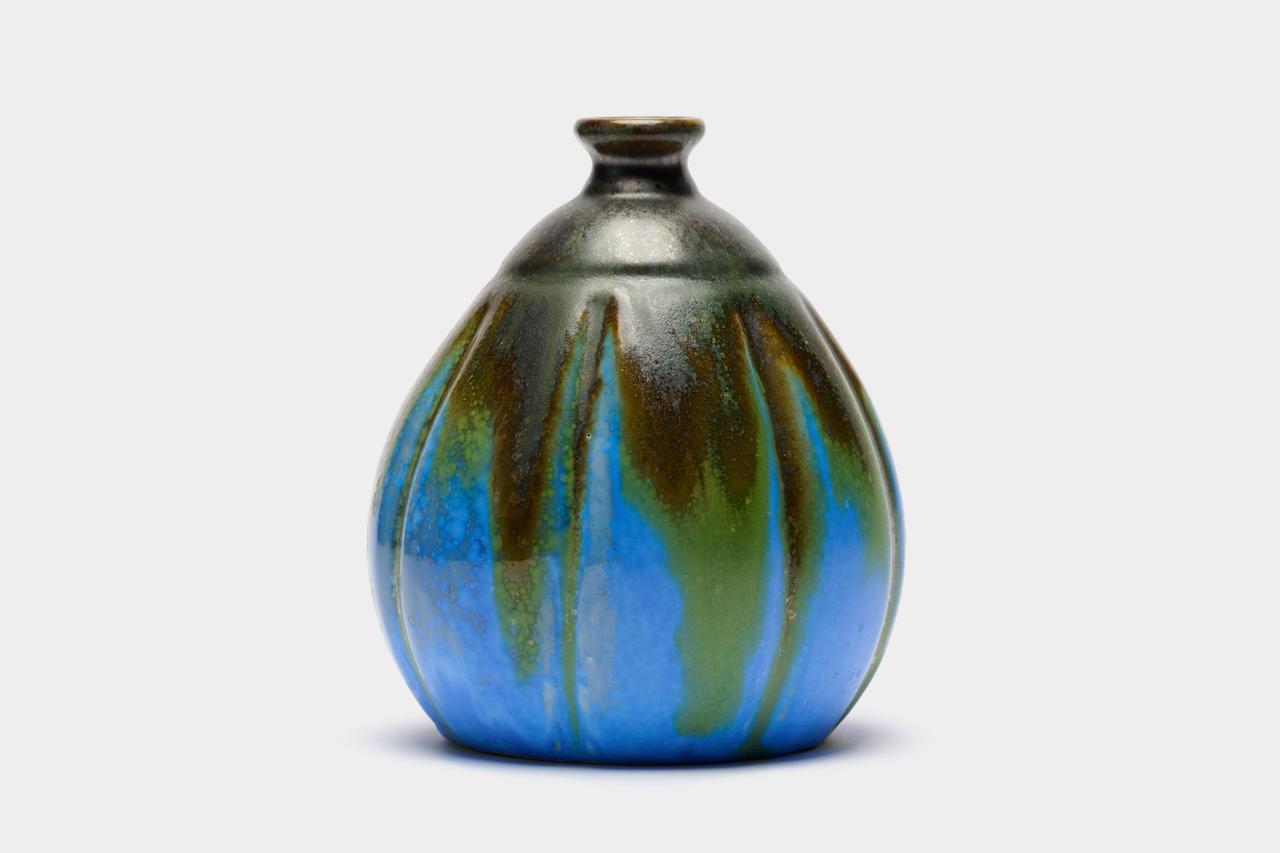
Les poteries d'Accolay - Accolay - Vase - Gauloise - Ceramic - ceramic vase


02
days
17
hours
10
minutes
54
seconds
Current bid
€ 45
No reserve price

Expert
Selected by John Laurance
Thirty years' experience in decorative objects and two decades as shop owner.
Estimate € 250 - € 330
 | €45 | |
|---|---|---|
| €40 | |
| €40 | |
Catawiki Buyer Protection
Your payment’s safe with us until you receive your object.View details
Trustpilot 4.4 | 143878 reviews
Rated Excellent on Trustpilot.
A mid‑century modern ceramic vase by Accolay, made in France with a turquoise glaze and concentric circle motifs, measuring 28 cm high, 22 cm wide and 25 cm deep, signed Accolay and in excellent condition.
AI-assisted summary
Description from the seller
Mid-century French vase by Accolay, turquoise concentric circle decoration, France, 1950s.
Mid-century ceramic vase by Accolay, produced in France in the 1950s. This sculptural vase features a vibrant turquoise blue glaze decorated with concentric circular motifs, a decorative language characteristic of Accolay pottery that emphasizes rhythm, movement, and bold color contrasts.
The dynamic surface treatment and expressive glaze place this piece firmly in the post-war French ceramics tradition, making it highly sought after by mid-century modern pottery and 1950s decorative arts collectors. Its balanced proportions and graphic design allow it to function as both a standalone sculptural object and as an element of a collection of curative ceramics.
The vase is signed "Accolay" on the bottom, confirming its authenticity and origin.
Dimensions:
Height: 28 cm
Origin: France
Period: 1950s
Material: Glazed ceramic
About Accolay Pottery
Accolay pottery was founded in 1945 by four young artists – André Boutaud, Louis Dangon, Slavic Paley and Raude – who left Paris and the Saint-Germain-des-Prés scene during World War II. In order to avoid compulsory work in Germany, they trained at the Cluny School of Pottery (Saône-et-Loire) under Alexandre Kostanda, where they developed their technical foundations in the field of pottery.
Their early creations were ceramic buttons, initially intended for personal use. In 1945, their work drew the attention of Christian Dior, who commissioned buttons, brooches, and jewelry for his new fashion house. The resulting media exposure launched their success and, in October 1945, they established a communal workshop in a dismantled factory in the village of Accolay, in Yonne, Burgundy.
In 1946, thousands of colorful ceramic buttons and jewelry were produced, featuring animal, plant, and abstract shapes. With the evolution of fashion, Accolay shifted in 1948 toward decorative and utilitarian ceramics, notably vases, photo frames, fruit baskets, and small sculptural objects.
In 1952, Canadian painter and designer Rafael Giaroussu joined the group, inaugurating a period marked by humor, experimentation, and bold decorative expression. Accolay ceramics were widely distributed, notably in service stations along major roads to the south of France, such as the N6 and N7, contributing to their great popularity.
The workshop continued to innovate in the 1960s and 1970s, producing ceramics incorporating resin inlays, as well as lamps and light tables. Following the oil crisis and changes in travel patterns, production gradually declined. After the death of André Boutaud in 1983, continuity became difficult and Accolay production ceased in 1989.
Today, Accolay ceramics are celebrated for their expressive glazes, graphic motifs, and the joyful spirit of the mid-century, representing nearly three decades of creative success (1945-1975) in post-war French ceramics.
Details
Era
1900-2000
Title additional information
ceramic vase
Number of objects
1
Country of origin
France
Model
Gauloise
Designer/artist/maker
Accolay
Material
Ceramic
Style
Mid-century modern
Manufacturer/brand
Les poteries d'Accolay
Colour
Blue, Green, Turquoise
Condition
Excellent condition: barely used with minimal signs of wear
Height
28 cm
Width
22 cm
Depth
25 cm
Estimated period
1940-1950
Sold by